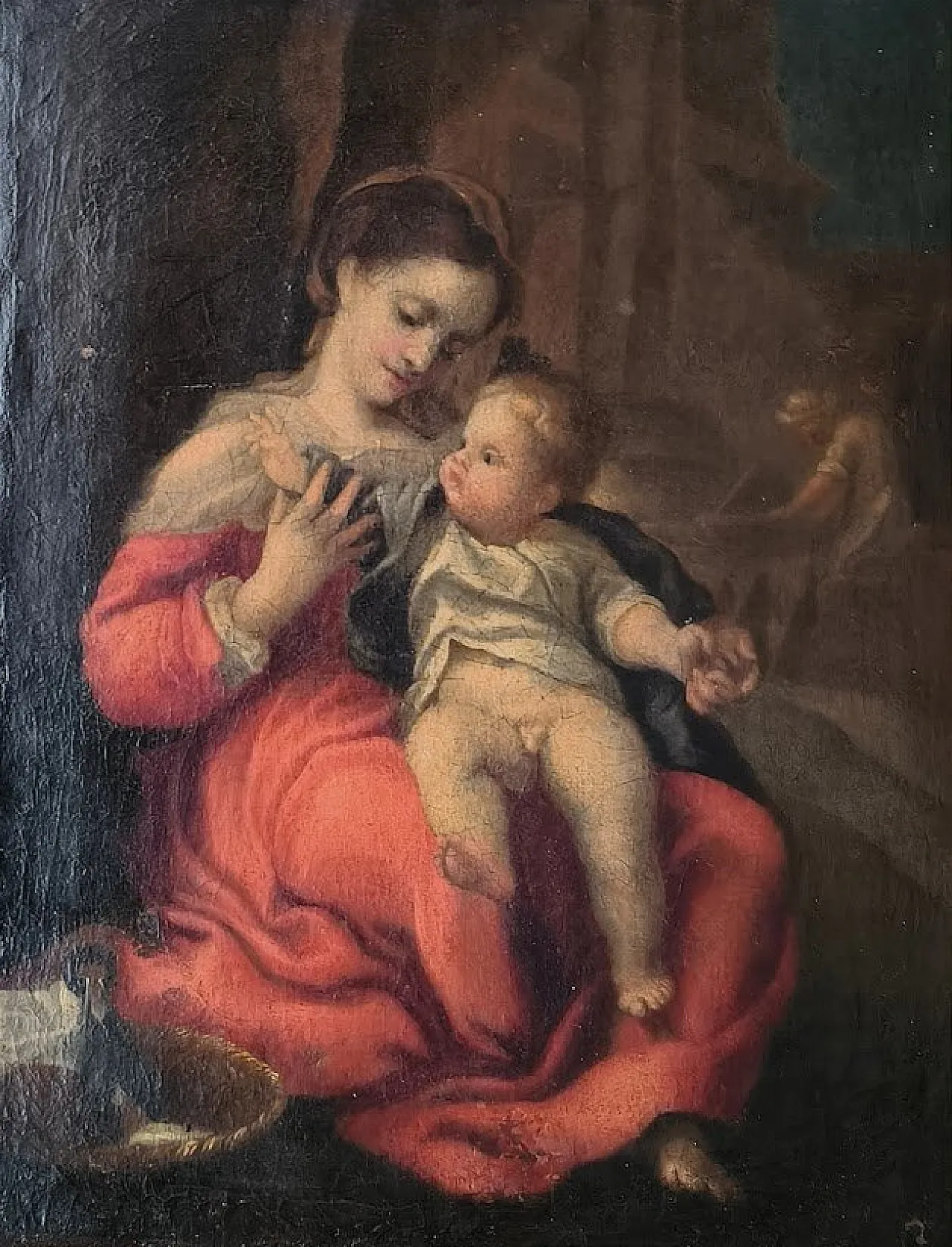
Antonio Allegri known as Correggio (Correggio REGGIO EMILIA, August 1489 – Correggio REGGIO EMILIA, 5 March 1534) Oil painting on canvas reproducing the Madonna della Cesta by Correggio (circa 1525) and presumably created between the 1600s or 1700s. It has been relined and restored; seen with Wood's lamp it has very few restorations. Measurements without frame: 38 x 30 cm. The original painting (34 x 25 cm) is in the National Gallery in London. This small painting, intended for private devotion, had the honor of being cited in Giorgio Vasari's Lives in a decidedly enthusiastic manner: "wonderfully beautiful, by the hand of Correggio, in which Our Lady puts a shirt on the infant Christ". Its oldest provenance is precisely the one mentioned by Vasari who remembers it within the first half of the 16th century in Parma with the famous Cavalier Baiardo, Parmigianino's client and a fine collector of the time. Probably thanks to this commendatory mention, the work was appreciated by bishop Federico Borromeo who wanted a copy for his Milanese collection, entrusting the task to his illuminator Gerolamo Marchesini. Furthermore, for similar reasons, Diana Scultori in Rome, in 1577, made an engraved copy which must have contributed to spreading its fame. Also from the Roman context comes the testimony of Federico Barocci who showed himself ready to welcome the narrative suggestions offered in works such as the Albani Madonna. And it could not be otherwise since the artist from Urbino was looking for a less intellectual and artificial language than that spoken by his mannerist contemporaries, a language capable of dressing sacred history in a dress of fresh and persuasive naturalism. These aspirations led him on more than one occasion to reflect on the models offered by Correggio's religious art. The fulcrum of the painting is represented by the affectionate relationship that binds the Virgin to the Child, by her sweet attempt to dress him in the little blue shirt that she has just finished sewing. The sewing basket with clearly visible scissors opens the painting on the left and, although it is possible to read symbolic allusions in it, its role is above all to give the image a convincing "real effect". By representing the Virgin as very young, almost a teenager, as she has just put aside her sewing tools, Correggio manages to place the sacred story in a framework of simple and captivating everyday life. Jesus is a true man, according to the male evidence of the body, yet his mother has prepared a double garment for him as a sign of the two natures, human and divine, that he carries within himself. The truth of his destiny is expressed by his opening his arms in a cross, while his small right hand blesses with the Trinitarian symbol. Particularly for the background, where Saint Joseph can be glimpsed, it is possible to refer to Nordic models, in particular to an engraving by Dürer that Correggio perhaps had the opportunity to know, the Holy Family in Egypt.



.png)




 SILVER Seller in Ferrara, Italy