

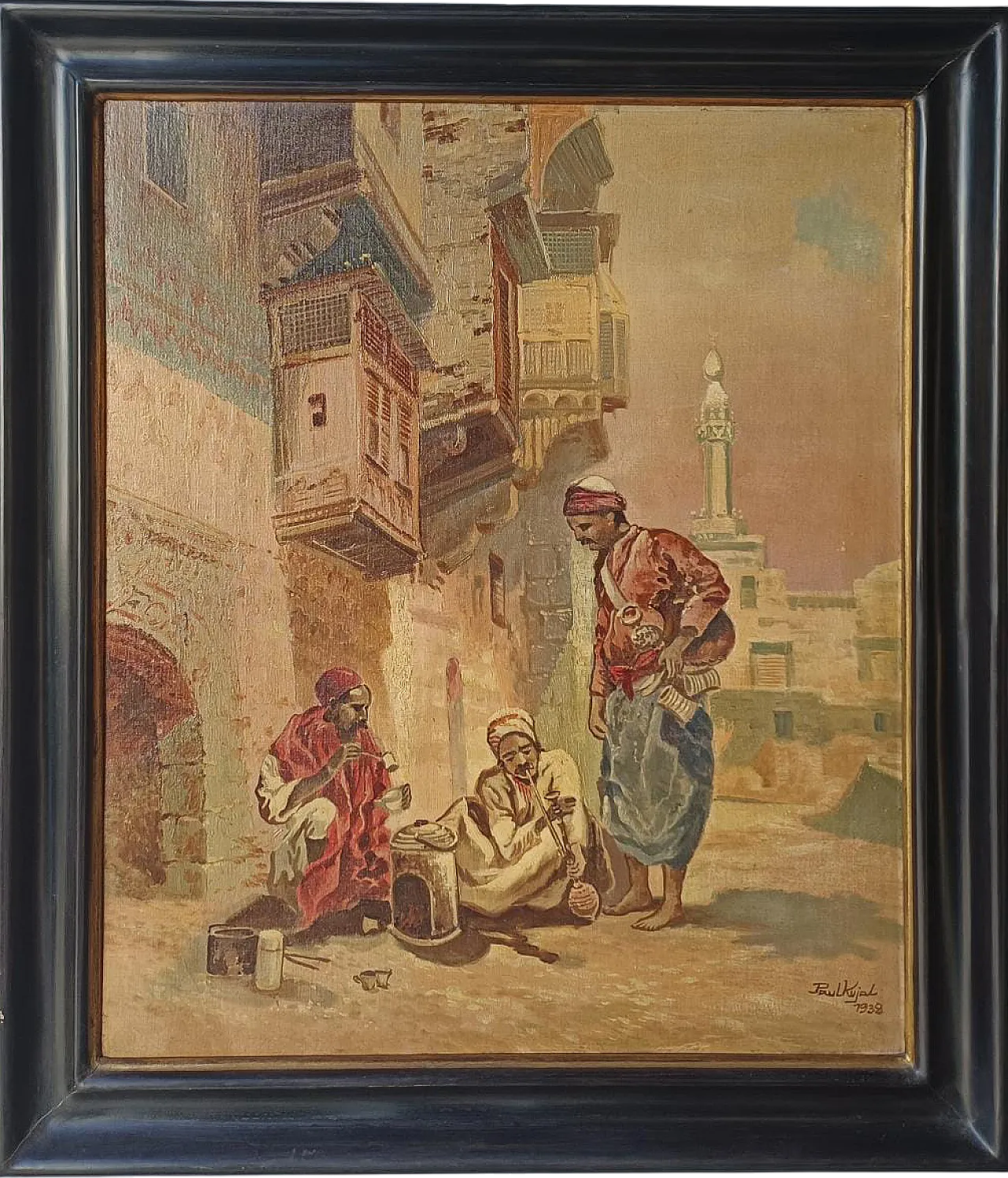
Orientalist life scene by Paul Kujal, 1930s


.png)
Paul Kujal Vienna, 1894 – ? Orientalist life scene, 1938 Oil on pressed cardboard, cm. 80×67 Signed and given lower right: “Paul Kujal / 1938” Within ebonized wooden frame Although little known in historiography, PaulKujal is mentioned in art markets as an Austrian painter, active in the first decades of the twentieth century, with landscape works with a “impressionistic” and signed taste, dated between the twenties and fifties. Born permanently in 1894 in Vienna, he trained in academic contexts, participating in exhibitions in Austria and the United States. The orientalist work proposed here expands his production, signaling a marked interest in ethnic themes and exotic scenarios, interpreted with documentary and chromatic sensitivity. The composition is balanced between characters arranged in a semi-circle, which stabilize a dynamic relationship between them and the viewer. The color uses a palette rich in ocher, warm earths and reds, balanced by glasses and metal accessories to suggest an arid but convivial atmosphere. The brushstroke is defined but soft, probably carefully executed in detail of fabrics and objects, referring to a figurative taste tending towards anecdotal realism. Attention to the details of the environment is evident: the mashrabiyas, the architecture in the background and the everyday objects (teapot, hookah) recall the orientalist practice of ethnographic representation. The work is a significant example of the orientalist taste oriented towards documentary realism, rather than haremistic fantasies, complemented by a vibrant chromatic sensitivity. Although the author left no significant traces in the academic texts, the signature and data confirm an original work aligned with the European interests of the time towards the exotic. Ideal for collectors interested in orientalist and figurative-influenced painting of the 1930s, in bourgeois environments, cultural history studies and collections.
ID: 73557-1760107632-133320

 SILVER Seller in Venezia, Italy