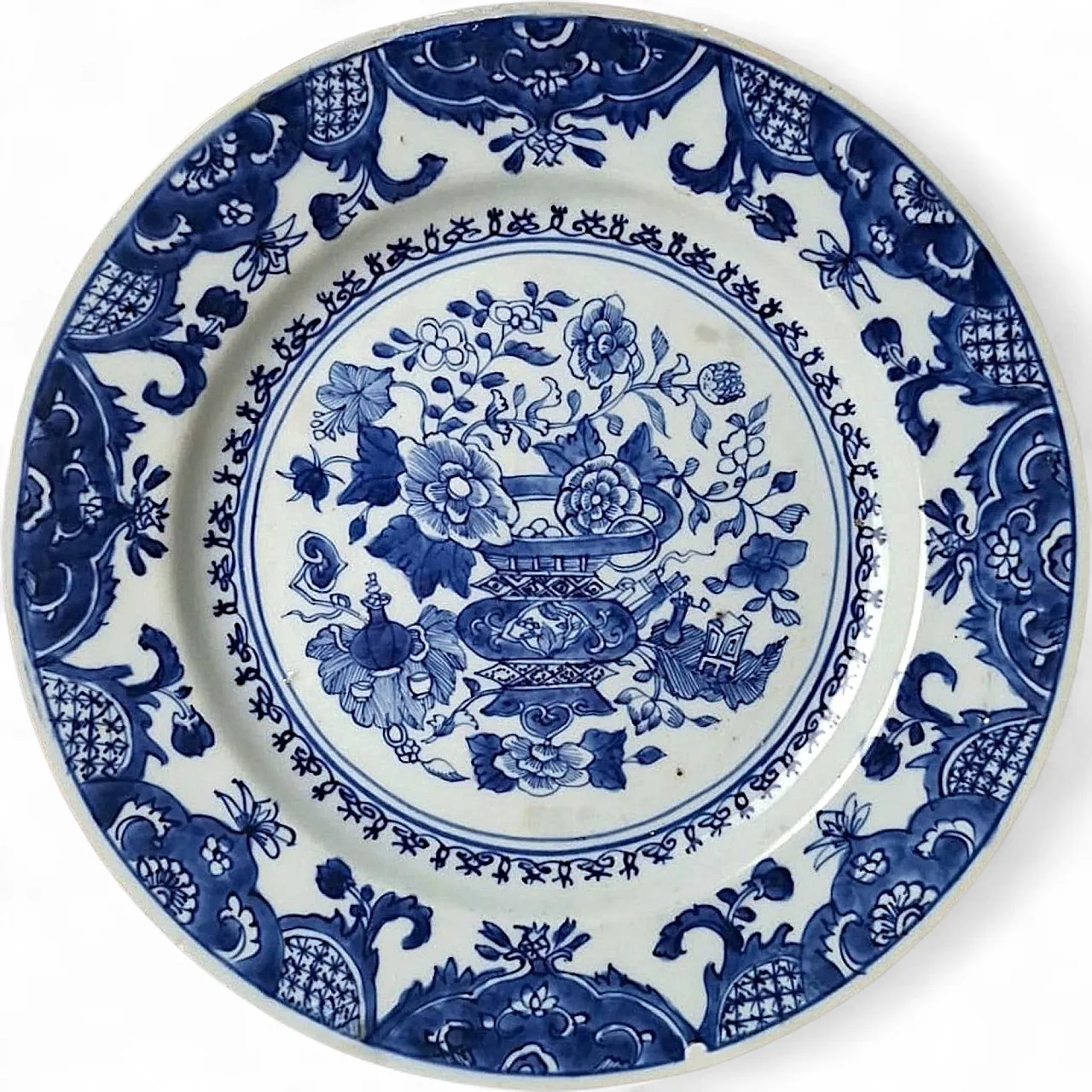
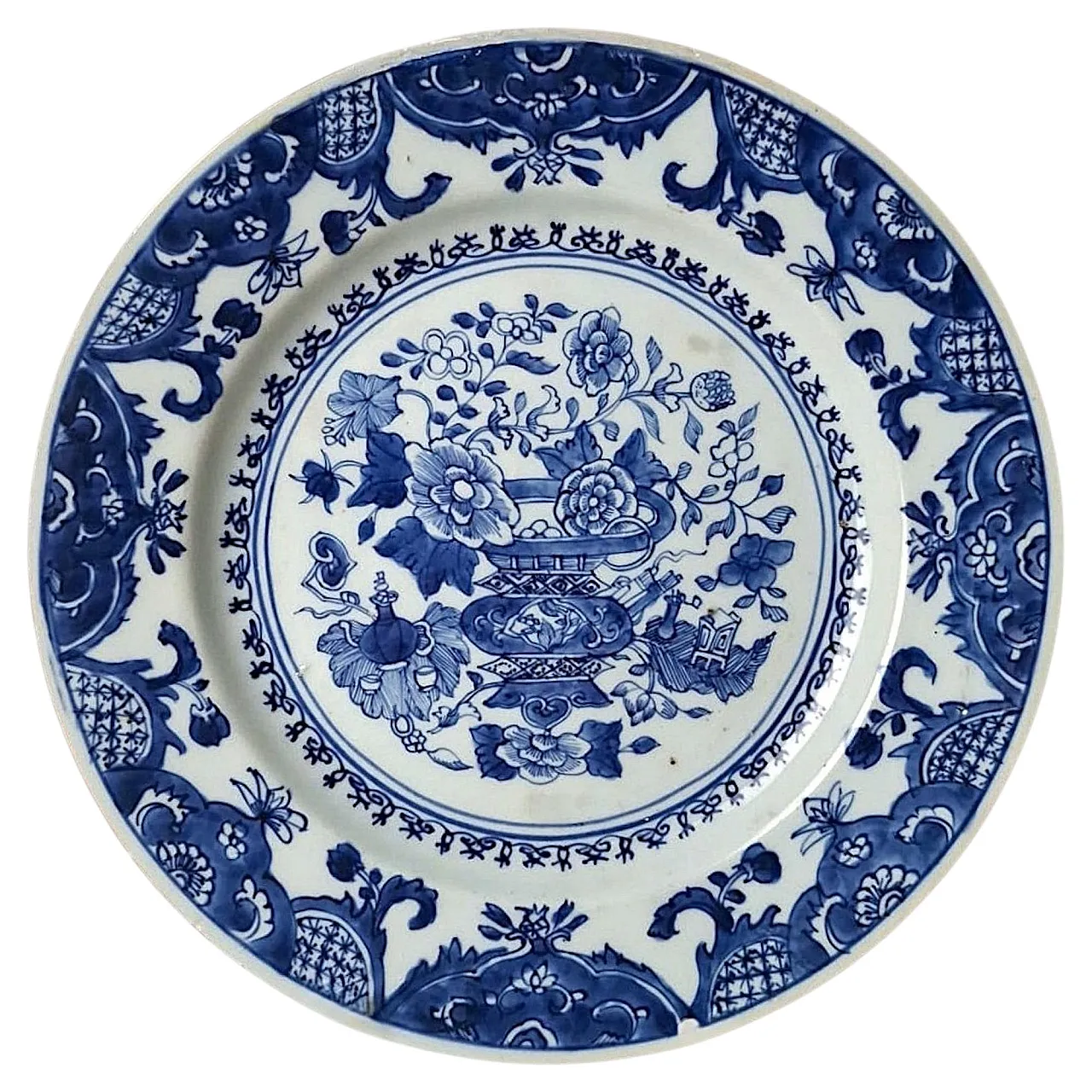
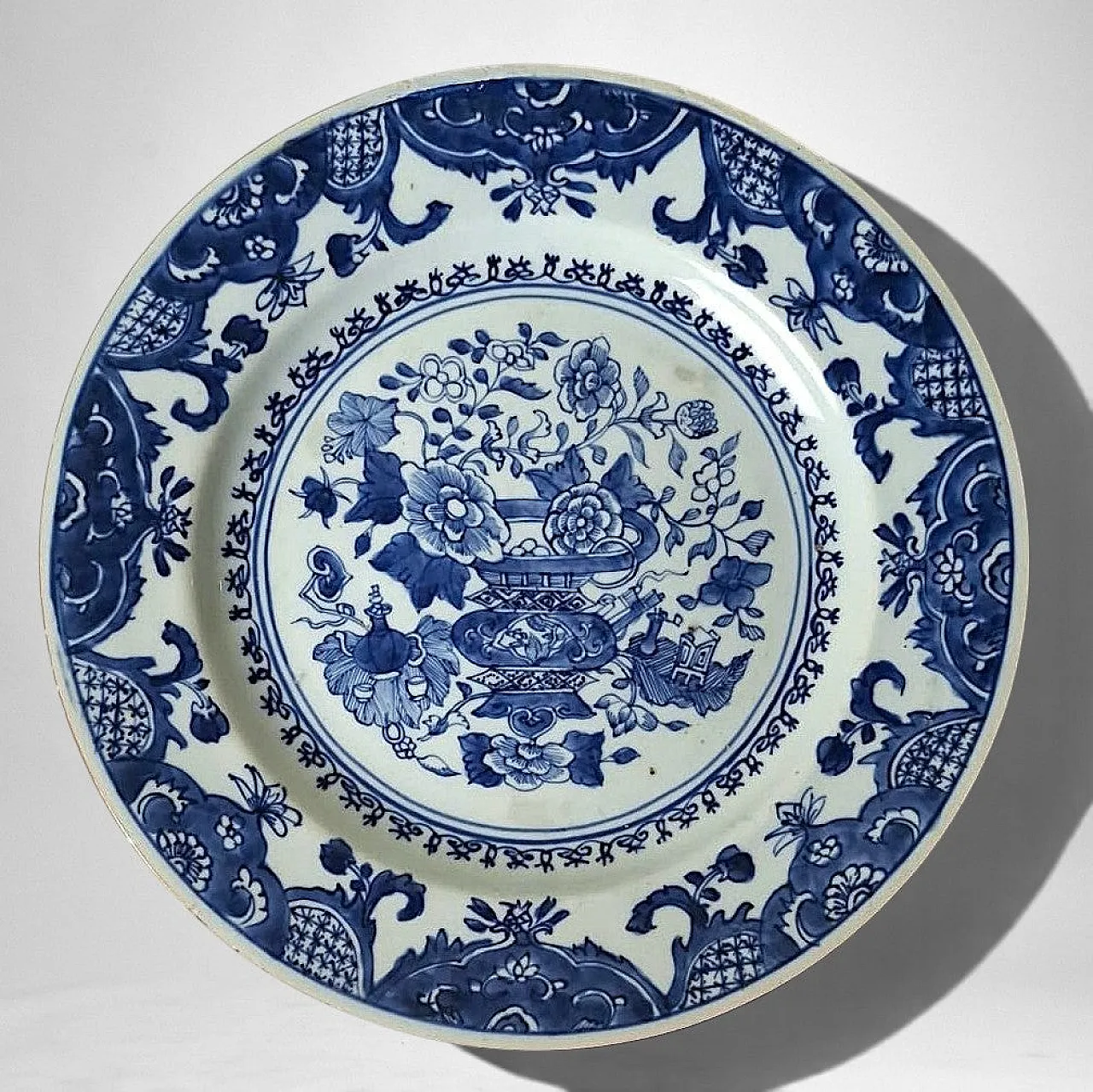
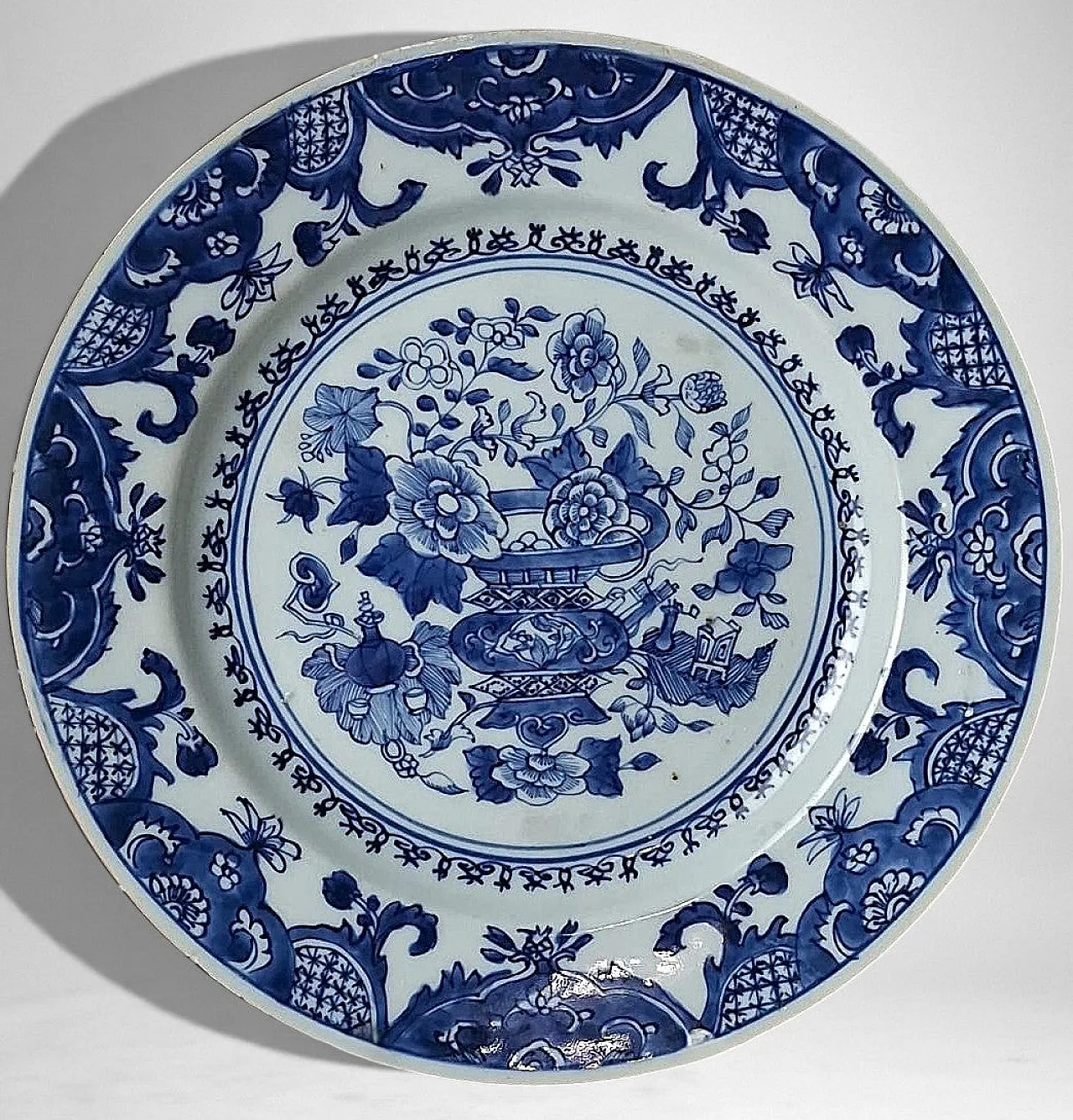
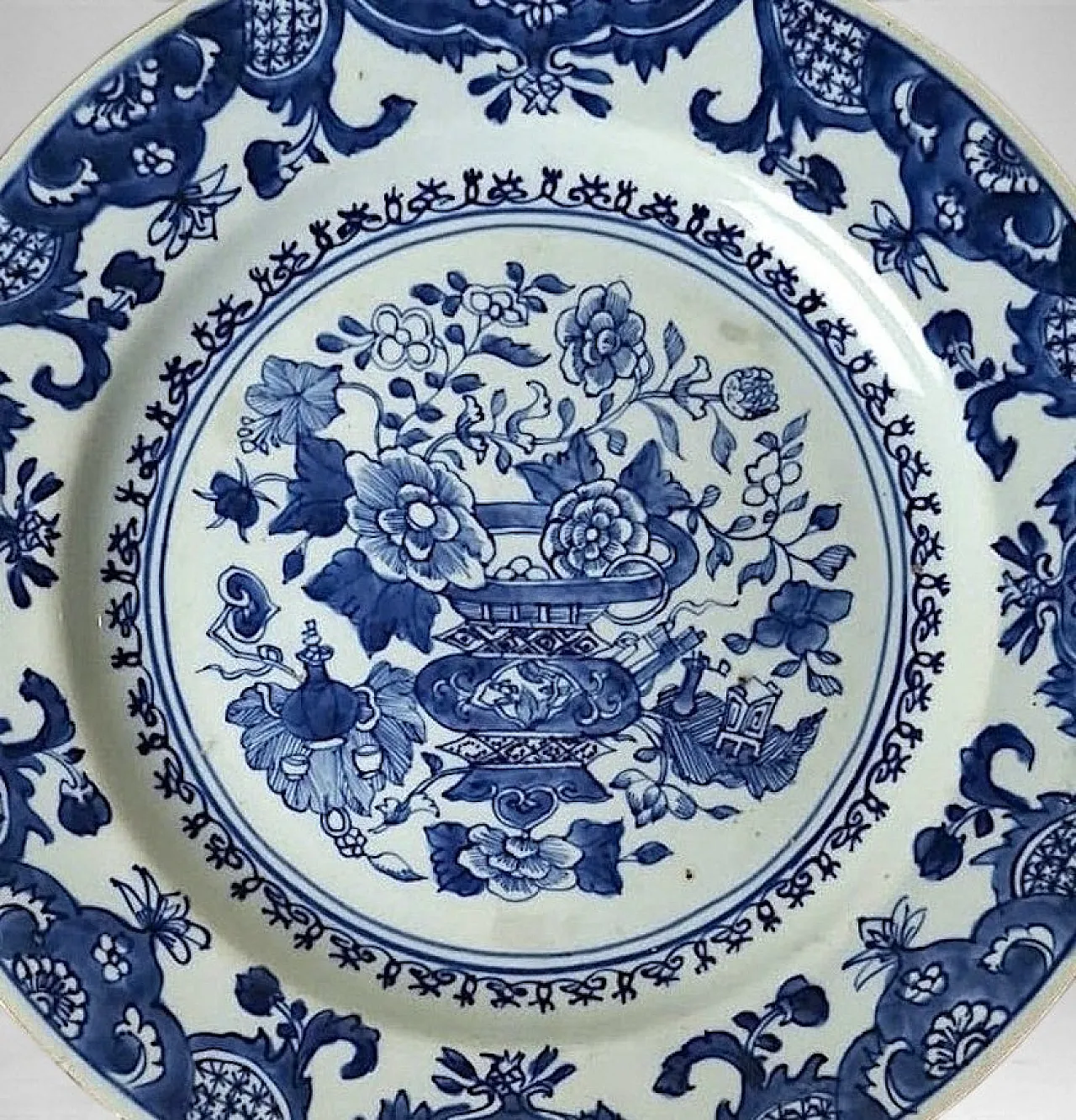
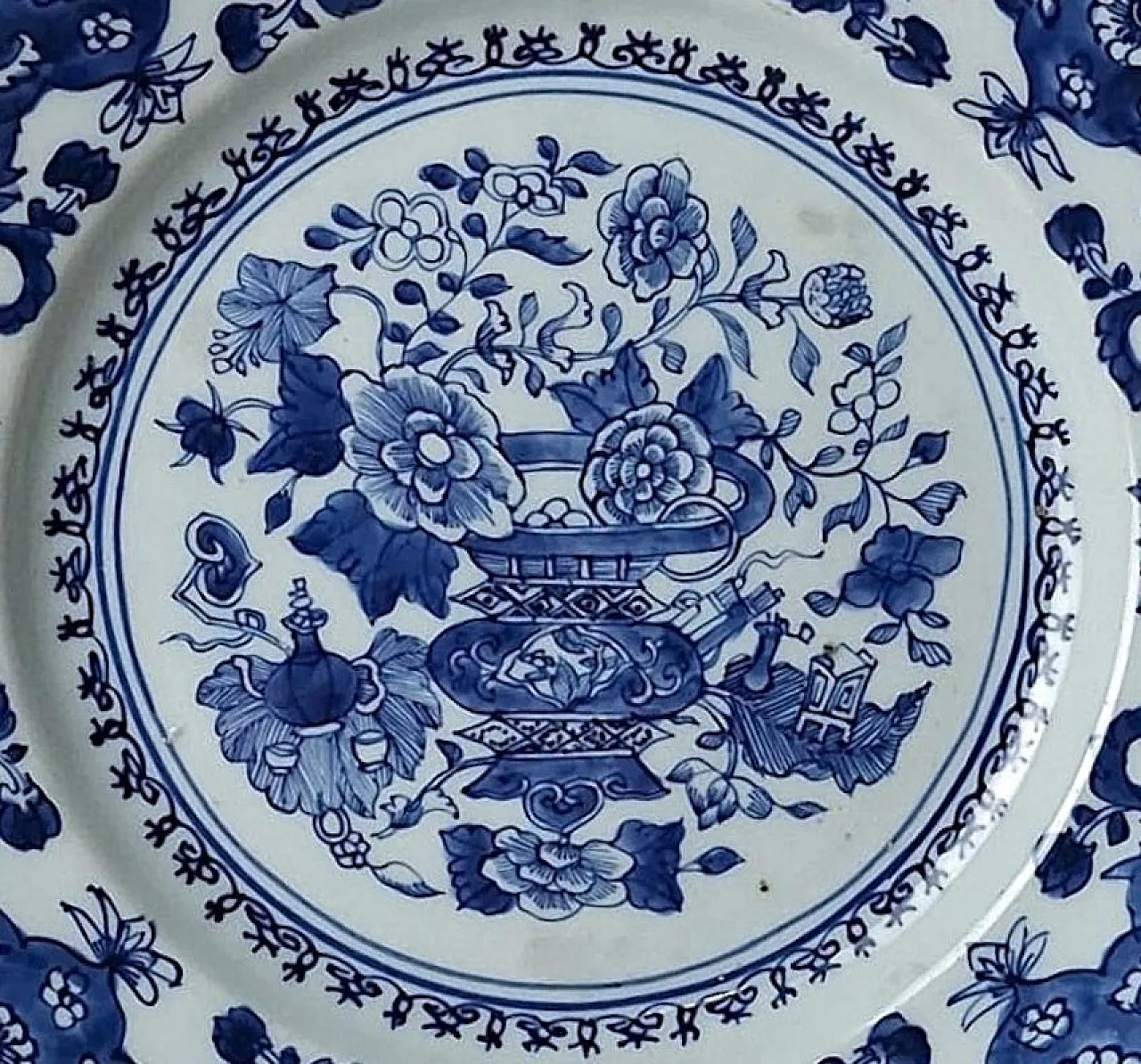
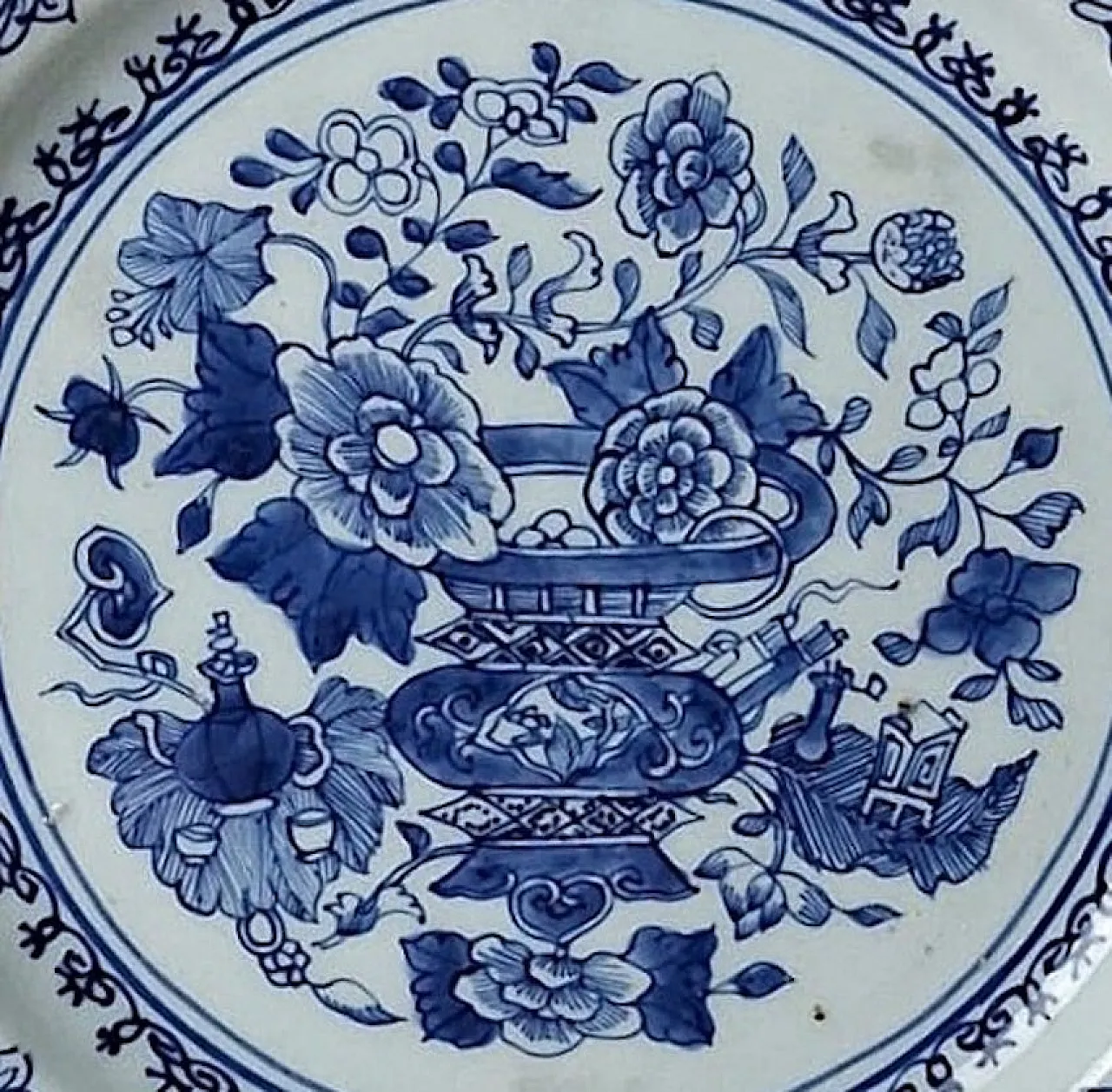
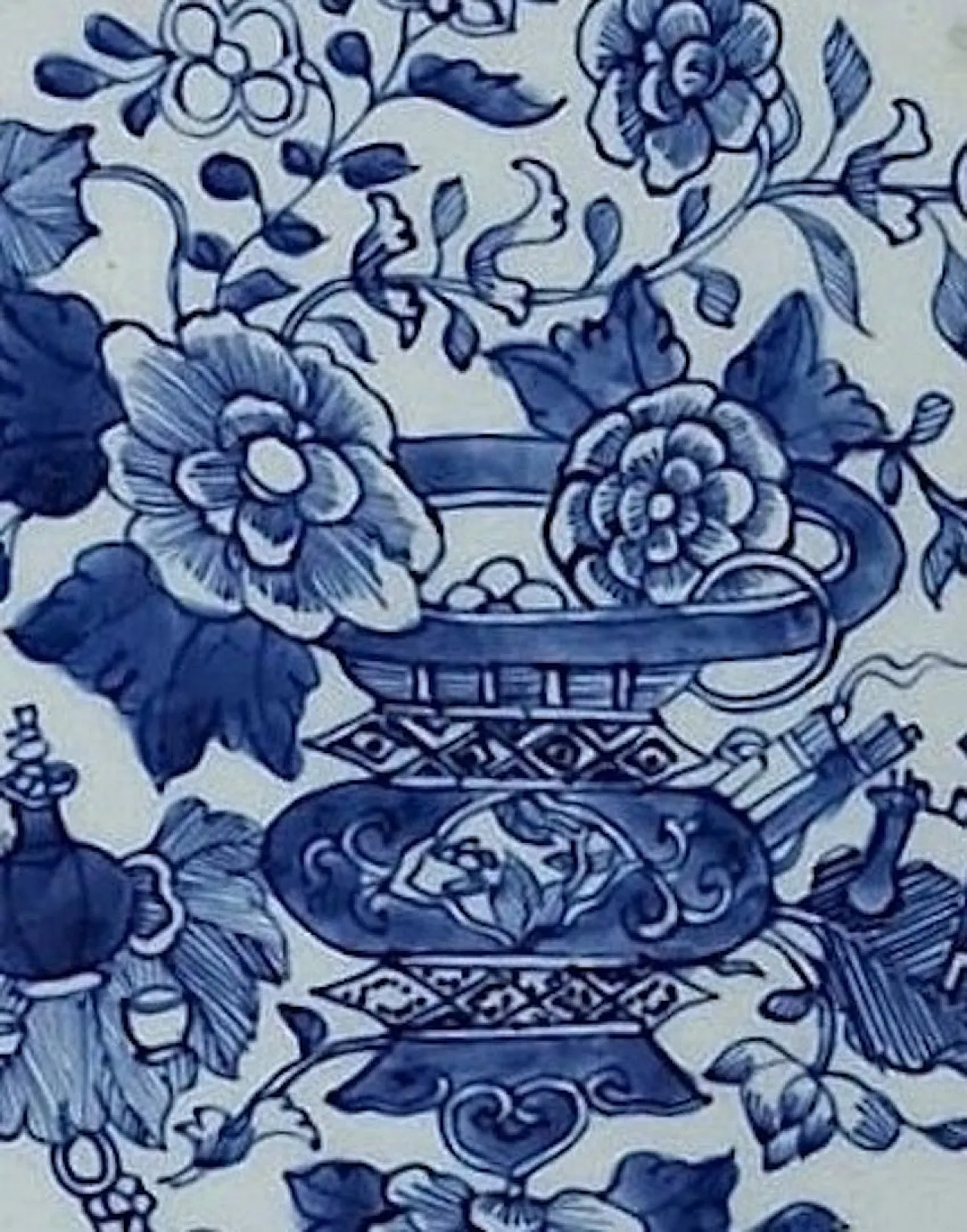
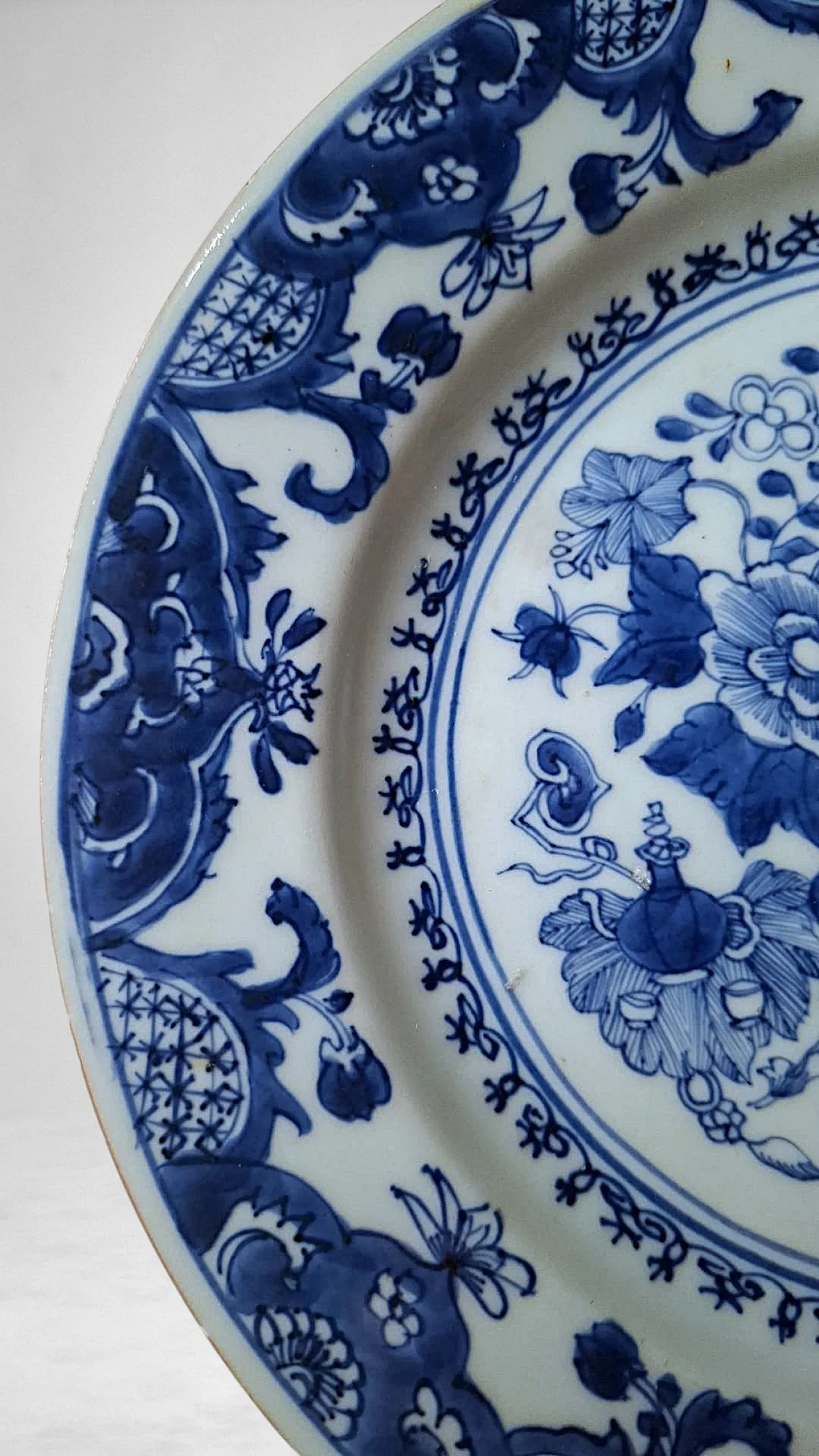
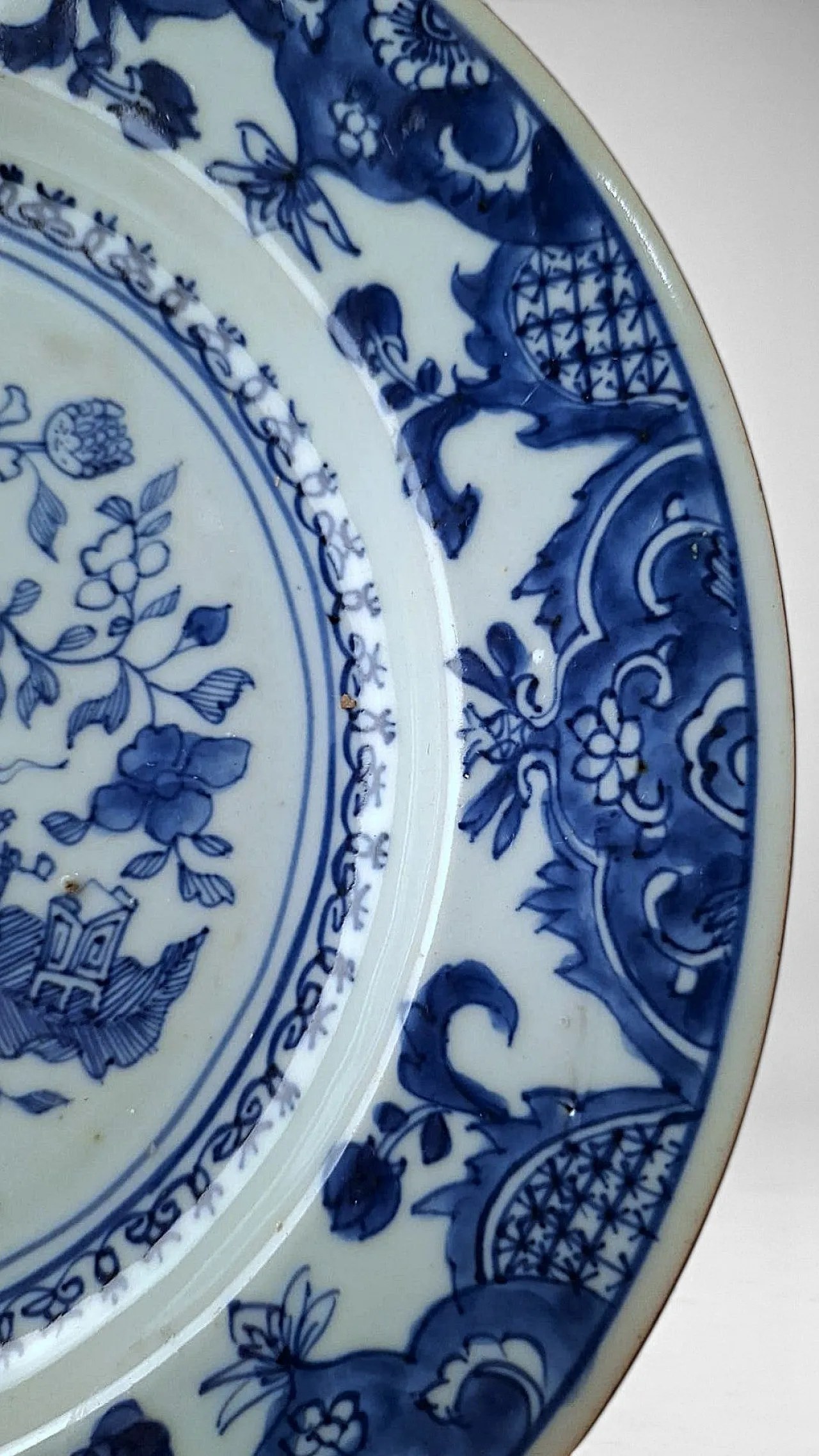
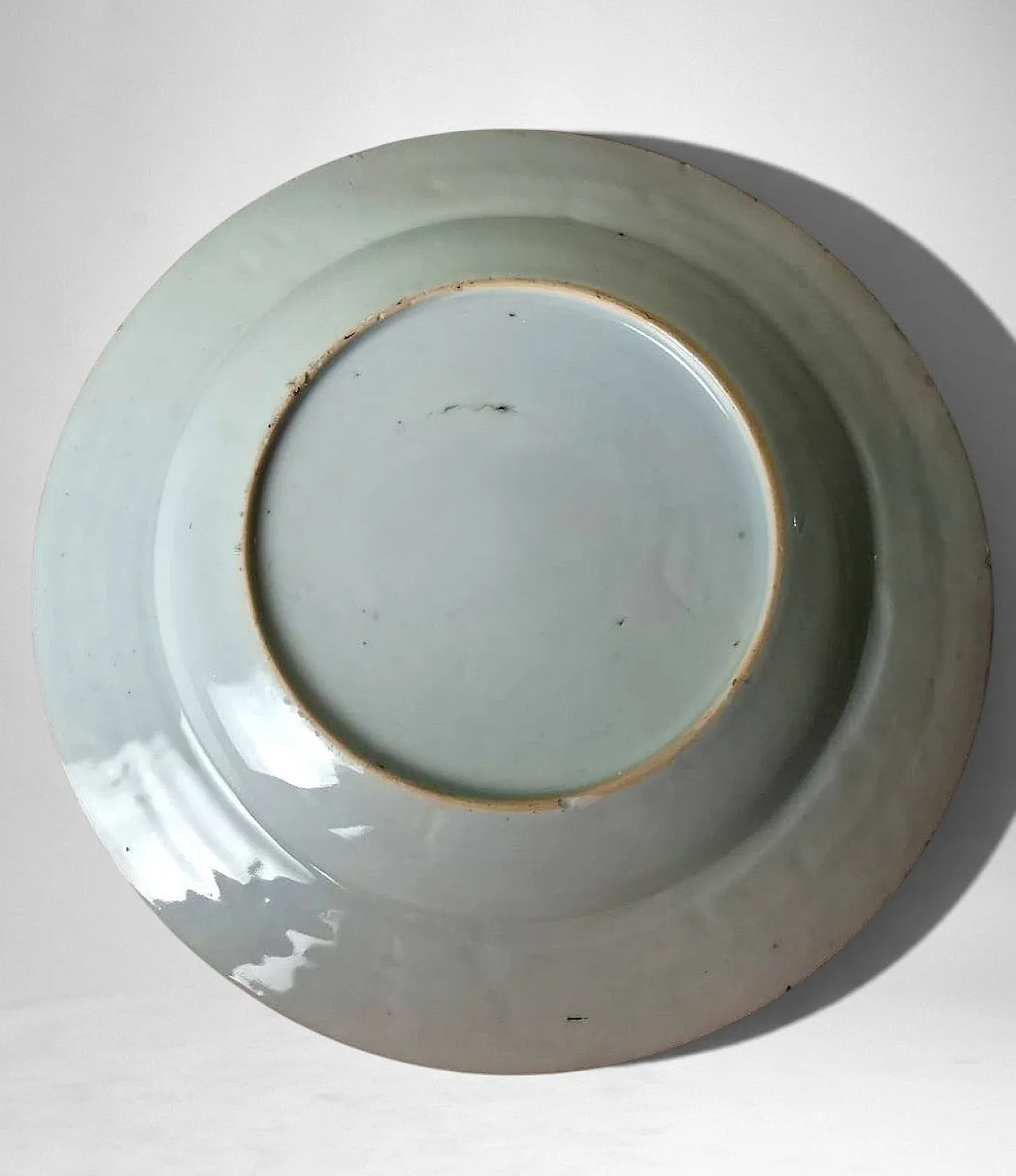
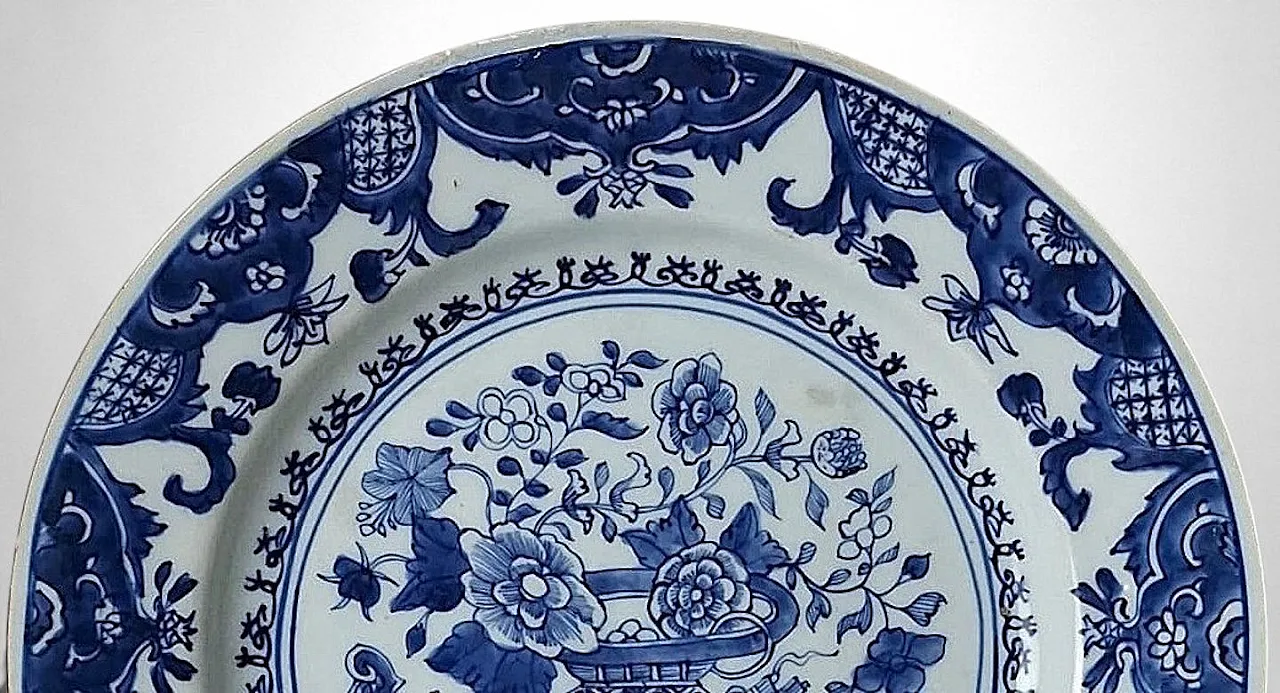
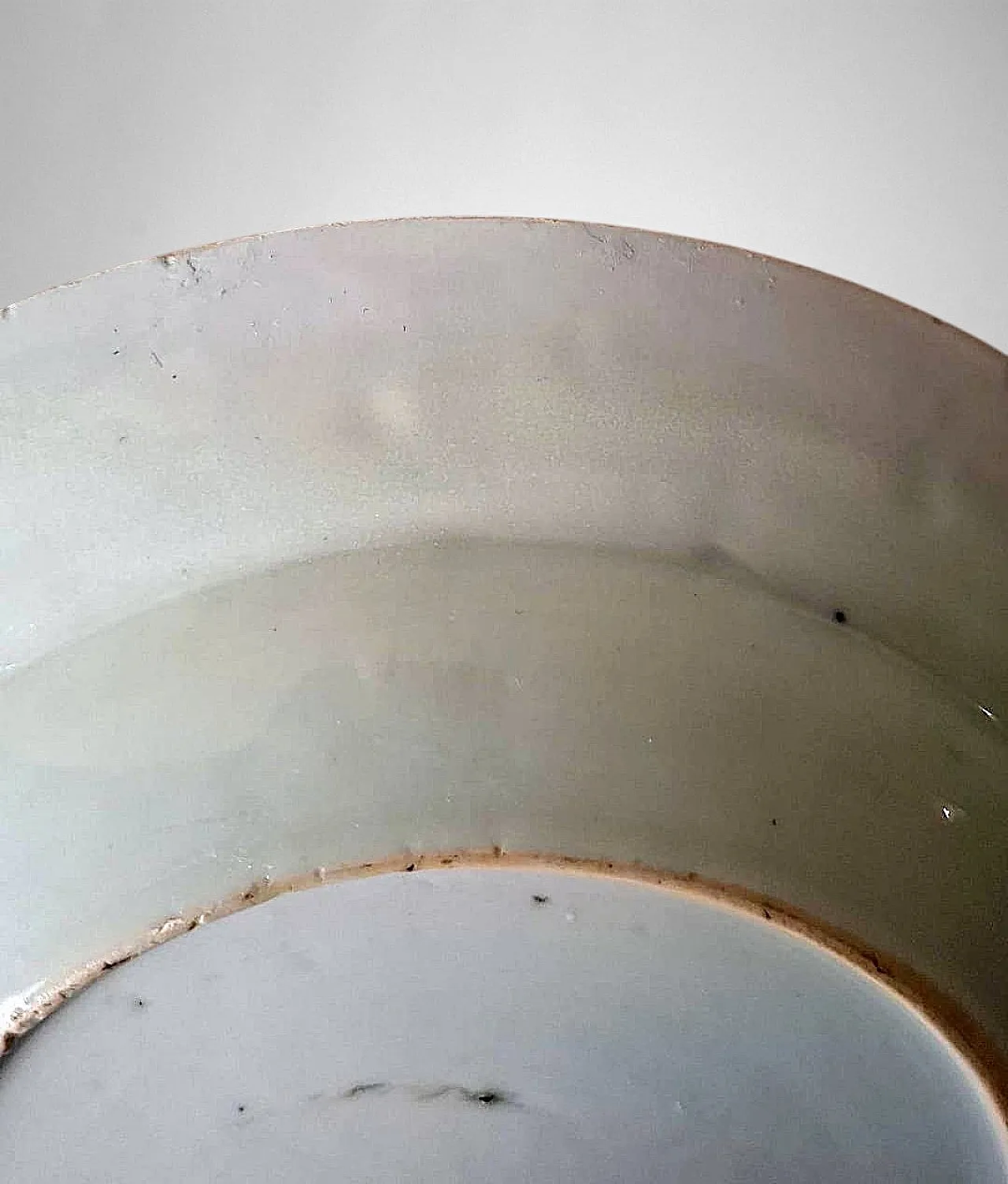
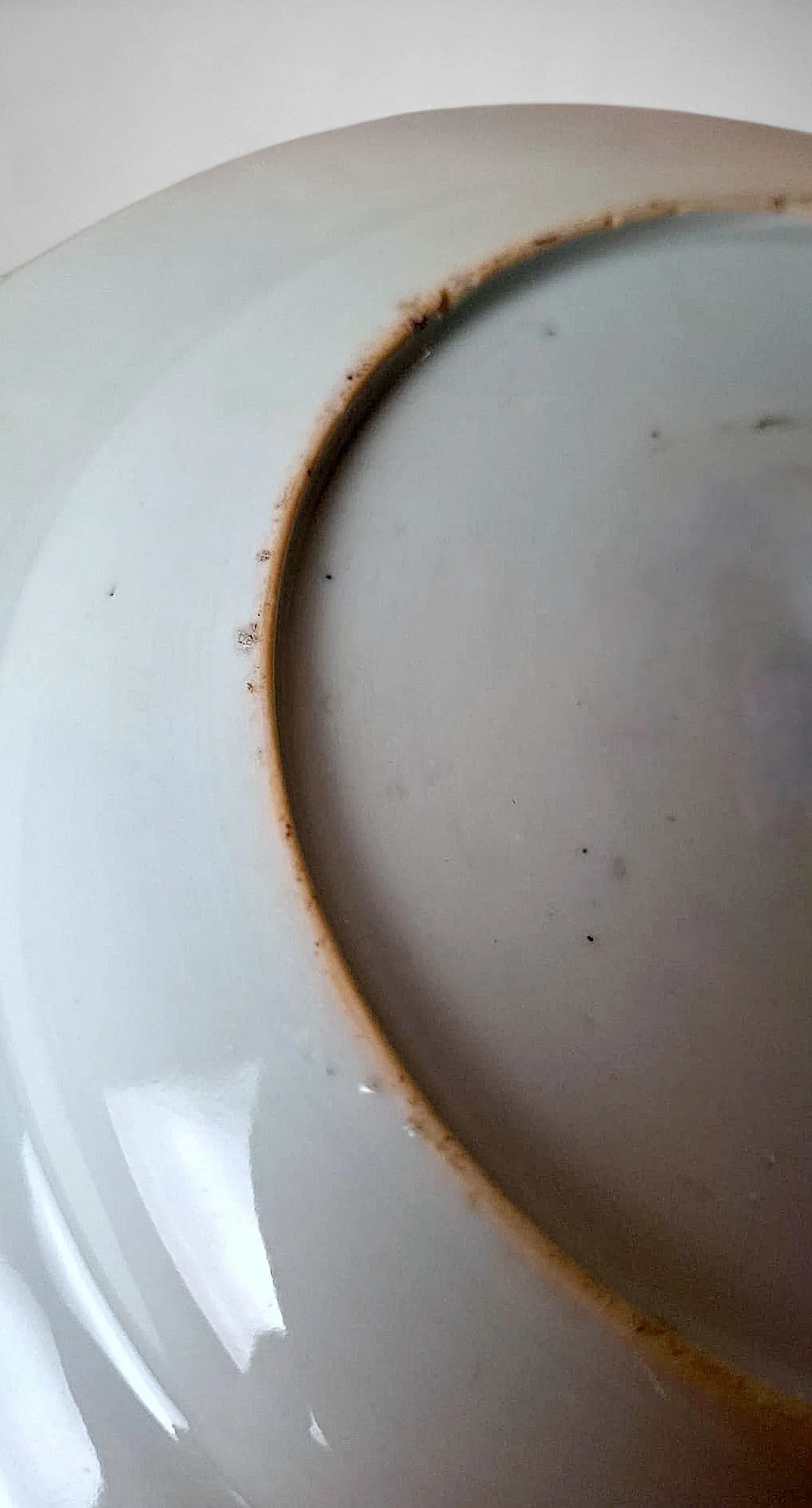
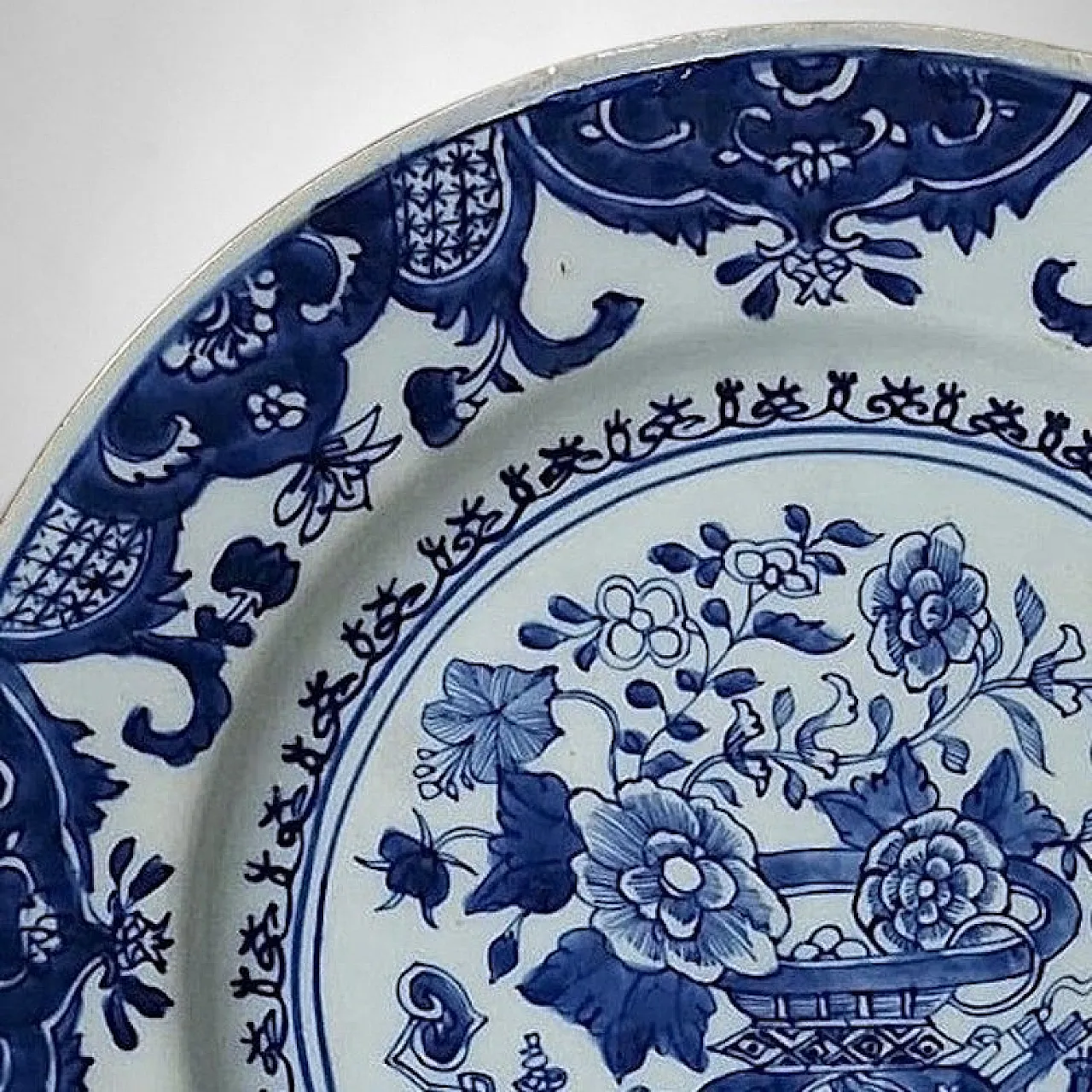
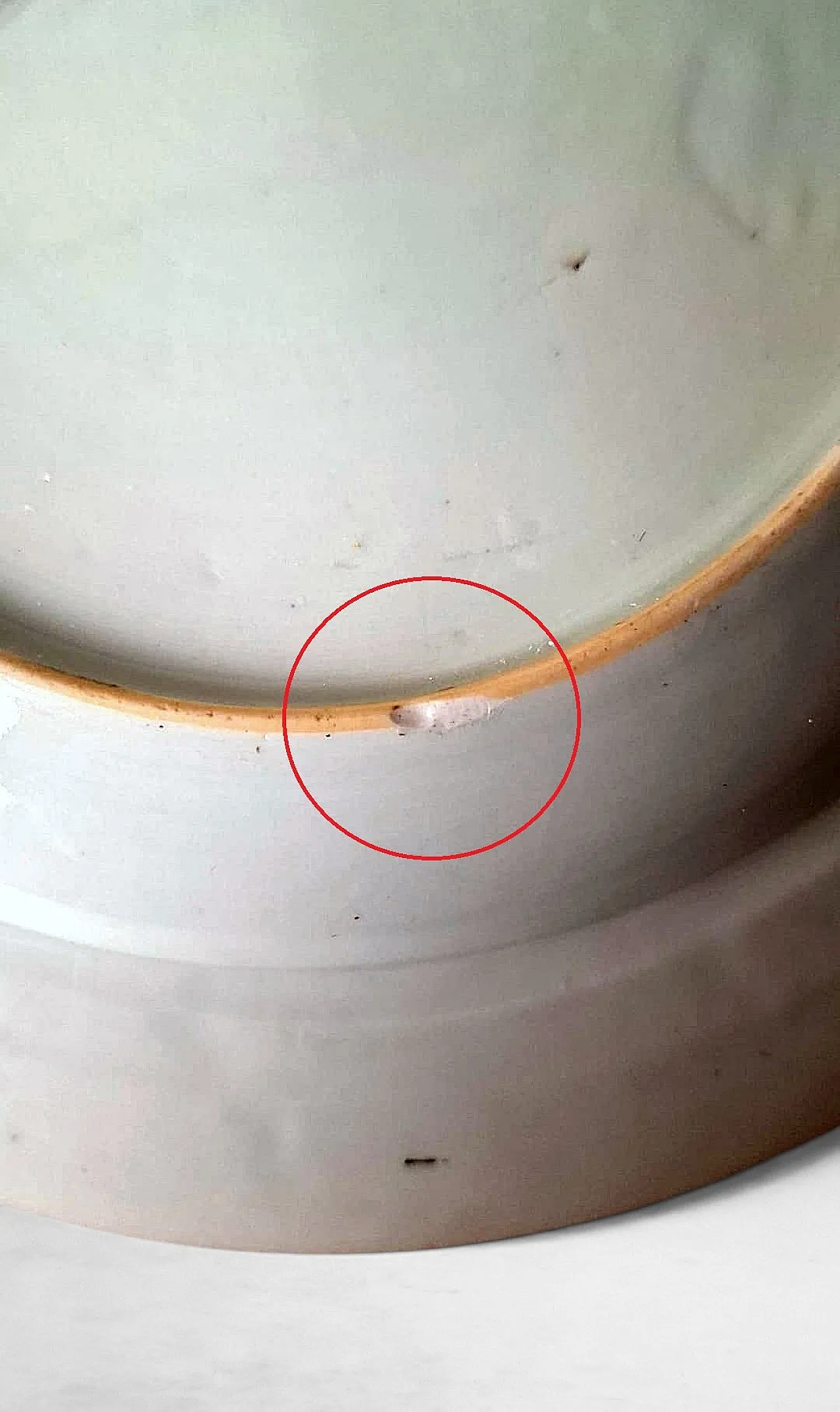
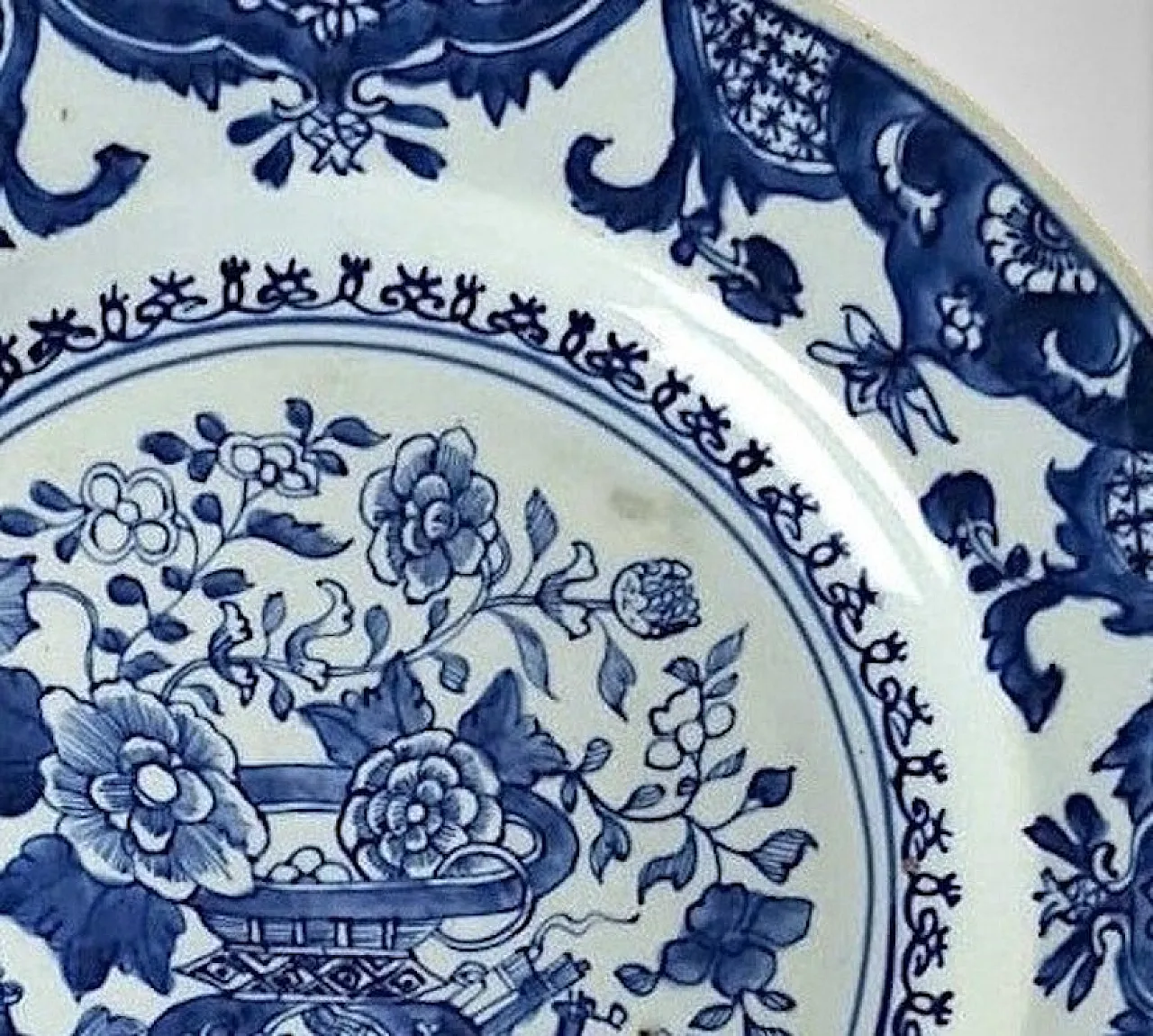
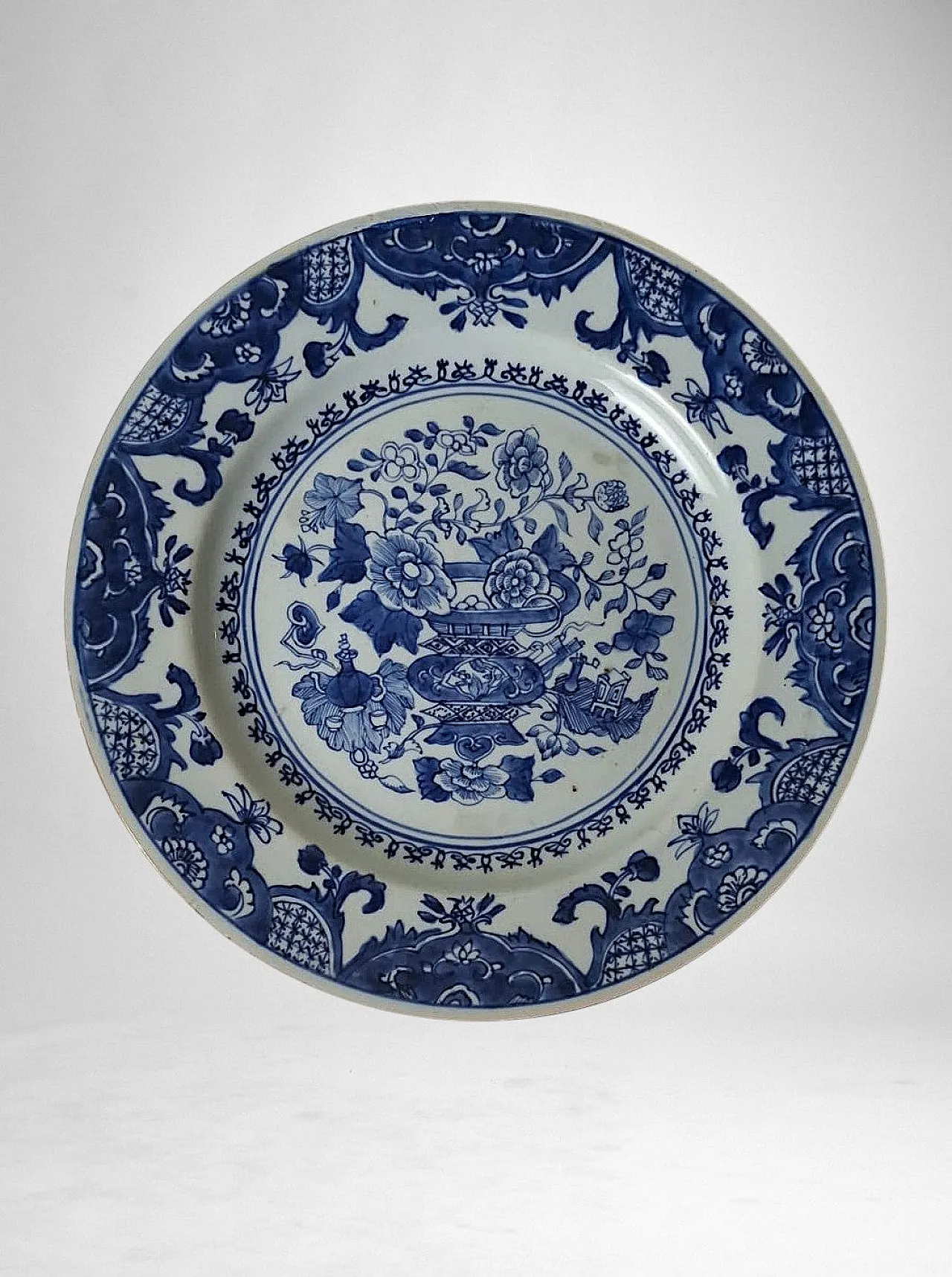
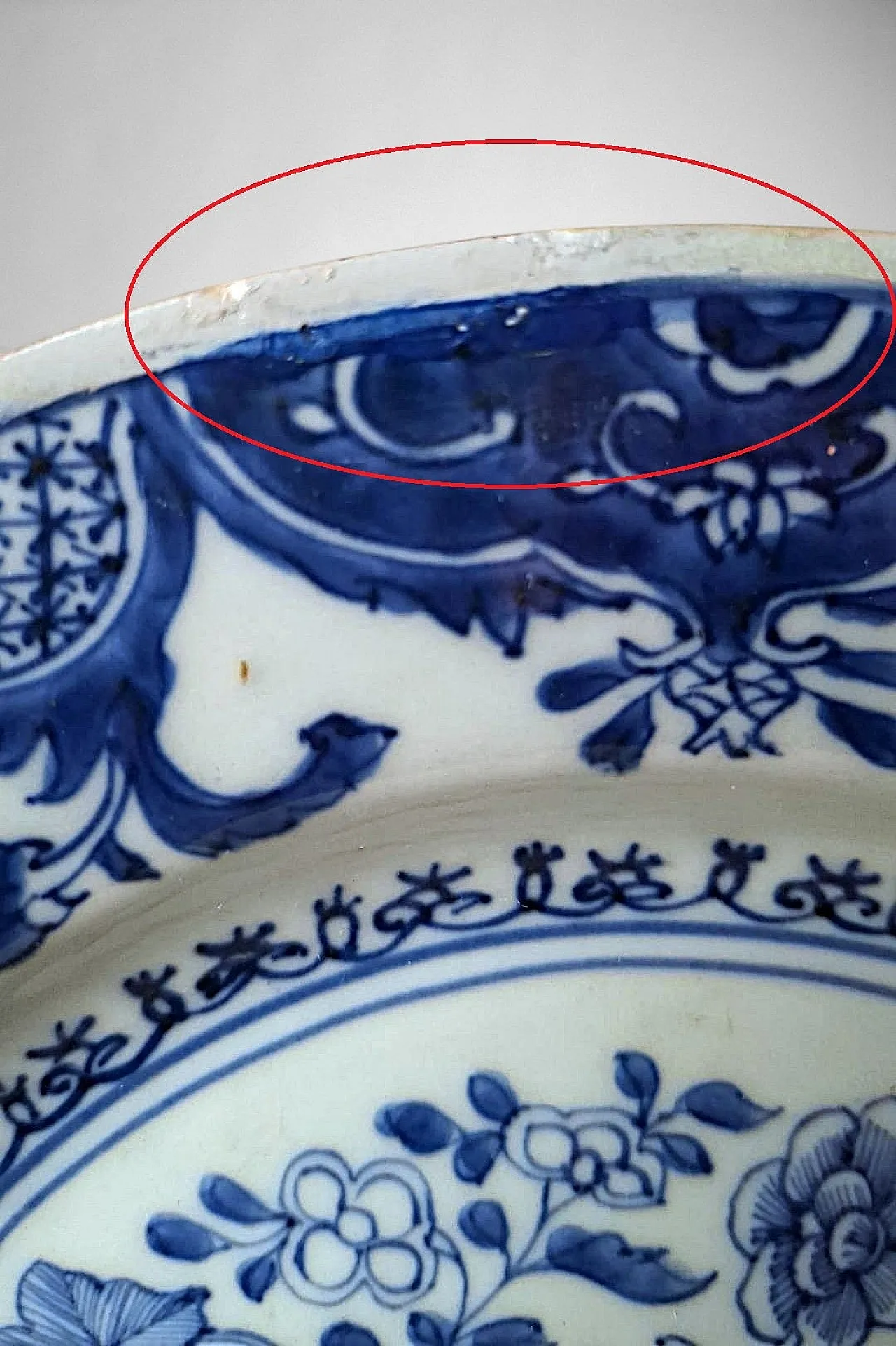
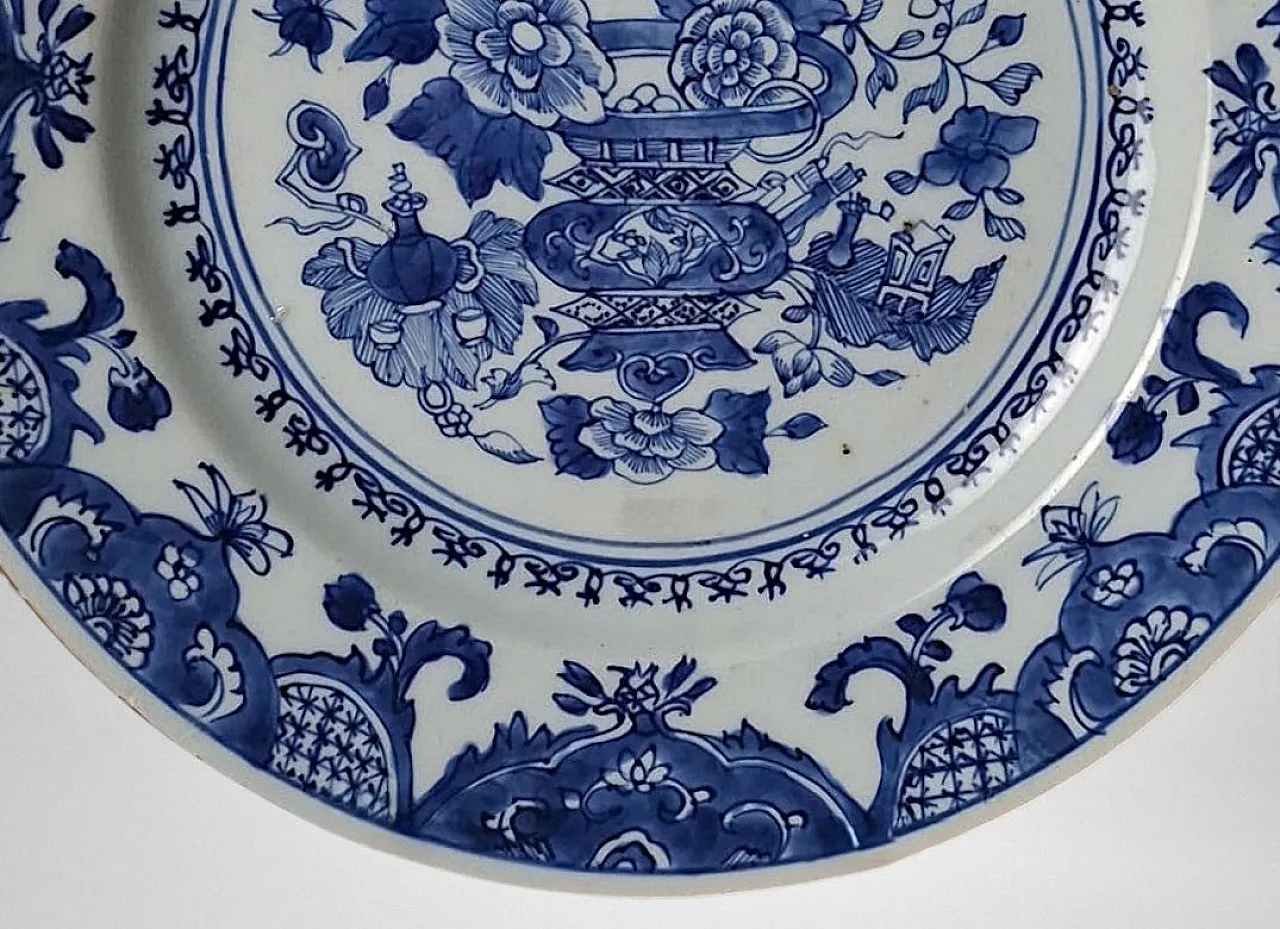
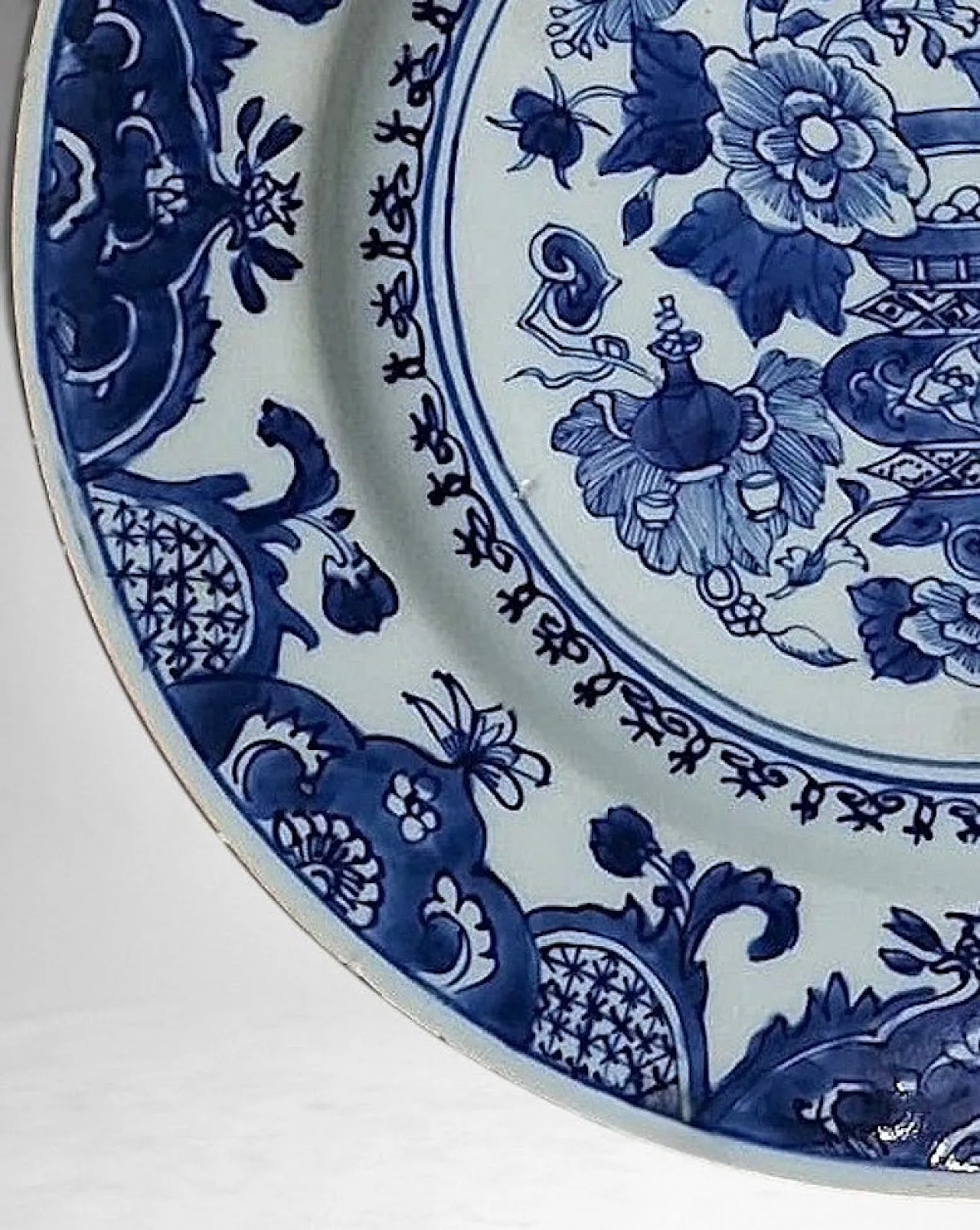
This Chinese export porcelain plate was produced at the renowned kilns of Jingdezhen during the Qianlong period (1736–1795), under the Qing Dynasty, most likely between circa 1760 and 1775. The plate was made for the European market and intended for export through the well-established maritime trade routes connecting China with the principal Western markets. The decoration is entirely hand-painted in cobalt blue underglaze and depicts a flower-filled basket or vase overflowing with peonies and other blossoms, surrounded by traditional Chinese Bogu motifs, known as the “Precious Objects.” The border features a richly articulated, symmetrical geometric and floral pattern, with broad areas of cobalt-blue underglaze characteristic of porcelain produced at Jingdezhen for the Western market. Blue-and-white decorative schemes of this type belong to the broader repertoire of Chinese export porcelain produced from the mid-18th century through the final decades of the century. Blue-and-white landscapes, floral compositions, and auspicious decorative motifs were among the most highly appreciated forms of Chinese porcelain on European markets during this period. The absence of a mark on the underside is entirely consistent with the nature and intended commercial use of the piece. A considerable quantity of Chinese porcelain made for the European trade during the 18th century was left unmarked. Imperial reign marks were primarily associated with wares produced for the imperial court and official commissions. At the same time, a significant portion of the commercial production made at Jingdezhen for export remained without identifying marks. Consequently, the absence of a mark on the base should not, in itself, be considered evidence against the proposed attribution or dating. Several formal and technical characteristics are consistent with an 18th-century production, including the subtly shaped rim, the particular tone of the cobalt blue, the decorative repertoire, and the relatively low foot. These features are frequently encountered in Chinese export porcelain of the period. The plate can be attributed to the Jingdezhen kilns in Jiangxi Province, the foremost center of Chinese porcelain production and, since the 14th century, one of the world's most important centers for the manufacture of porcelain. The local kilns produced wares both for the domestic market and for Chinese merchants engaged in the flourishing international trade. The East India Companies played a fundamental role in distributing Chinese goods throughout Europe. They generally did not operate their own porcelain factories at Jingdezhen; rather, they functioned as major commercial intermediaries, purchasing and transporting large quantities of Asian goods to the West, including tea, silk, and porcelain. Among the principal companies involved in the China trade were the British East India Company, founded in 1600; the Dutch East India Company (VOC), founded in 1602; the French East India Company (Compagnie française des Indes); the Danish East India Company; and the Swedish East India Company. The commercial route followed by porcelain destined for Europe generally involved the transportation of wares from the Jingdezhen kilns to Chinese merchants and subsequently to the port of Canton (Guangzhou). From there, cargoes were transported by European trading companies to their respective markets. In the absence of specific provenance documentation, it is not possible to establish with certainty through which particular East India Company this plate was imported into Europe. It is, however, entirely consistent with the international trading system that, throughout the 18th century, brought Jingdezhen porcelain to European collectors, aristocratic families, and refined domestic interiors. The plate is in good condition for its age and nature. A small period repair is visible on the rim, while a small chip is present on the underside; both are clearly shown in the photographs. The porcelain surface retains the characteristic tactile quality of an 18th-century handmade object and displays minor irregularities resulting from the traditional processes of shaping, decorating, and firing. Small inclusions and minute traces of iron oxidation are also visible, attributable to the mineral composition of the raw materials used in the ceramic body and glaze. These characteristics, which have naturally developed and become more pronounced over the centuries, are consistent with the normal aging of an antique ceramic surface. They contribute to the historical patina, material authenticity, and distinctive character of this Chinese export porcelain plate. Measurements: Diameter 23 cm (9.05 in.); Height 2 cm (0,78 in.).





 SILVER Seller in Prato, Italy