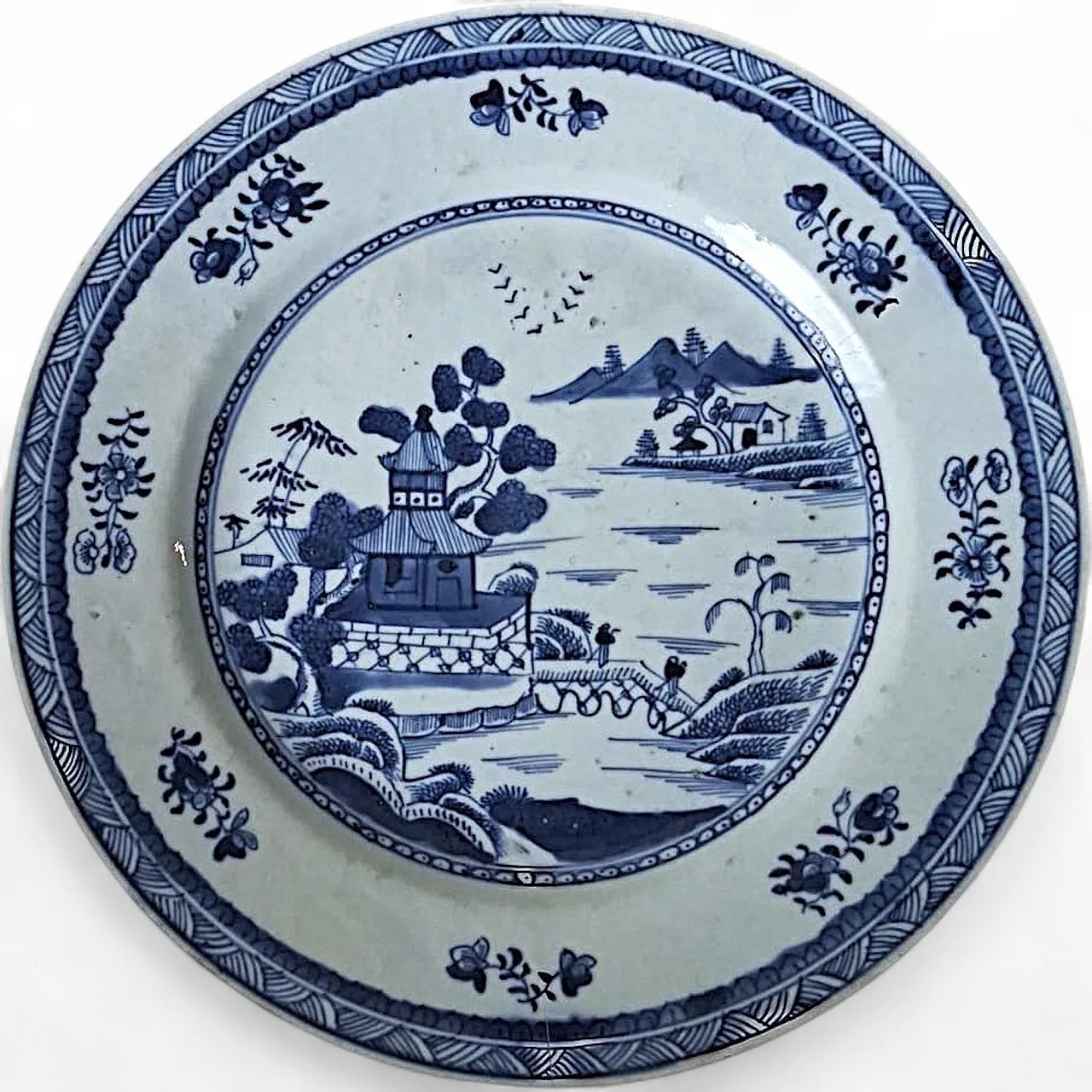
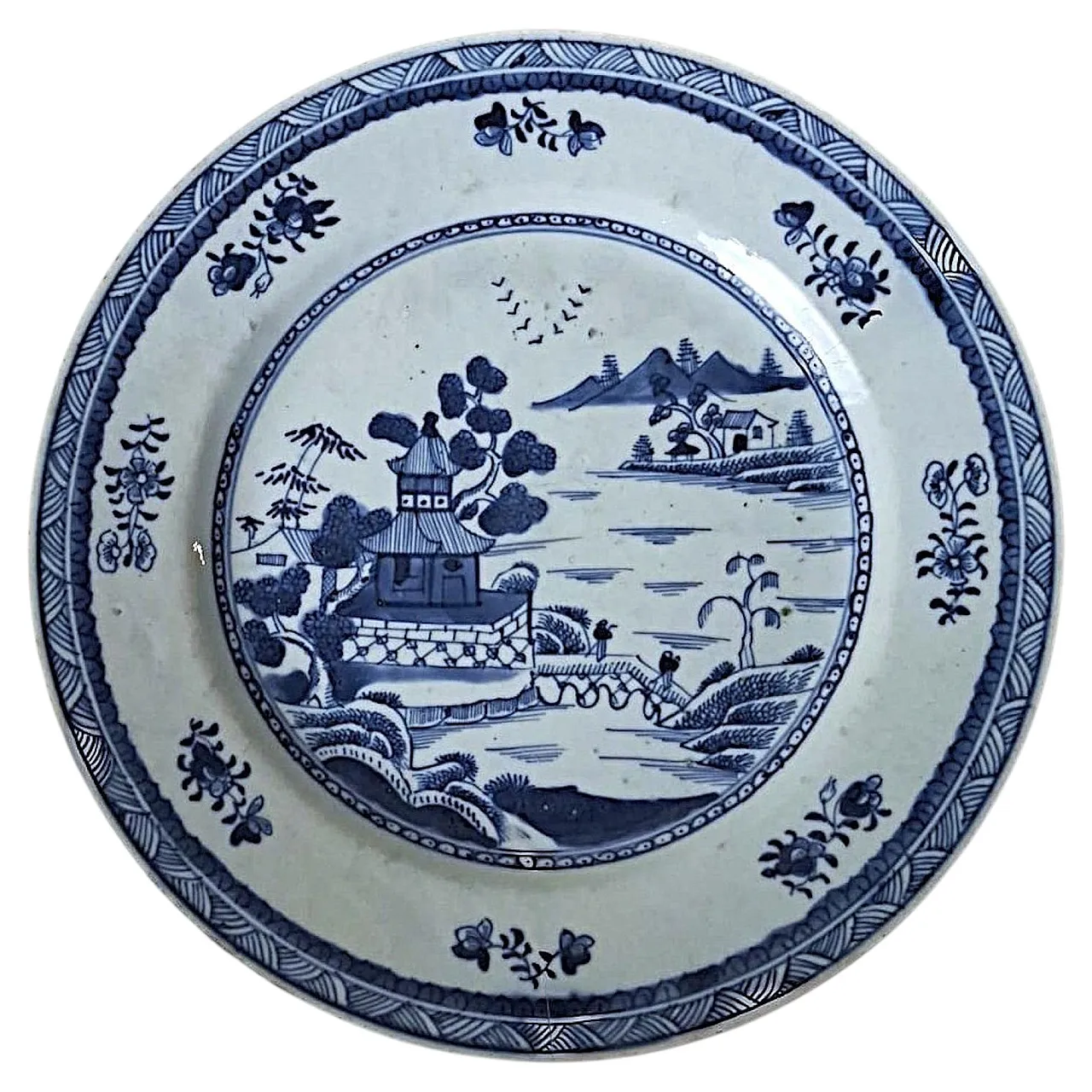
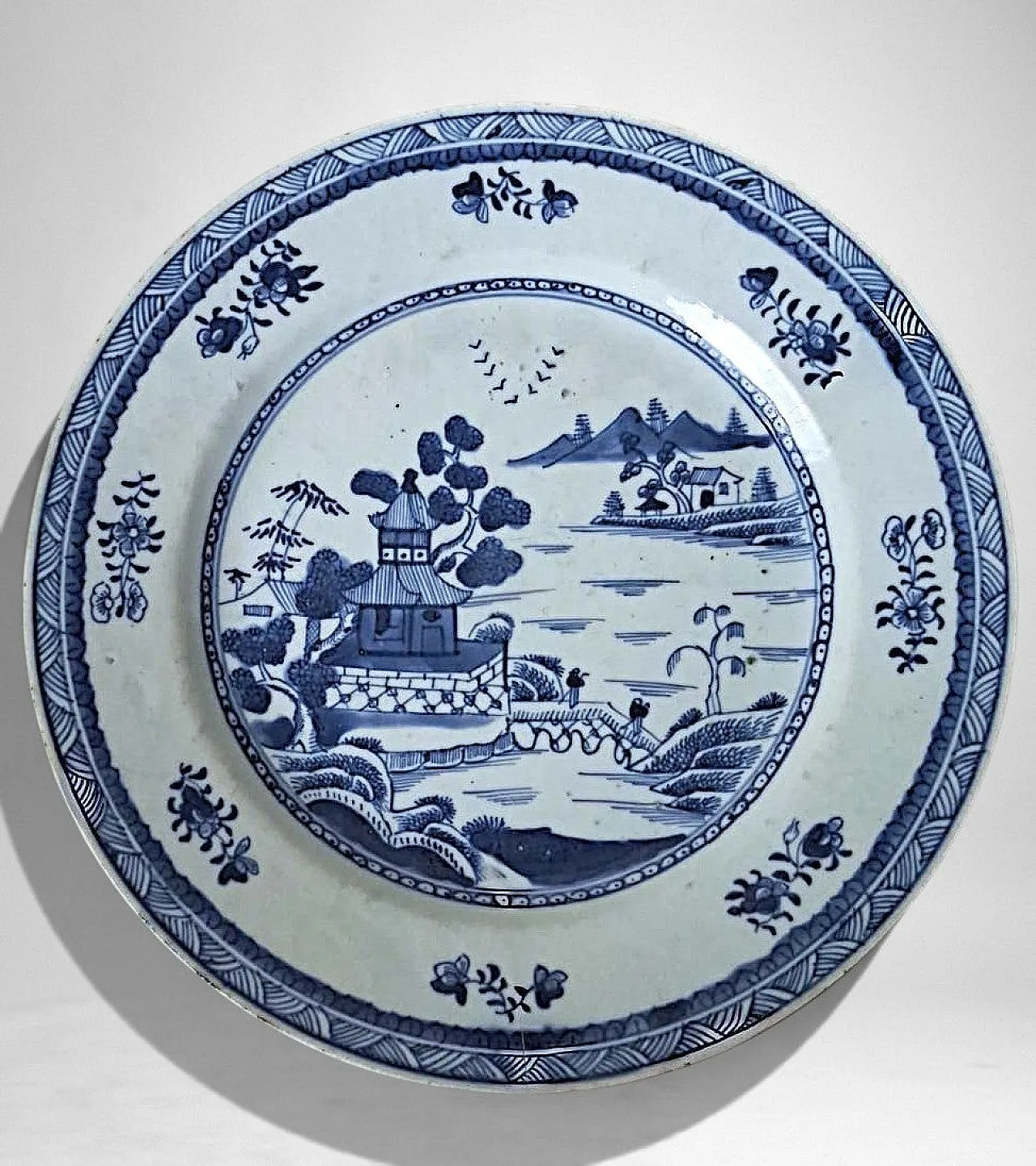
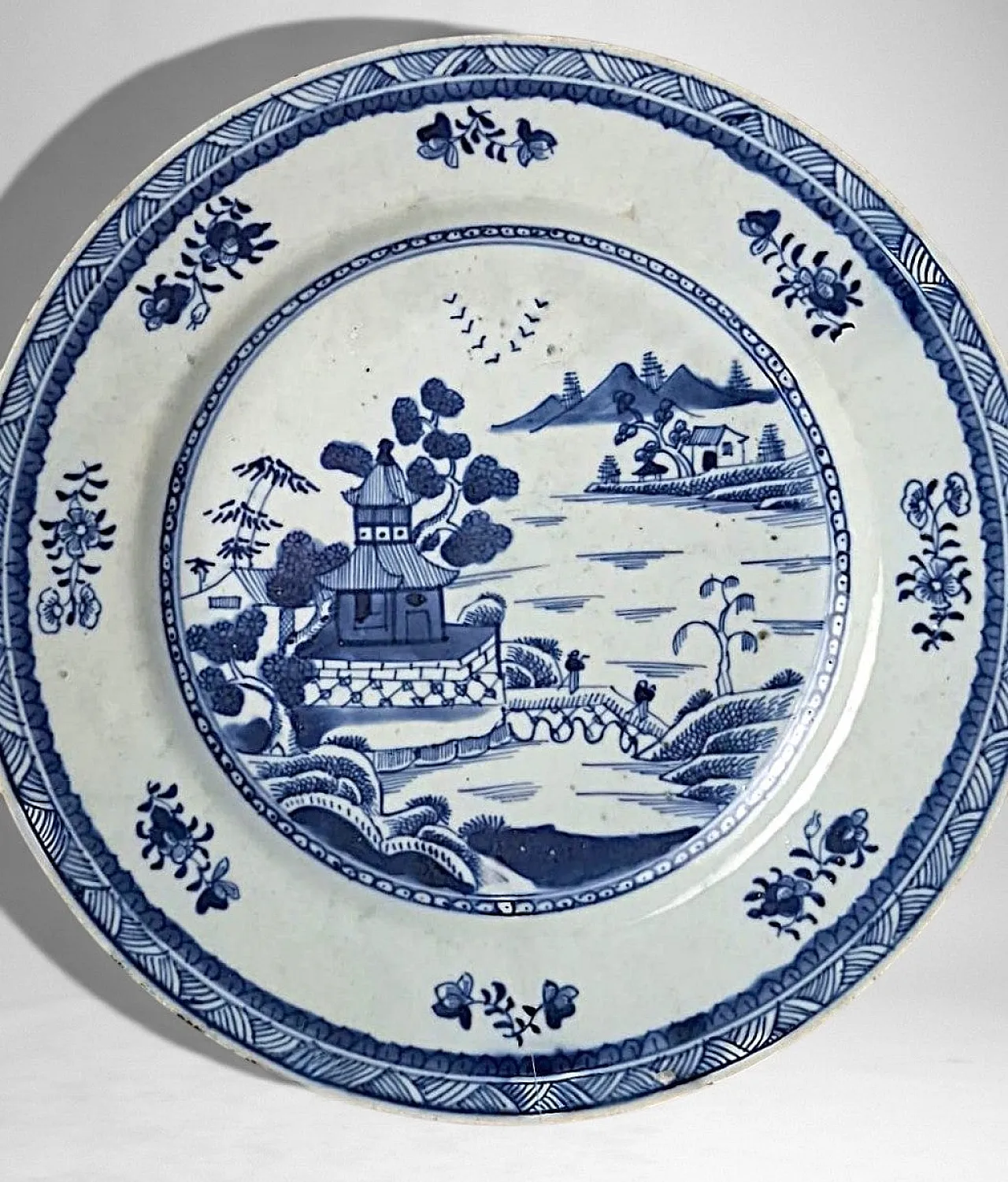
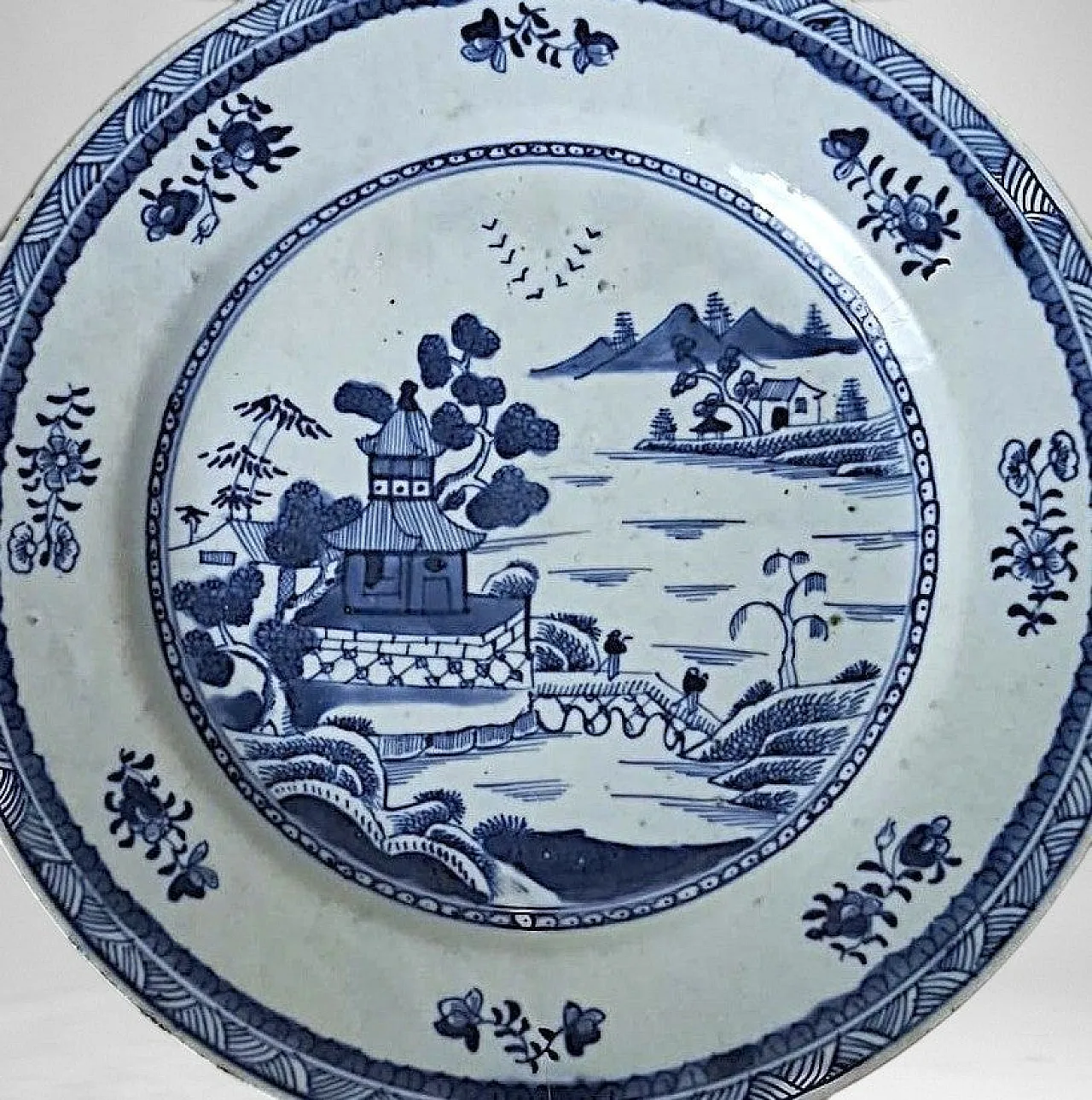
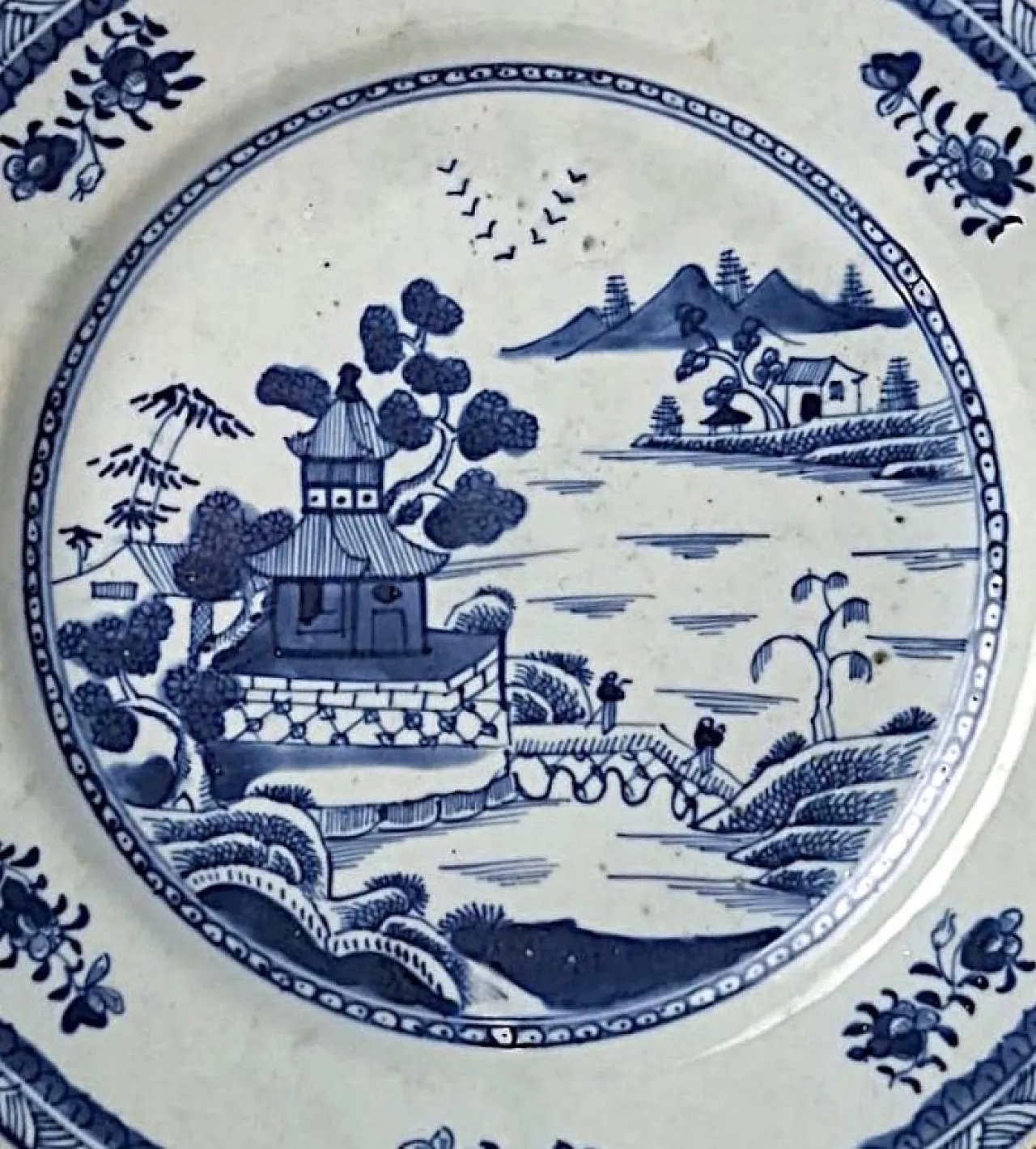
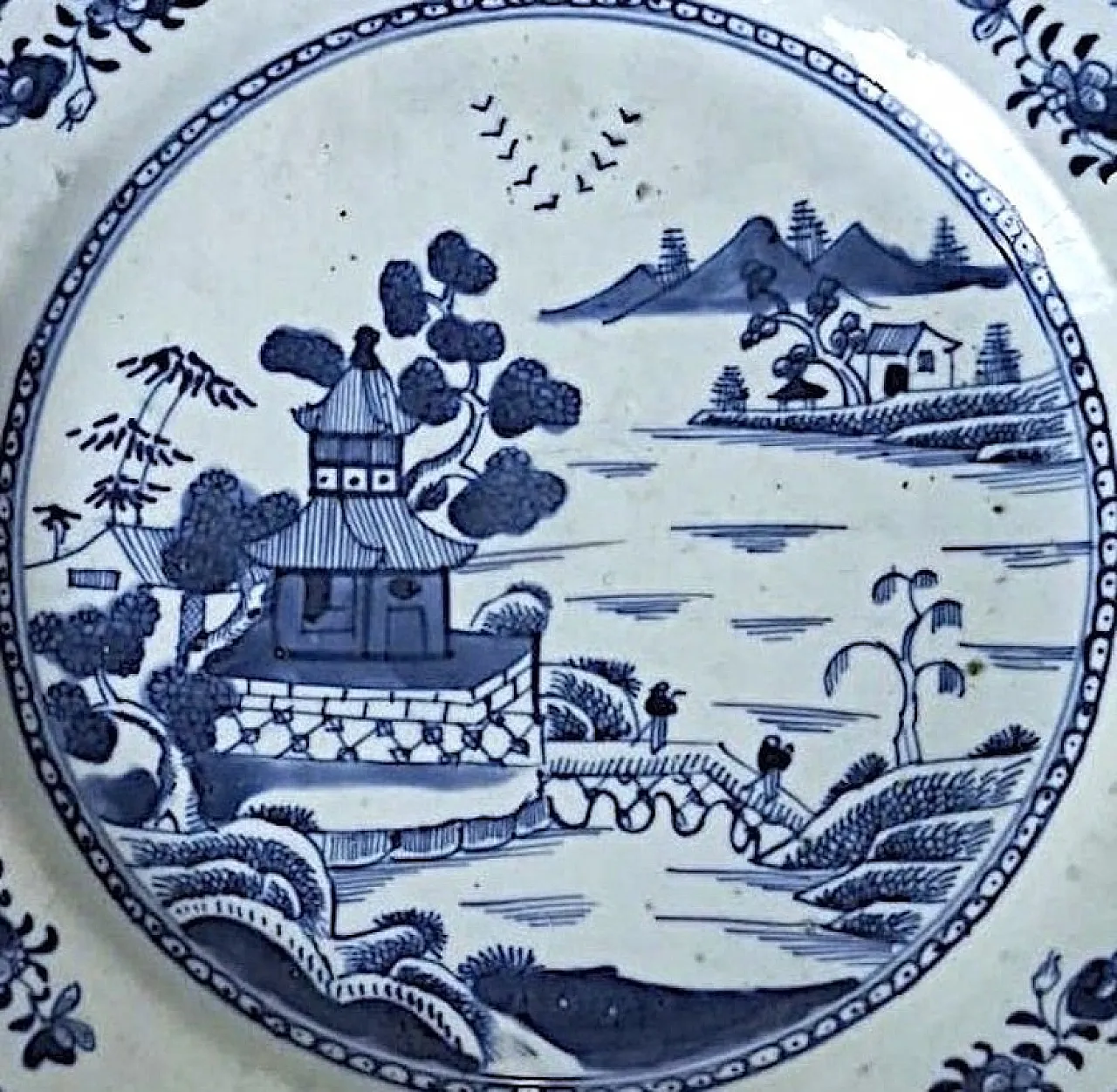
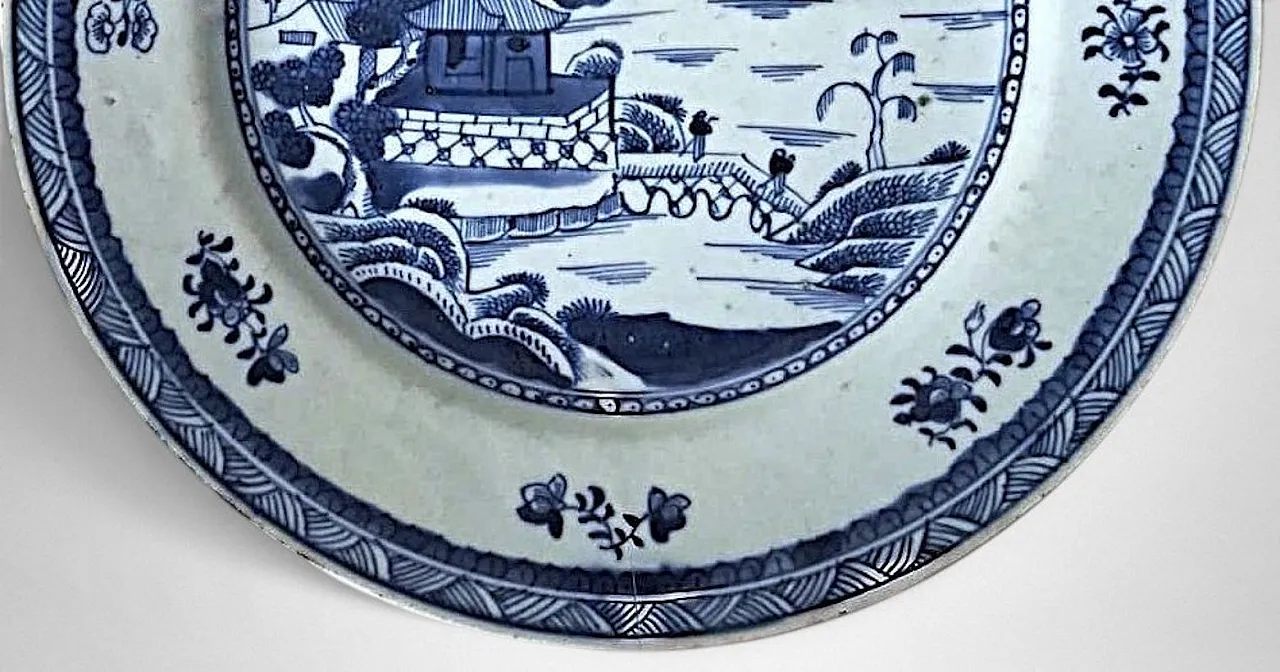
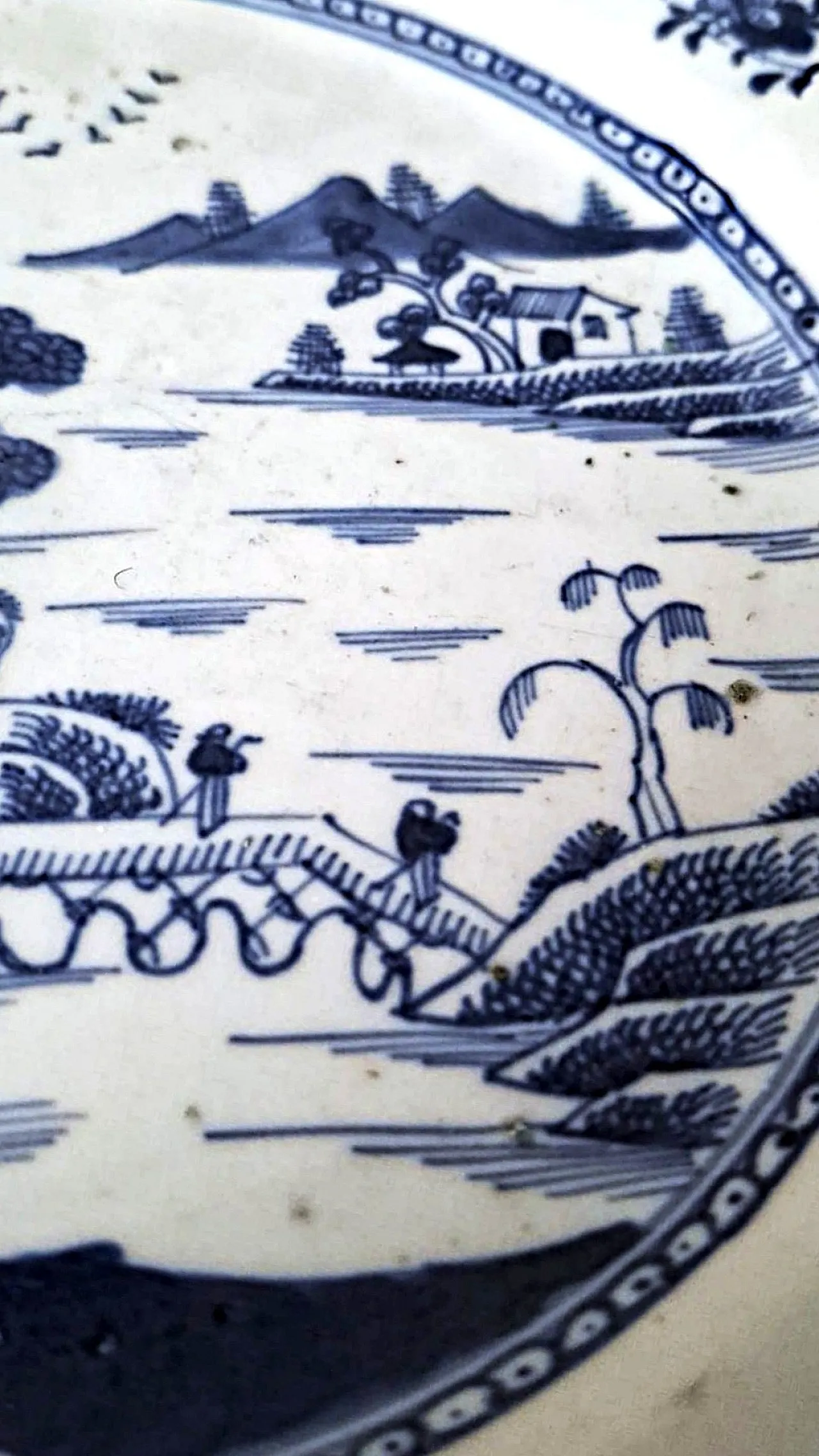
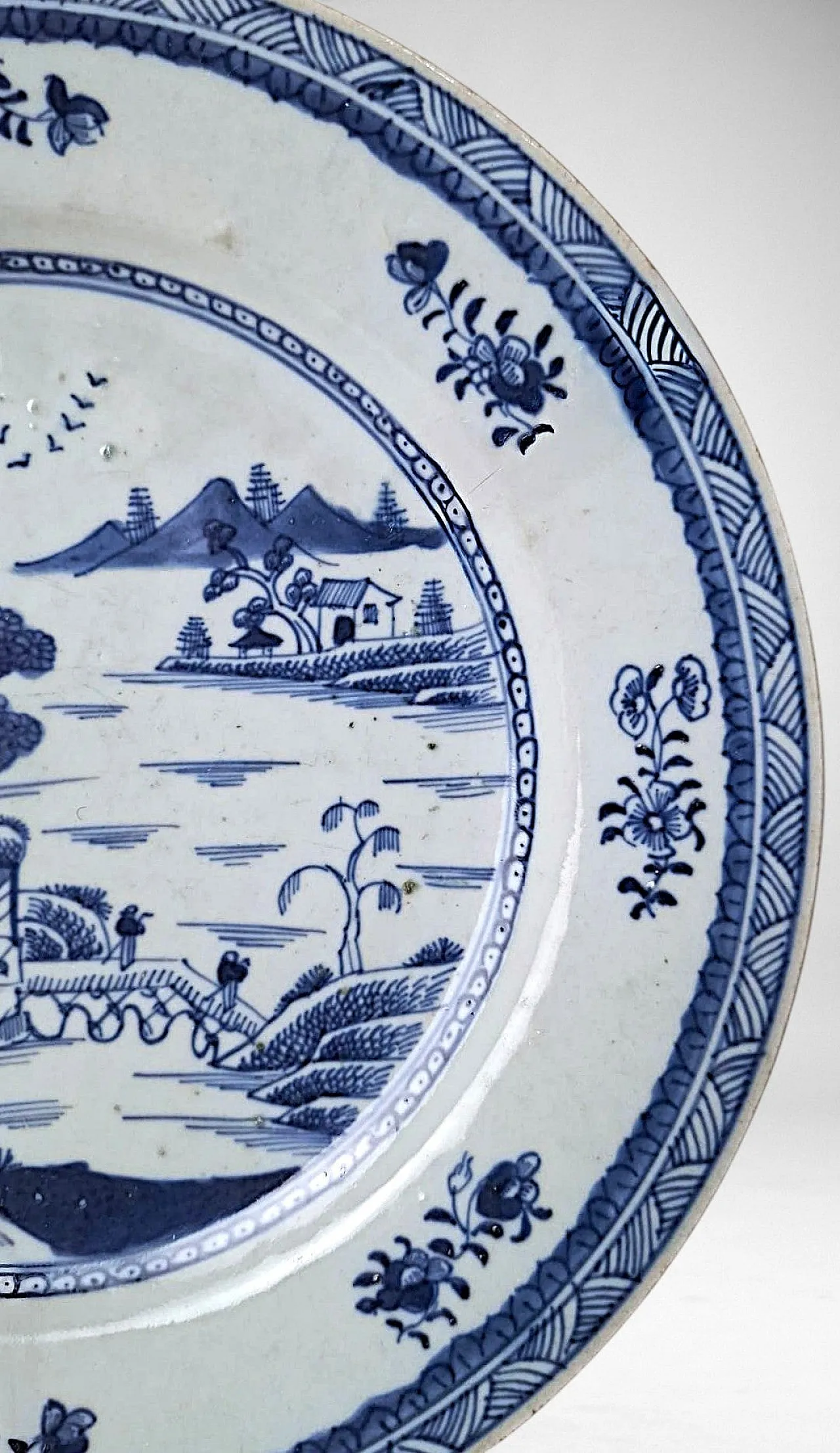
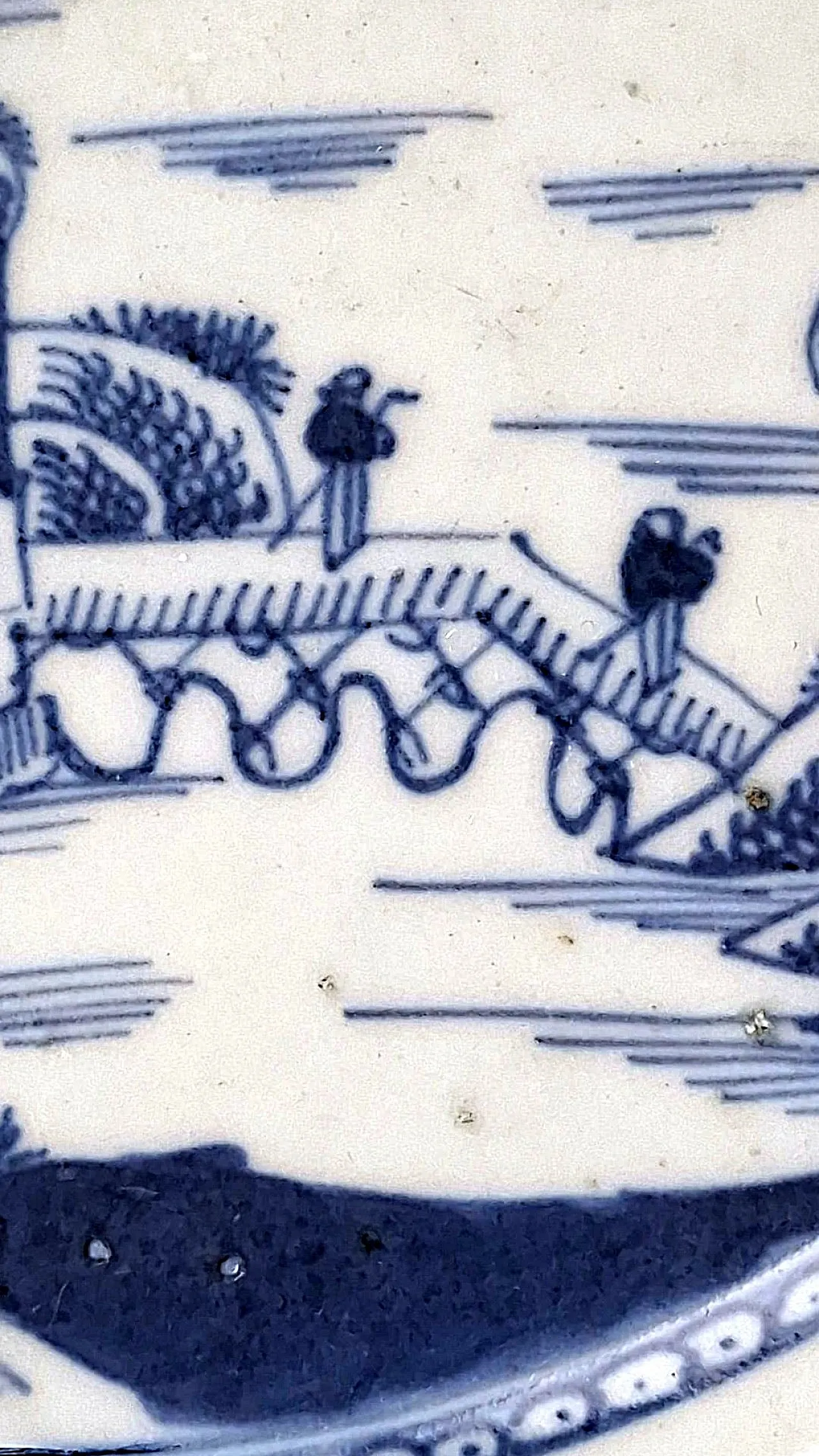
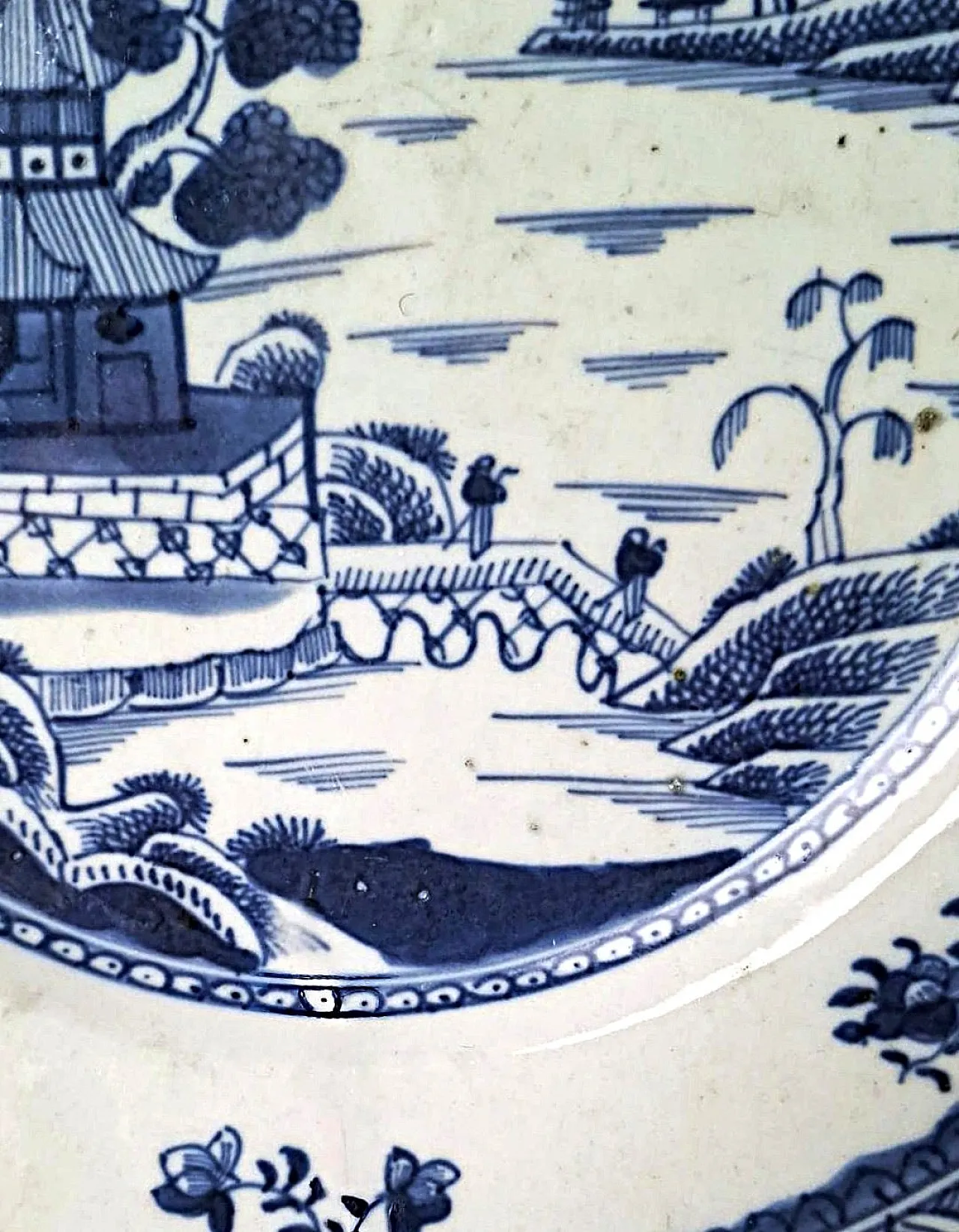
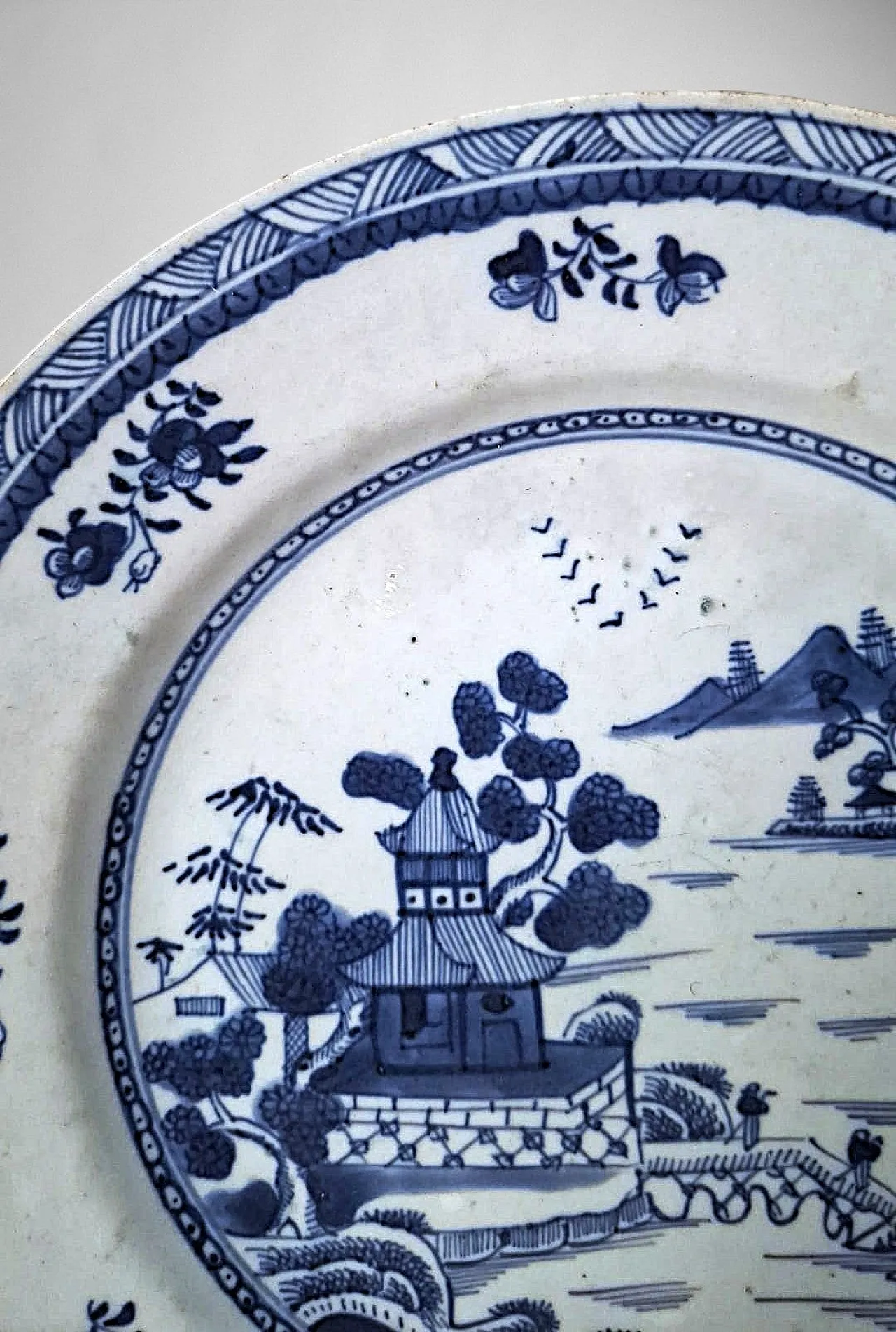
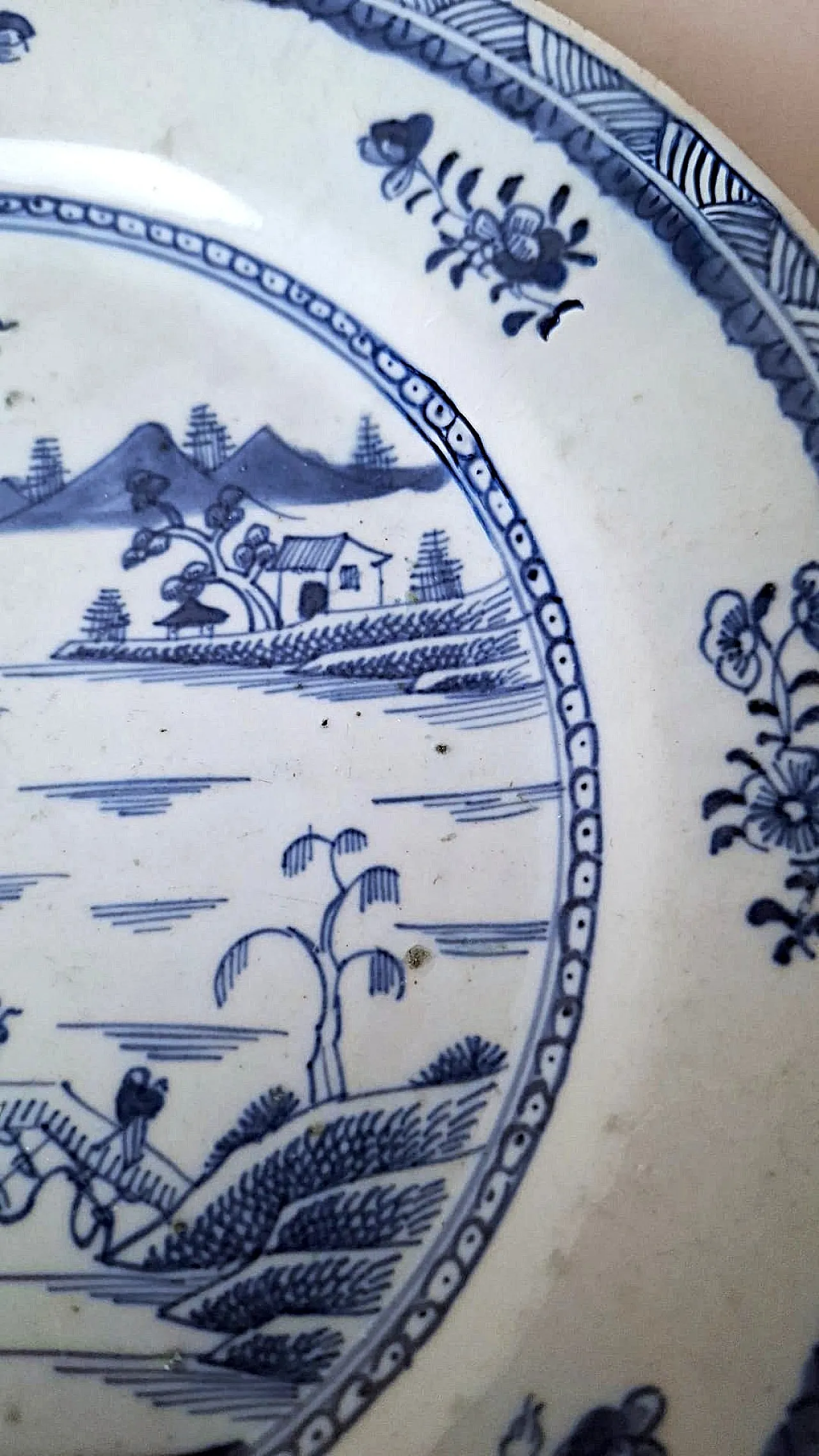
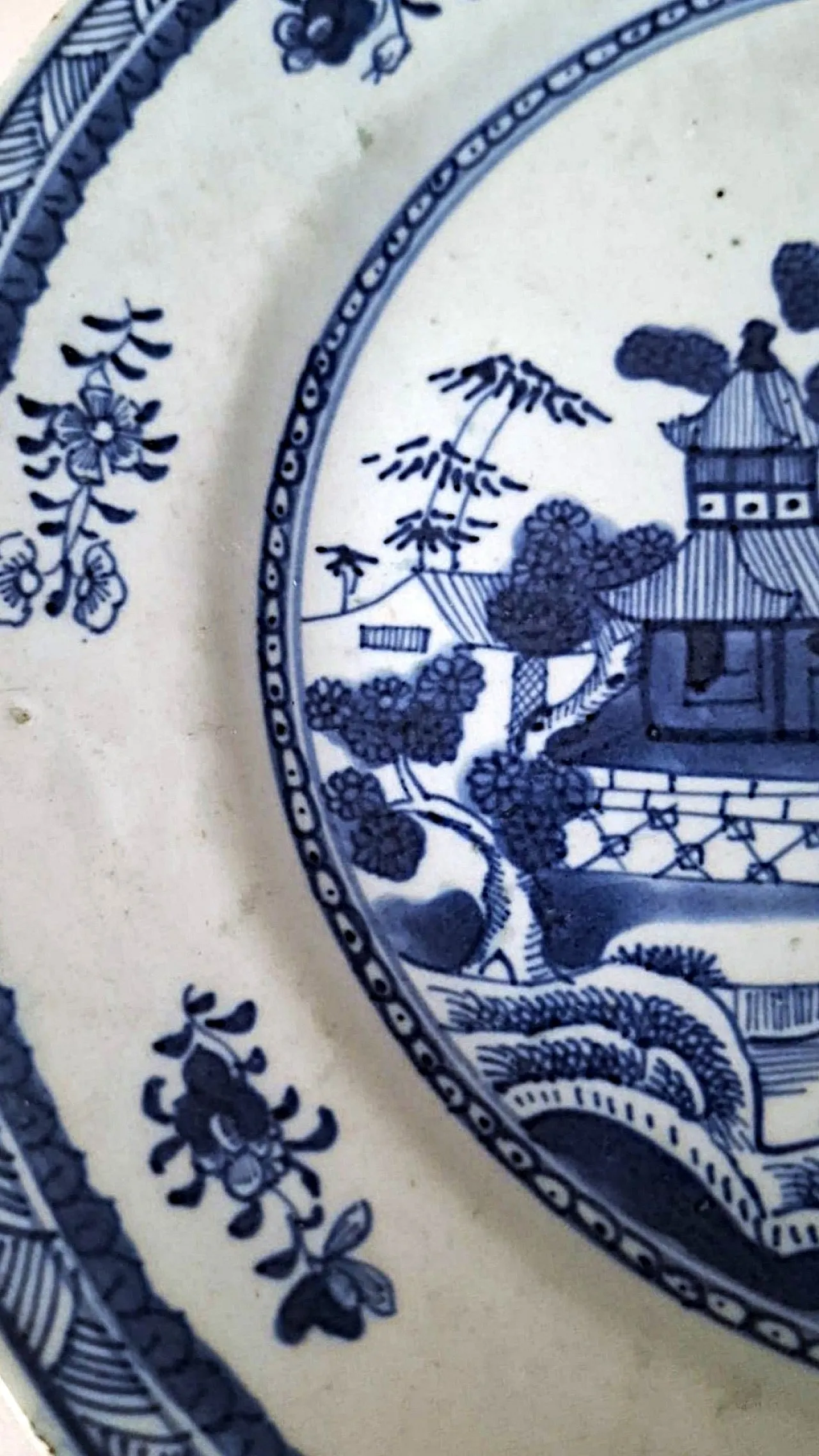
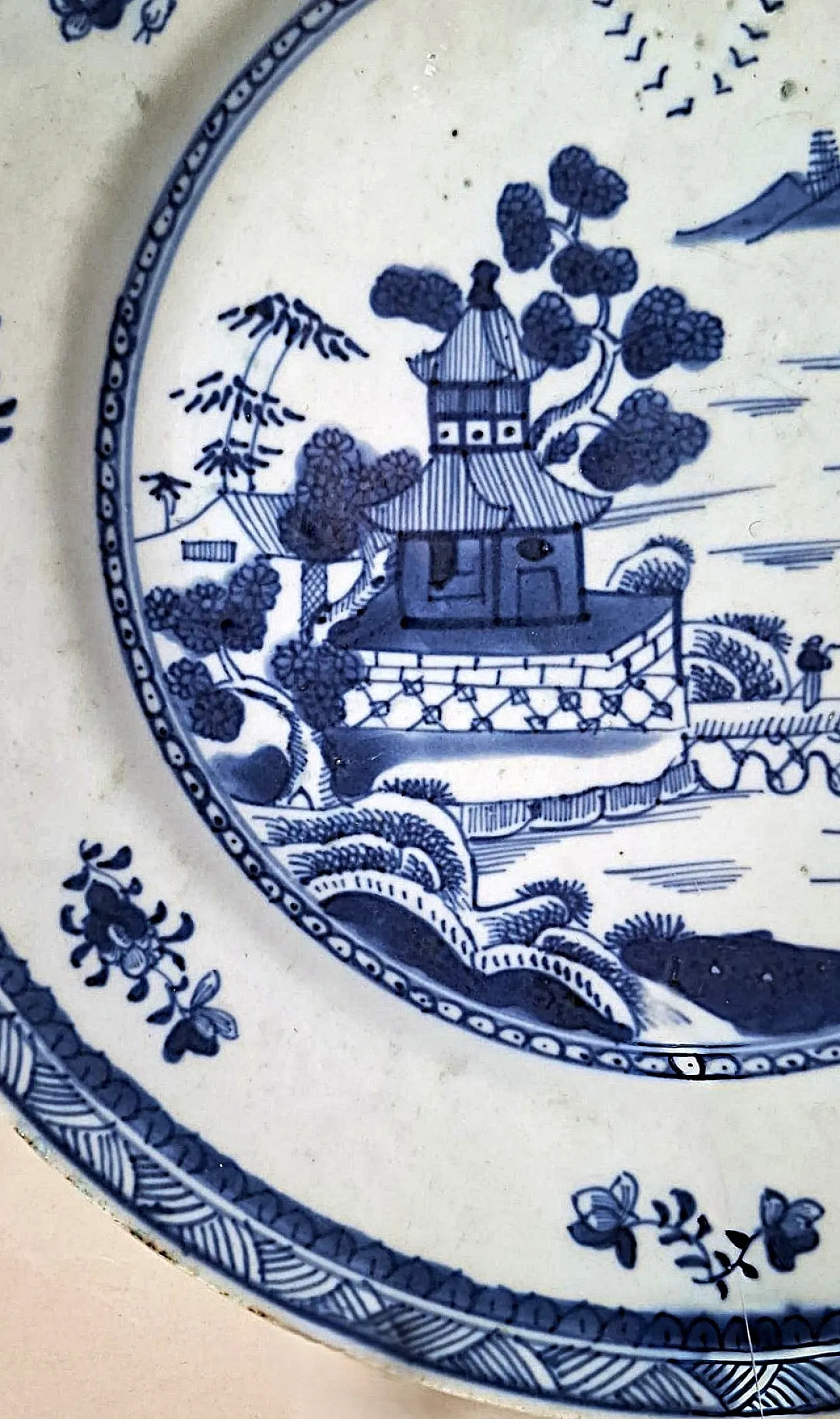
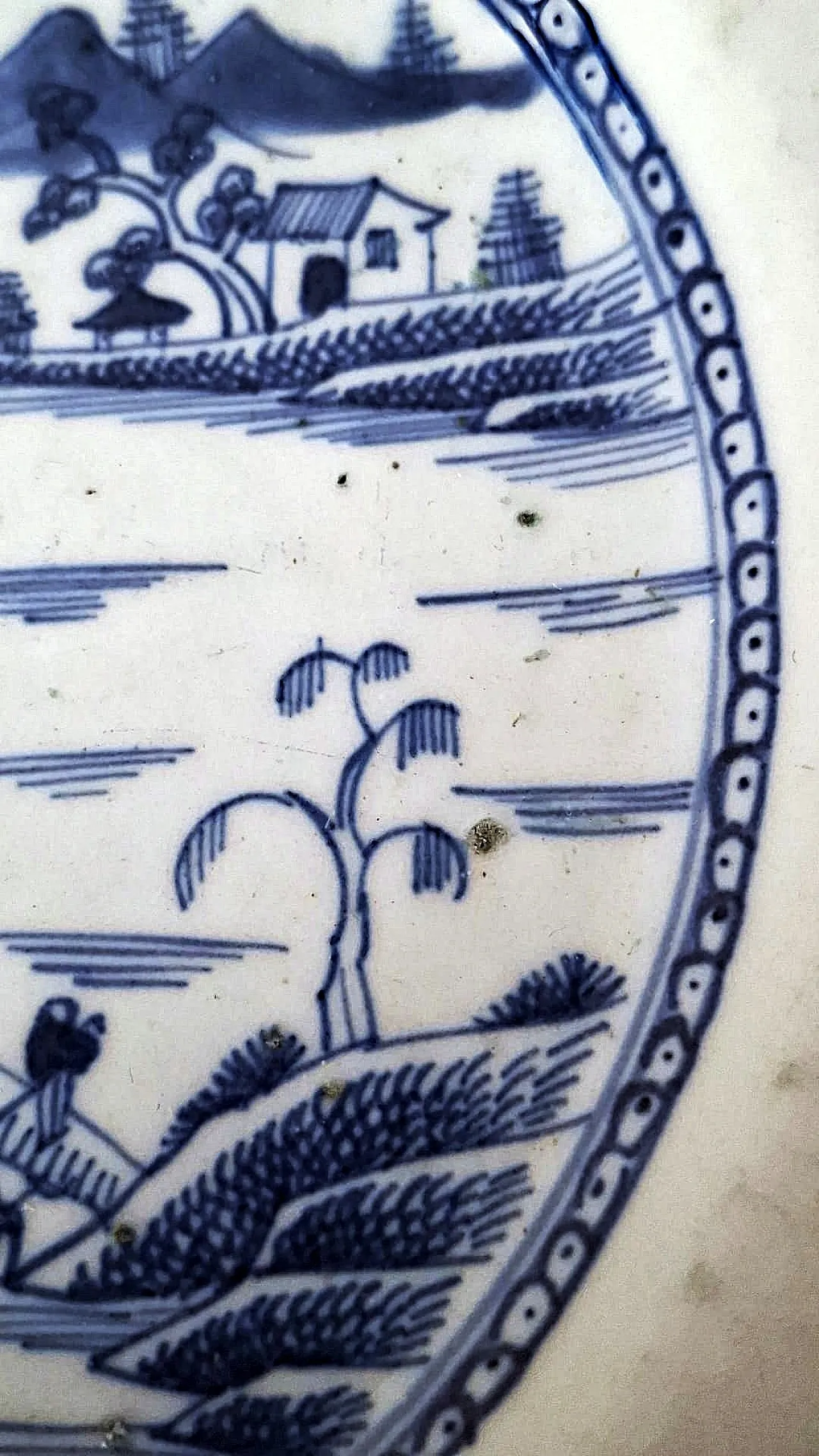
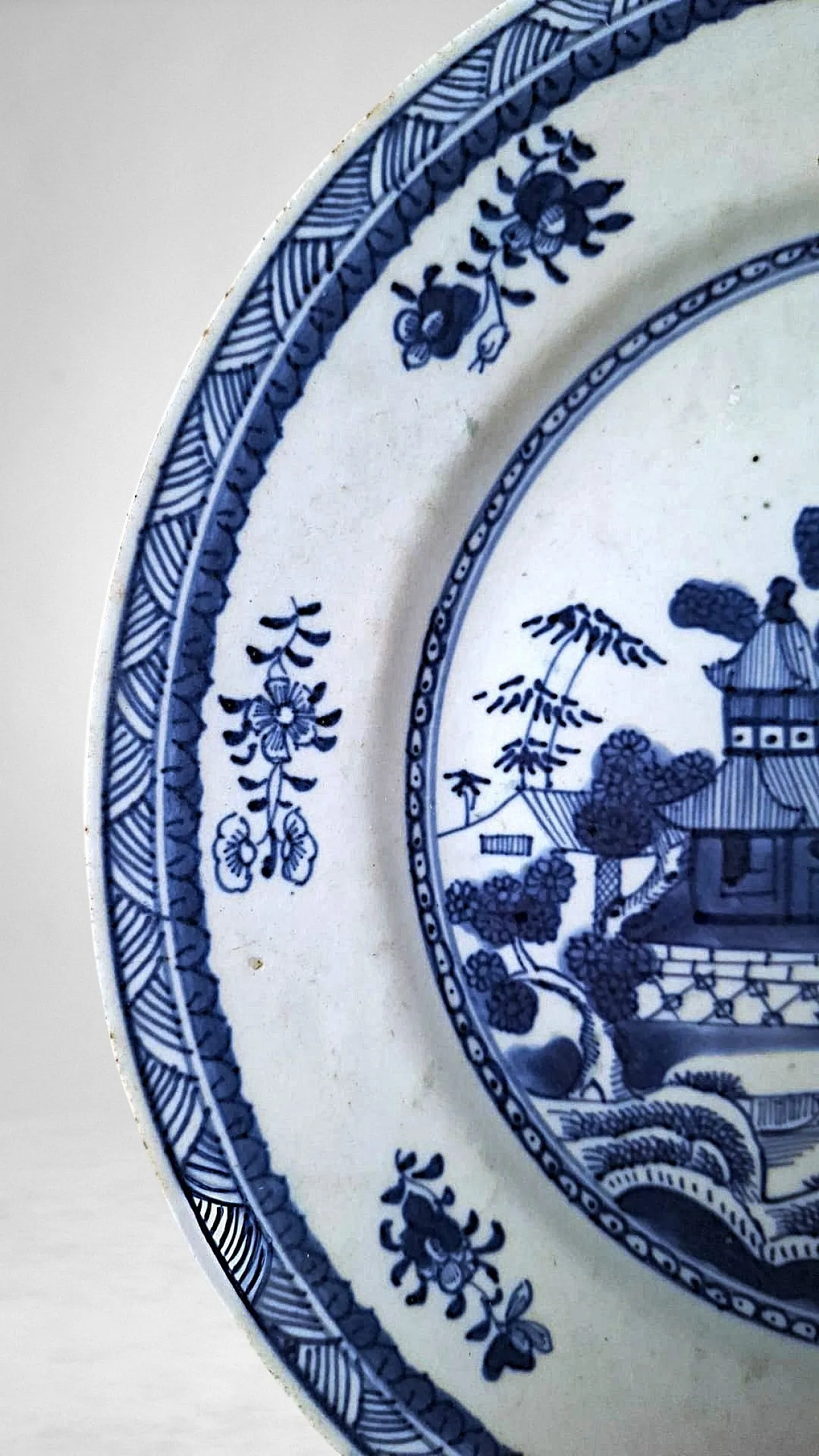
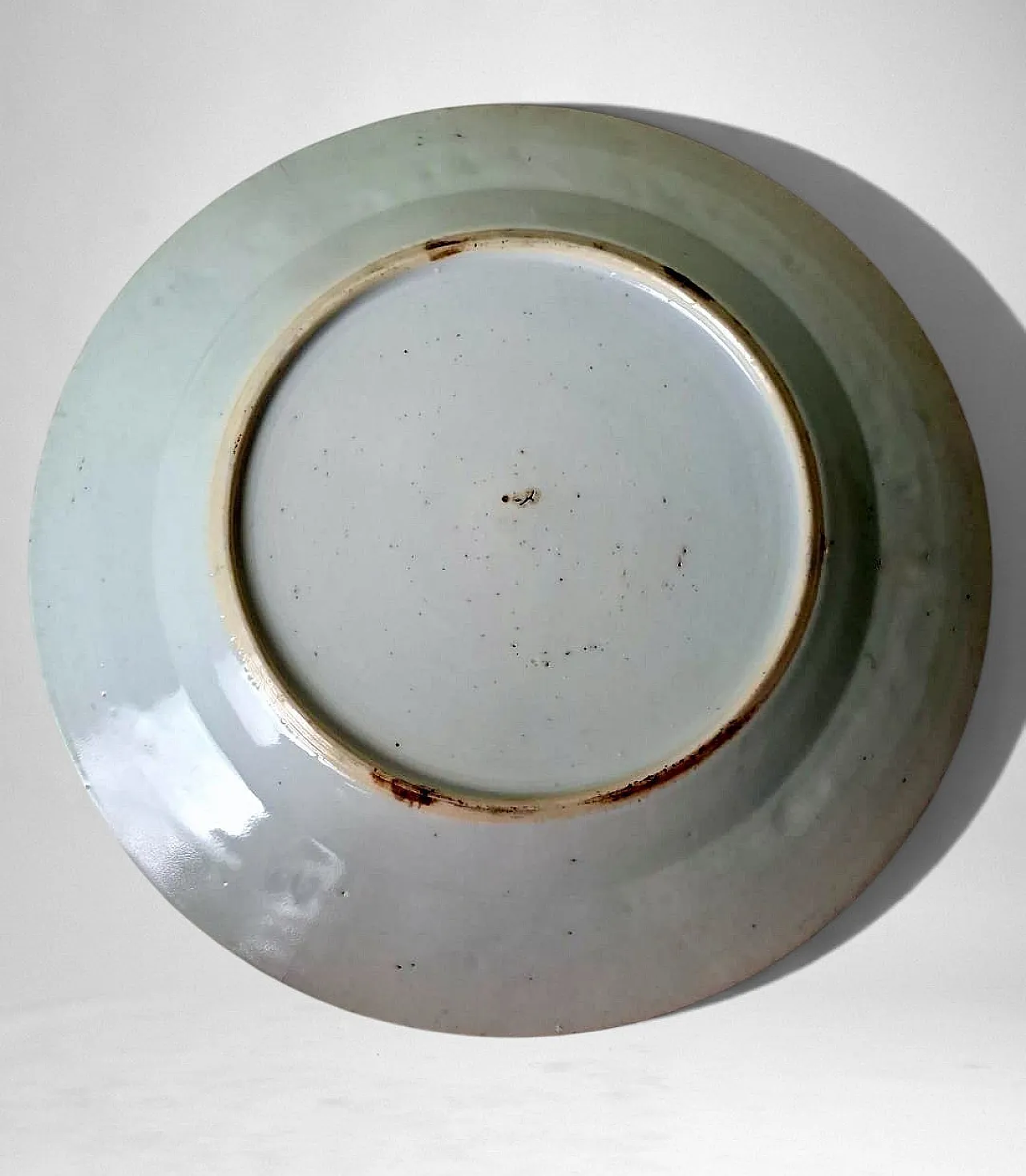
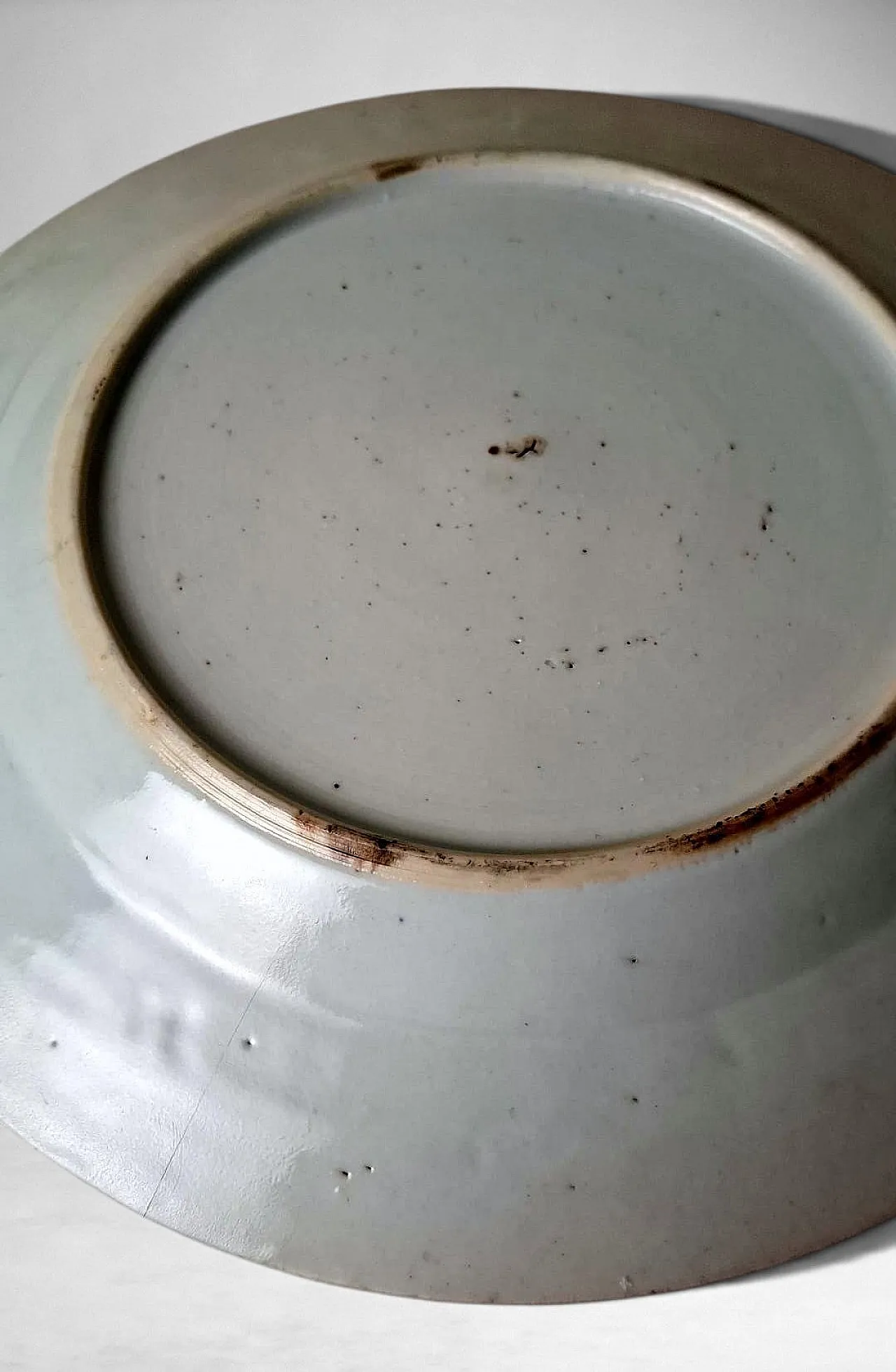
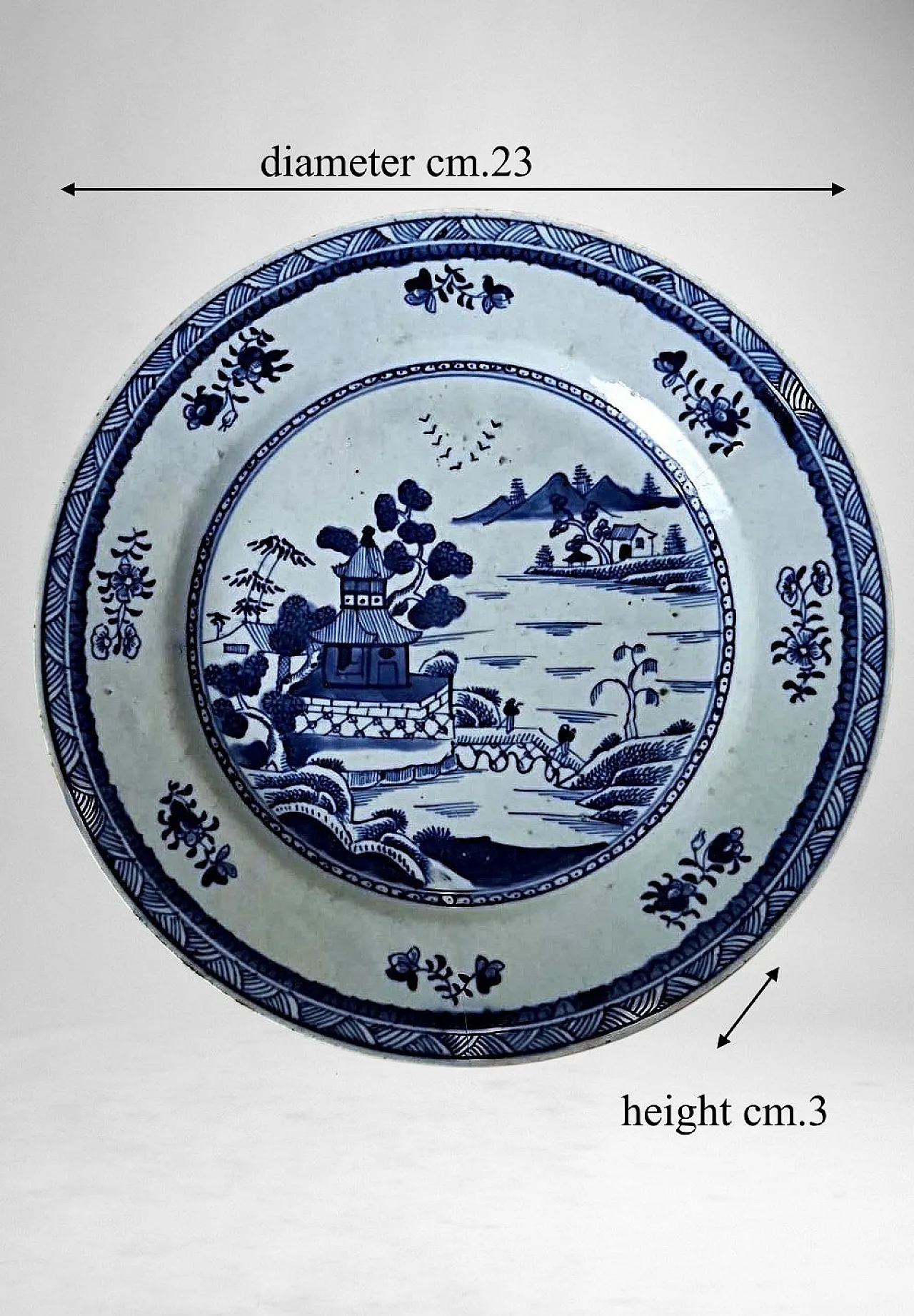
This fine Chinese export porcelain plate was made at the renowned kilns of Jingdezhen during the Qianlong period (1736–1795) of the Qing Dynasty, most likely between circa 1760 and 1775. Produced specifically for the European market, the plate was intended for export through one of the major European East India Companies. The decoration is entirely hand-painted in underglaze cobalt blue and belongs to the celebrated pattern traditionally known as “Nanking” or “Chinese Landscape Pattern.” The composition depicts pagodas, bridges, mountains, willow trees, rocks, and small figures set within a serene and harmonious landscape. This type of decoration was particularly popular from approximately 1740 to 1780 and became one of the most extensively exported Chinese porcelain patterns to Europe during the 18th century. The border is embellished with geometric fretwork motifs alternating with floral reserves and scrolling elements, characteristic of Chinese export porcelain produced for the European market and commonly associated with East India Company trade. This highly successful type of decoration had a lasting influence on Western ceramics and later inspired celebrated English transferware patterns, most notably the Blue Willow design. The absence of a mark on the underside is entirely normal and consistent with Chinese export porcelain of this period. The majority of Chinese porcelain produced for the European market during the 18th century was left unmarked. Imperial reign marks were primarily reserved for porcelain intended for the imperial court, while numerous private kilns and workshops in Jingdezhen did not apply identifying marks to pieces made for export. Consequently, the absence of a mark should not be regarded as a negative factor in assessing the authenticity or dating of this piece. Several features further support its attribution to the 18th century, including the subtly shaped rim, the characteristic tonal quality of the cobalt blue, the landscape composition typical of porcelain produced between approximately 1740 and 1780, and the relatively low foot, a feature frequently encountered on Chinese porcelain of the period. The plate can confidently be attributed to Jingdezhen, Jiangxi Province, a city that had already become the world’s foremost center of porcelain production by the 14th century. Its kilns produced porcelain for Chinese merchants who supplied the European trading companies. The East India Companies themselves did not operate porcelain manufacturing facilities; rather, they functioned primarily as commercial intermediaries, importing large quantities of Asian goods into Europe, with Chinese porcelain being among the most important commodities. The principal European companies involved in the China trade included the British East India Company, founded in England in 1600; the Dutch East India Company (VOC), founded in 1602; the French East India Company; the Danish East India Company; and the Swedish East India Company. The commercial route generally followed this sequence: Jingdezhen kilns → Chinese merchants → Canton (Guangzhou) → East India Company → Europe. It is plausible that this plate reached Europe through the British East India Company, although it cannot be established with certainty, and export through one of the other European East India Companies cannot be ruled out. In any event, the precise commercial route does not affect the historical attribution or collectible significance of the piece. The plate is in good overall condition. The porcelain retains the characteristic material quality and subtle irregularities associated with 18th-century handcrafted production, details that contribute to its authenticity, character, and historical appeal. Measurements: Diameter 23 cm (9.06 in); Height 3 cm (1,18in).





 SILVER Seller in Prato, Italy