

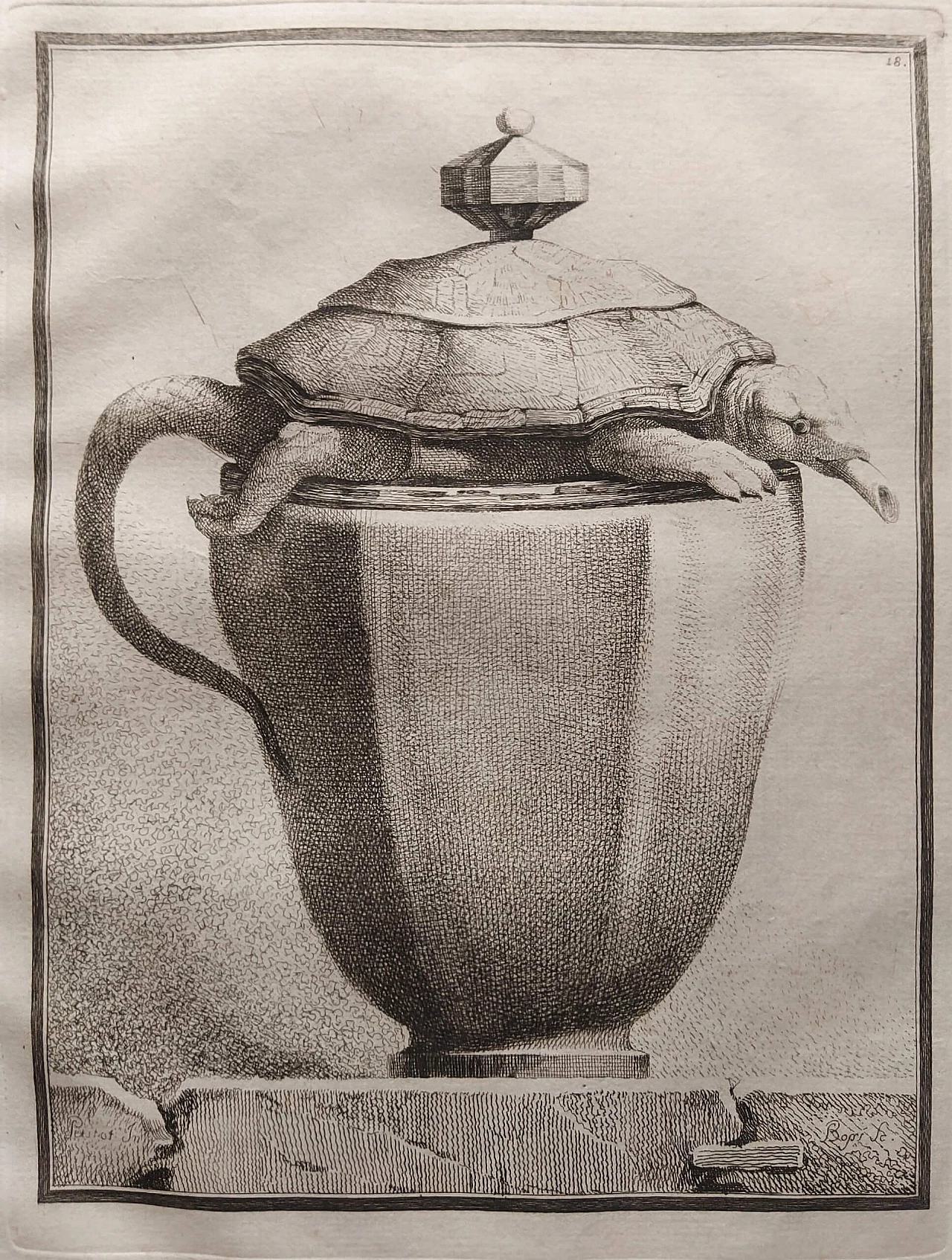
Benigno Bossi, Etching Cioccolatiera con tartaruga, 18th century
.png)
Benigno Bossi (Arcisate 1727 - Parma 1792) was an Italian painter, plasterer and engraver. The son of Pietro Luigi, an important plasterer active in Saxony, he followed his father to Germany and learned from him the art of stucco and was his collaborator. Here Benigno took an interest in engraving, especially etching and aquatinting, and some plates remain dated Dresden 1755. Following the Seven Years' War, Bossi returned to Italy. After a brief stop in Milan we find him active in Parma (1759) as an engraver and decorator. He began a successful collaboration with the French architect Ennemond Alexandre Petitot (Lyon 1727 - Marore 1801) who was called to the French court in Parma in 1753. In 1746 Bossi engraved from his drawings the Suite des vases tirée du cabinet de M. du Tillot and the highly original Mascarade à la Grecque d'après les dessins originaux tirés du cabinet de... le marquis de Felino..., Parma 1771; he made various stuccoes both for the Court and for the architect himself. A painter of neoclassical taste, he left paintings in churches in Parma and Colorno. His activity as an engraver was certainly the one in which Bossi put his mind and soul and reached the highest levels. He drew his subjects mainly from Parmigianino but also from Correggio, Guercino and Londonio; he also engraved many invention plates in which, free from models, his personal character is more evident, his sign is loose and lively. This print is number 18, as indicated by the engraved number in the top right-hand corner, and is taken from Petitot's drawing for the series Suite des vases..., 1746. Petitot was a great master of eighteenth-century ornamentalism and this series featuring vase models of pure ornamental invention is proof of this. In this panel, a large neo-classical vase is depicted with great technical skill on a dilapidated balustrade. By means of delicate and precise chiaroscuro contrasts the light is placed on it and creates structural plays. The upper part is modelled in the shape of a tortoise, the carapace ends in the grip, the pourer comes out of the mouth and the tail is welded to the body of the vase forming a practical handle. On the lower left is engraved "Petitot In" and on the right "Bossi Sc". The result is harmonious and architecture blends with fantasy. Excellent impression. Very good state of preservation. Wide margins beyond the copper plate. Another specimen is kept at Monza, Musei Civici di Monza Bibliography: Le Blanc, I, 1854, p. 483
ID: 11318-1626102158-21398
Time period

 SILVER Seller in Milano, Italy