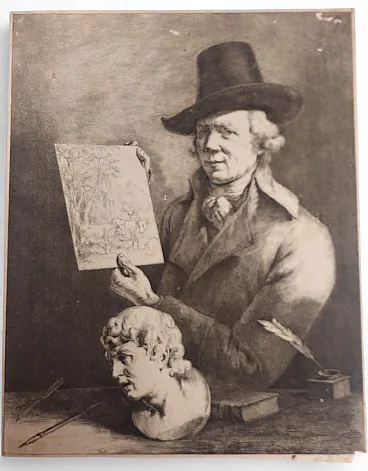


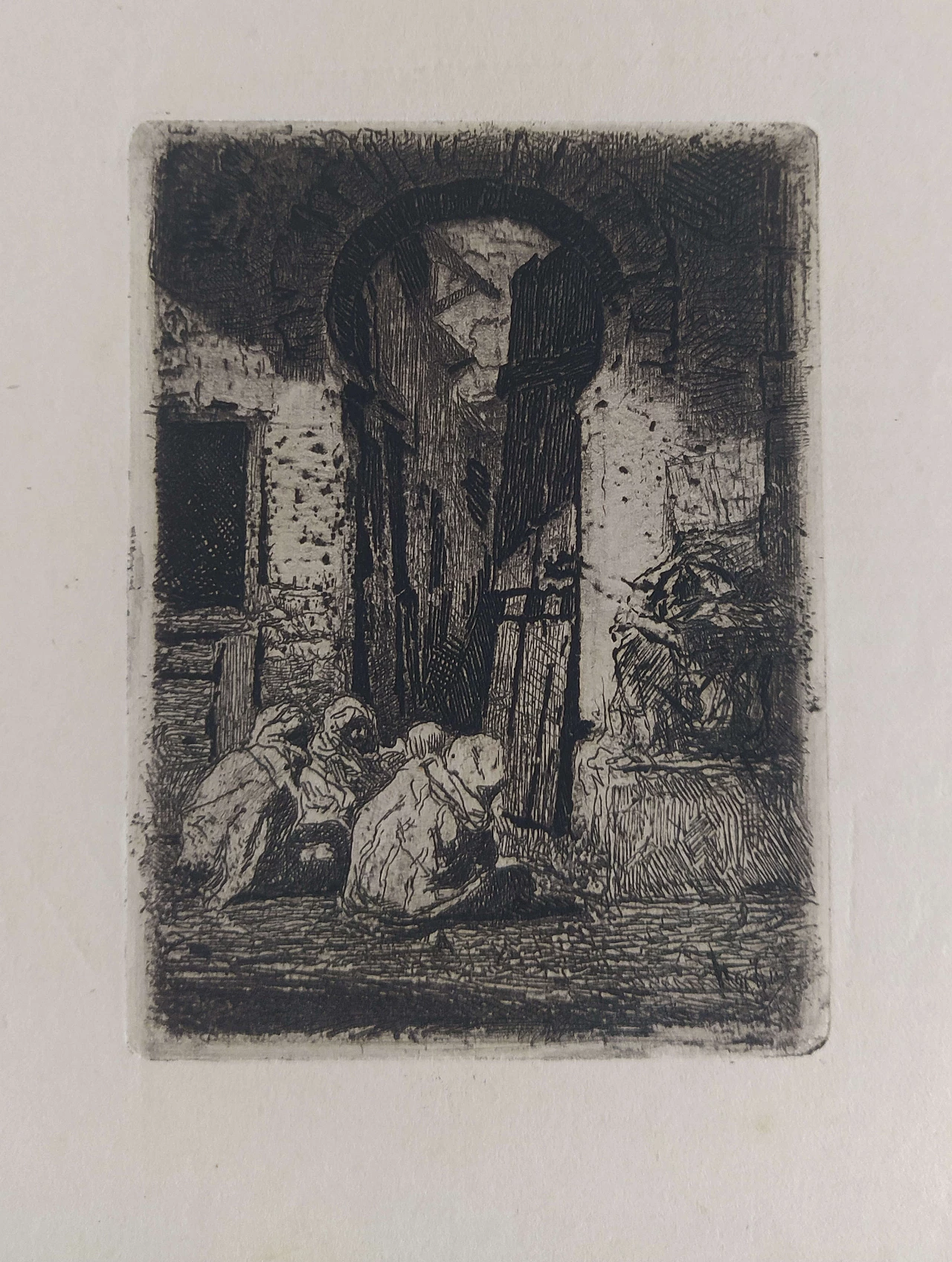
Mariano Fortuny y Marsal, Tanger, etching, 19th century
.png)
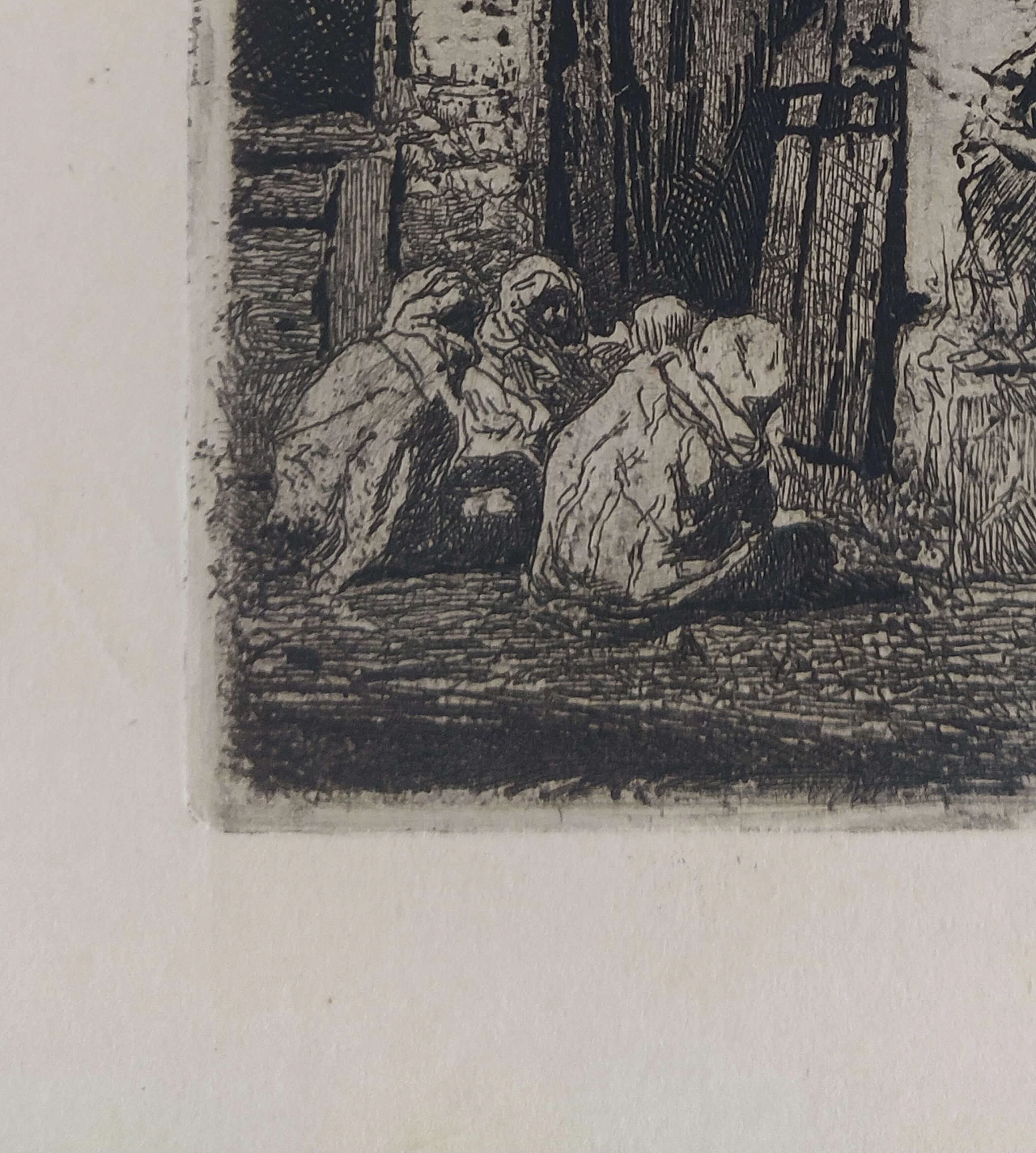
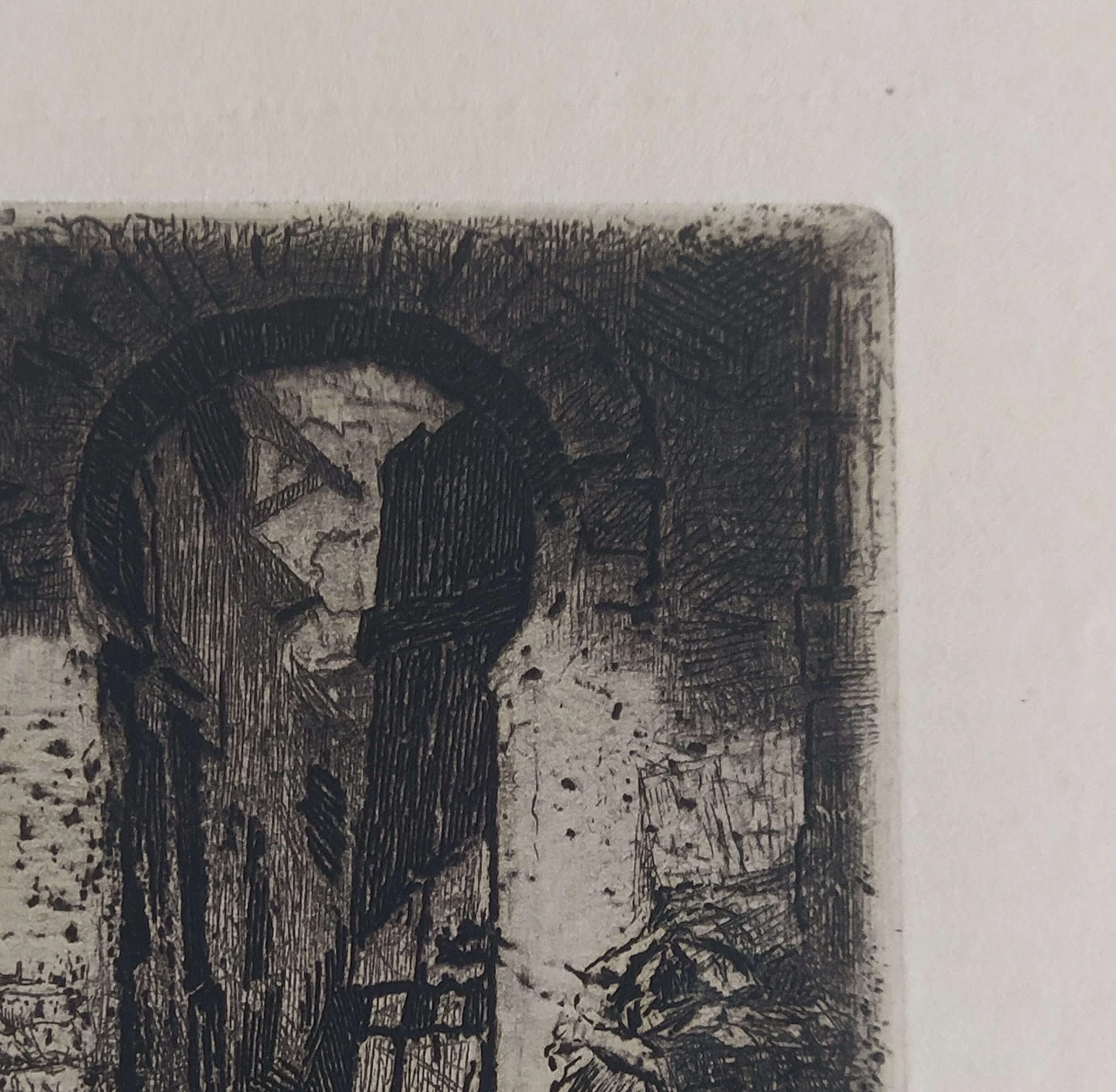
Mariano Fortuny y Marsal (Reus 1838 - Rome 1874) Spanish painter and engraver, collector and antiquarian. Of humble origins, he was orphaned at an early age but was taught by his grandfather who modelled terracotta figures. He tried his luck by transferring to the Escuela de Bellas Artes in Barcelona in 1853 and thanks to his artistic talents he won the Rome Prize in 1857, which allowed him to continue his studies in Rome. Here he arrived in 1858 and began to frequent Spanish artists, was influenced by the works of Domenico Morelli and became friends with the painter Attilio Simonetti (1843-1925) who led him to the discovery of Neapolitan artists. Simonetti became his pupil and shared a studio with him in Rome. With the outbreak of the Spanish-Moroccan War, Fortuny was called to Morocco to depict and immortalise the most salient moments of the fighting between 1860 and 1861. During this stay, Fortuny took inspiration for many of his paintings, either by depicting picturesque views or types with a documentary eye, or by reworking in the studio in a refined and decadent key certain other more exotic subjects that adhered to the Orientalist taste that was all the rage at the time. In 1862, he returned to Italy again, travelling between Florence and Naples where he met his painter friend Domenico Morelli, before returning to Rome and opening a new studio in Via della Purificazione. An artist perennially travelling between Italy, Spain and London and Paris, where he became the companion of the best artists of his time, he was appreciated and sought after internationally for his clear and cosmopolitan taste. He married Cecilia de Madrazo y Garreta in 1867, daughter of the Director of the Prado and granddaughter of a well-known Spanish painter. Fortuny, the most international and cosmopolitan of 19th century Spanish painters, devoted himself to engraving by proposing original Spanish or Orientalist subjects. His work betrays a profound knowledge of past masters such as Goya and Rembrandt. Fortuny employs a minute mark that is characterised, in most of the plates, by the search for violent light effects on shaded environments. The plates, like the author's own life, were subjected to continuous rehashes that are today well reconstructed in the catalogue raisonné based on the study of specimens in public museums. It is therefore possible today to clearly identify the various print runs; proofs, contemporary and posthumous runs up to 1916, as well as the various papers used by the author. In this print, number 17 in the catalogue, we see a view of the city of Tangier. Fortuny seems to be more interested in the architectural construction than in the animated scene itself, and skilfully creates an interplay of light and dark areas around an open arch that occupies the central part of the composition. In the foreground there are three figures sitting on the ground, Arabs wrapped in their caftans, they are anonymous figures gathered in a group to create a contrasting stain. Behind them, a keyhole-shaped arch opens, as if to invite the viewer to 'spy' beyond. Leaning against the arch is an old, open, now unserviceable wooden door, which leaves the viewer's gaze deep into a narrow maze of buildings in the Arab city. Excellent impression, strong chiaroscuro contrasts on ivory laid paper with watermark fragment 'Van Elde'. Condition: II/II. Specimen belonging to the 1st printing run (1875) letter-forward, without number, title and signature stamp. Very good state of preservation. Wide margins beyond the strike of the copper. Bibliography: Vives i Pique/Cuenca Garcia, Mariano Fortuny Marsal/Mariano Fortuny Madrazo, Electa, 1994, no. 17, p. 131.
ID: 11318-1700586379-77046
Time period

 SILVER Seller in Milano, Italy