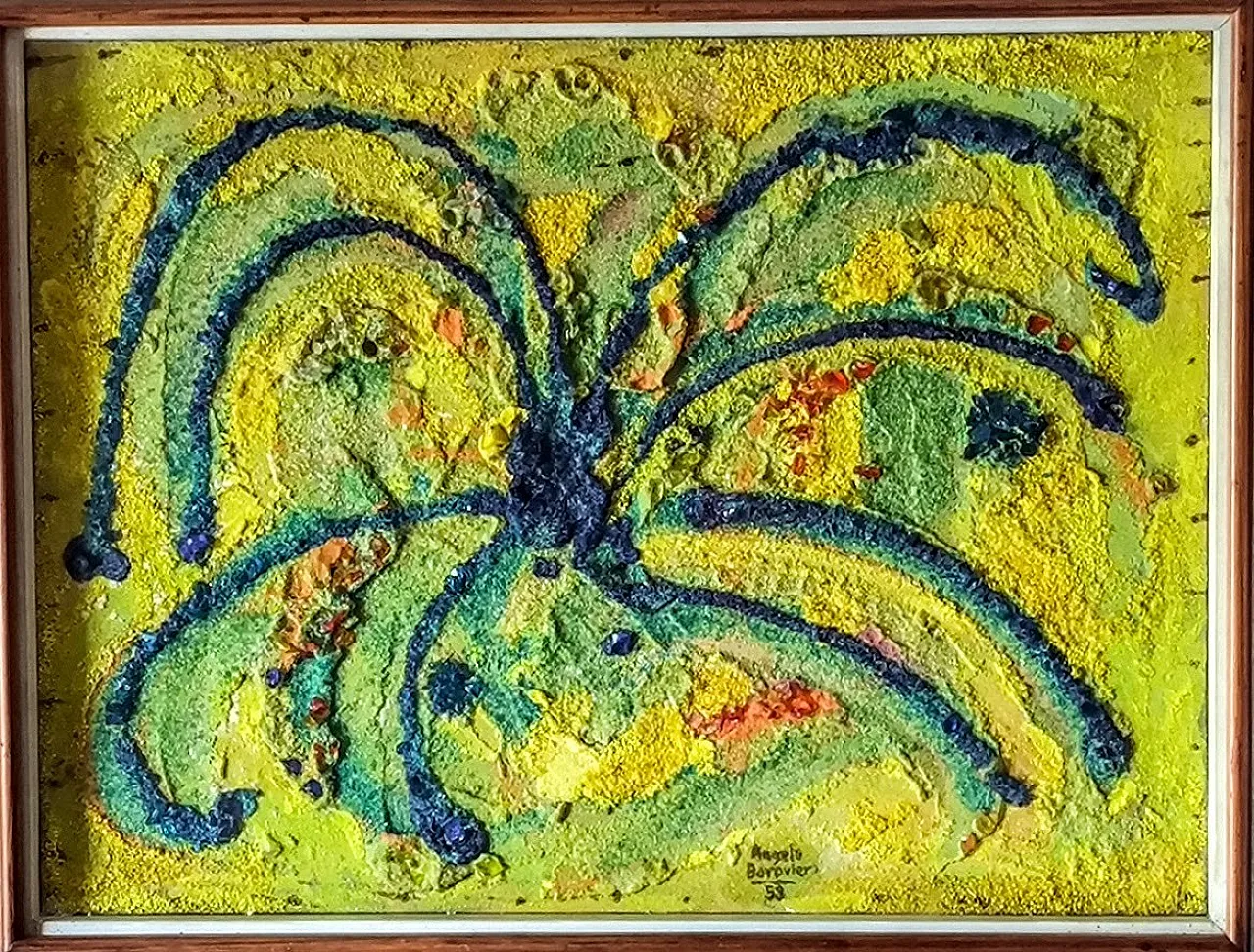
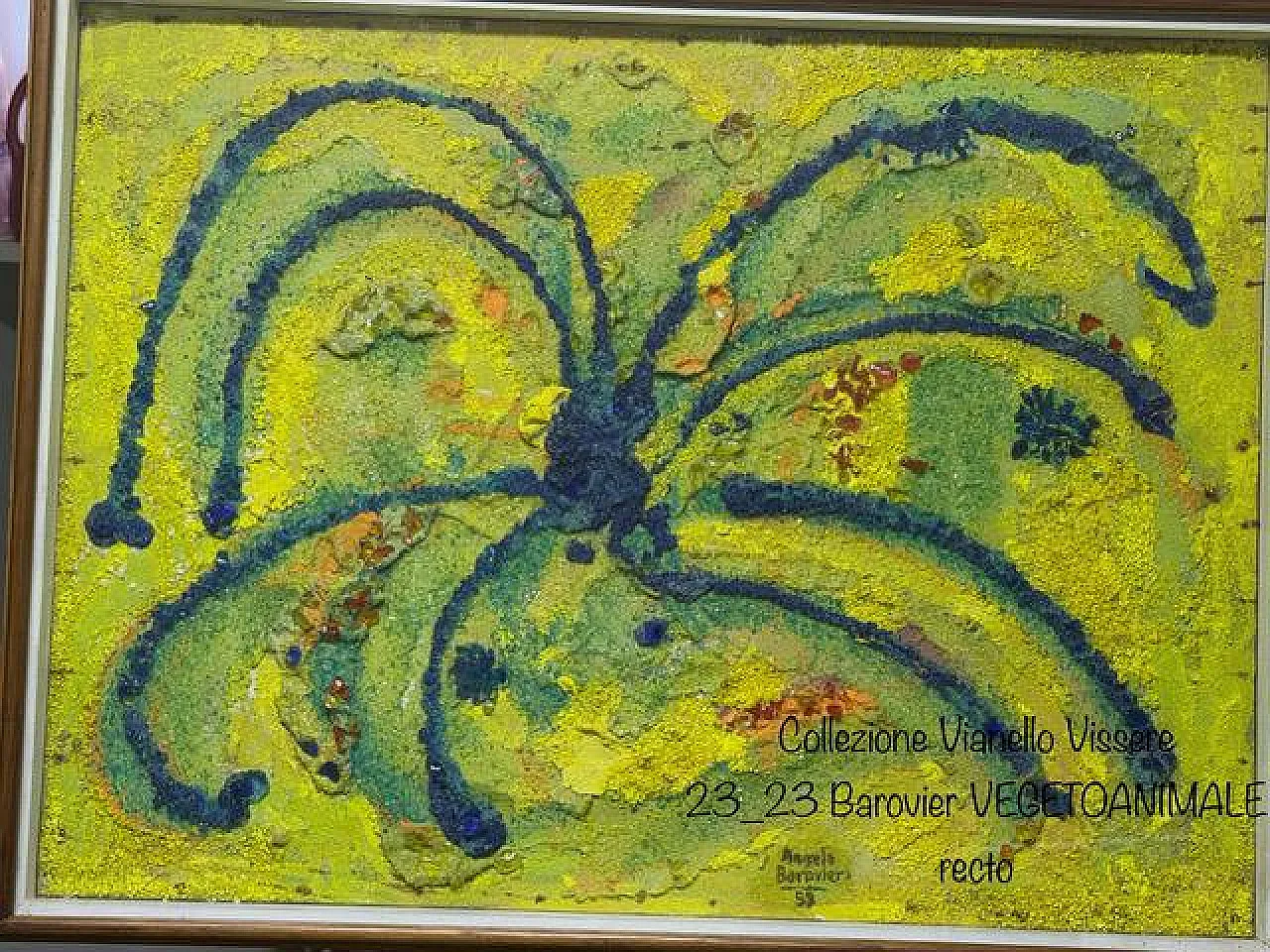
WORK 1: VEGETOANIMALE
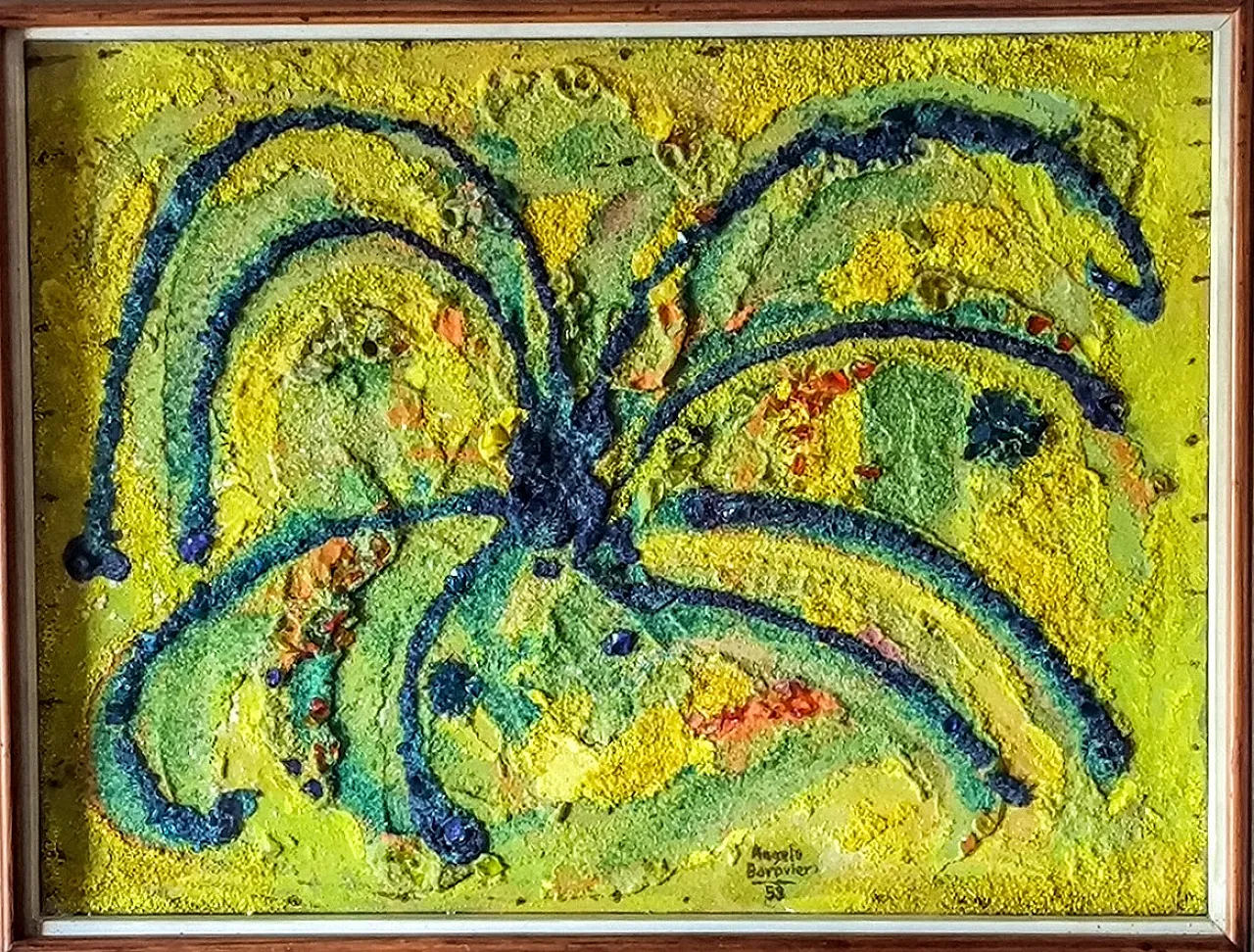
• Artist: Angelo Barovier (Venice, 1927 – Murano, 2008) – Renowned Murano designer and artist, known for his experimentation with materials.
• Title of the work: VEGETOANIMALE
• Signature and Dating:
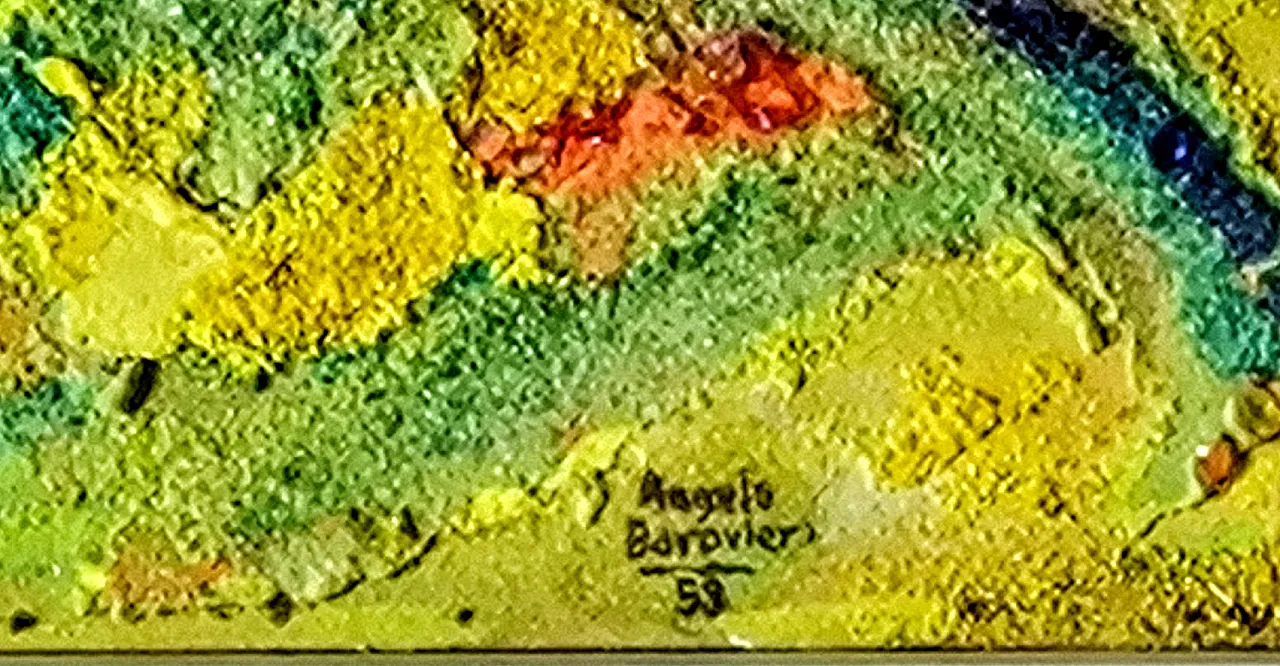
• On the front (recto): Signed and dated lower center "Angelo Barovier 59".
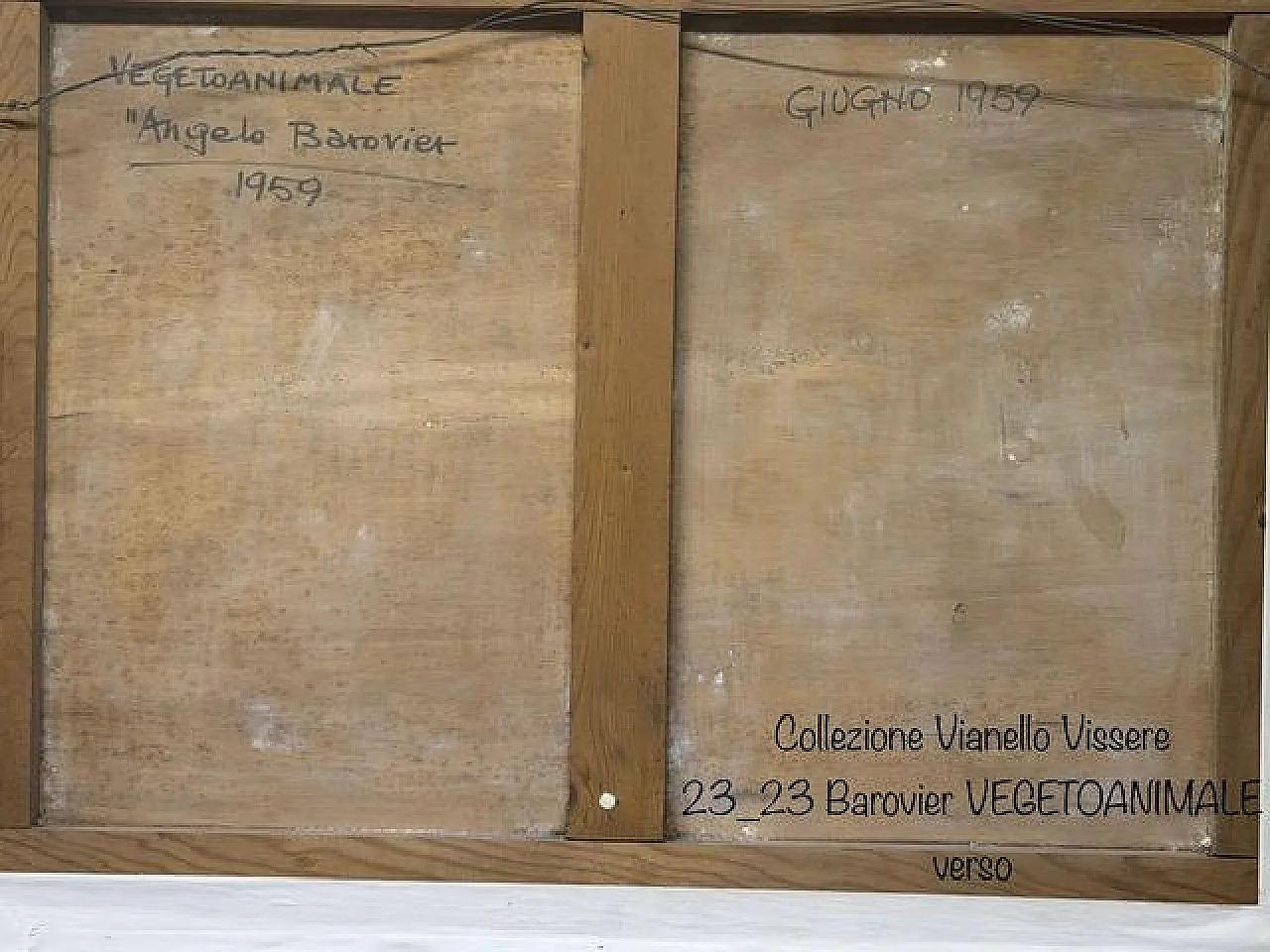
• On the back (verso): Titled, signed, and dated by hand on the panel "VEGETOANIMALE / "Angelo Barovier" / 1959" on the left; completion date inscribed "JUNE 1959" on the right.
• Technique and Materials: Glass painting (an exclusive and original avant-garde technique developed by the artist, performed by applying and layering glass powders, polychrome glass granules of varying grain sizes, and projecting enamels on the panel).
• Dimensions: 85 x 65 cm
• Period: June 1959 (Informal period, full experimentation with glass and materials).
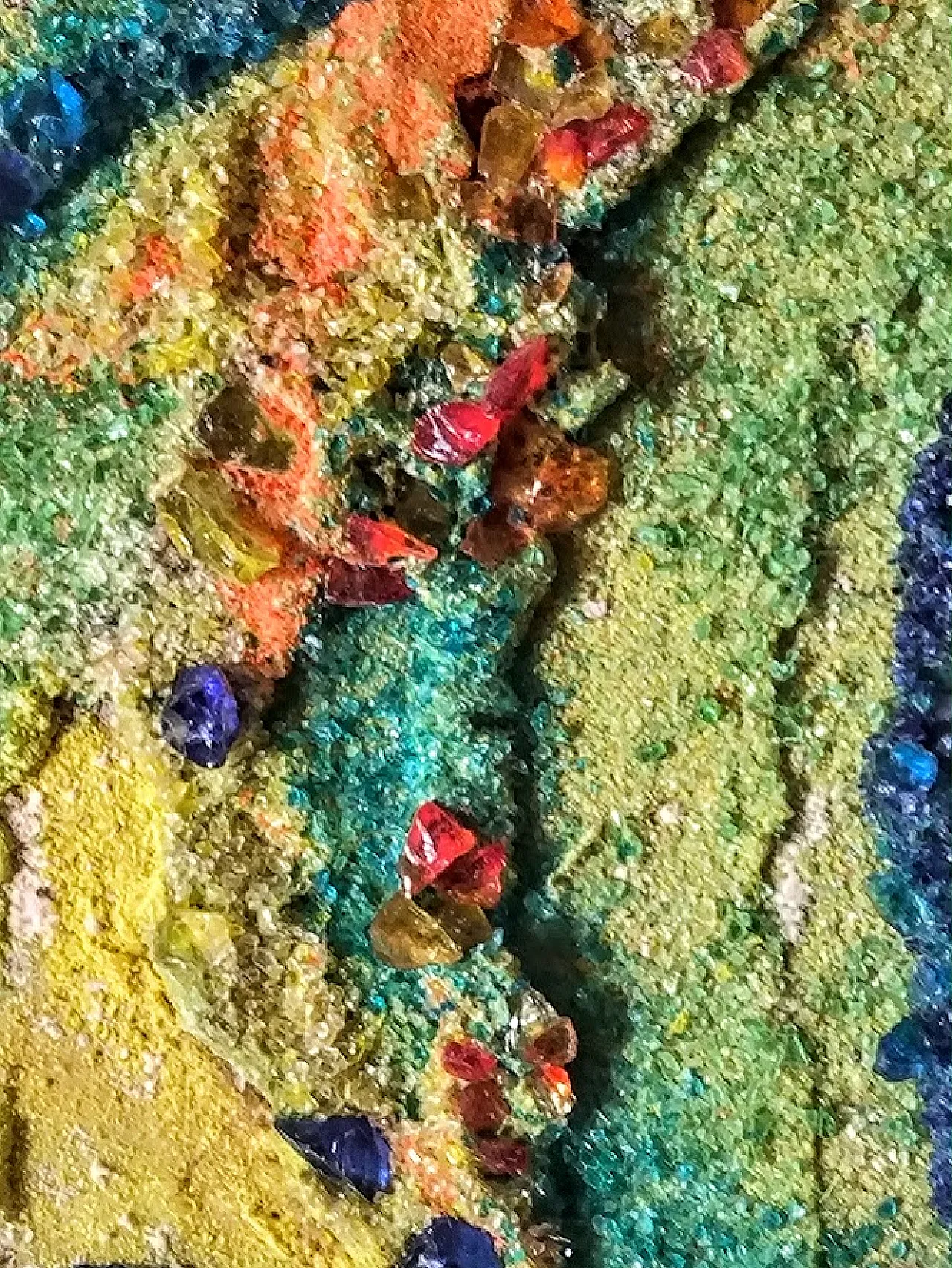
• Description of the Subject: Abstract-informal composition with strong plastic relief. A central, branched organic structure in dark cobalt blue is inserted against a background saturated with acid yellows and greens with a rough texture, evoking hybrid natural forms, halfway between elements of marine biology, flora, and primordial cellular structures.
• Historical Provenance: Vianello Vissere Collection.
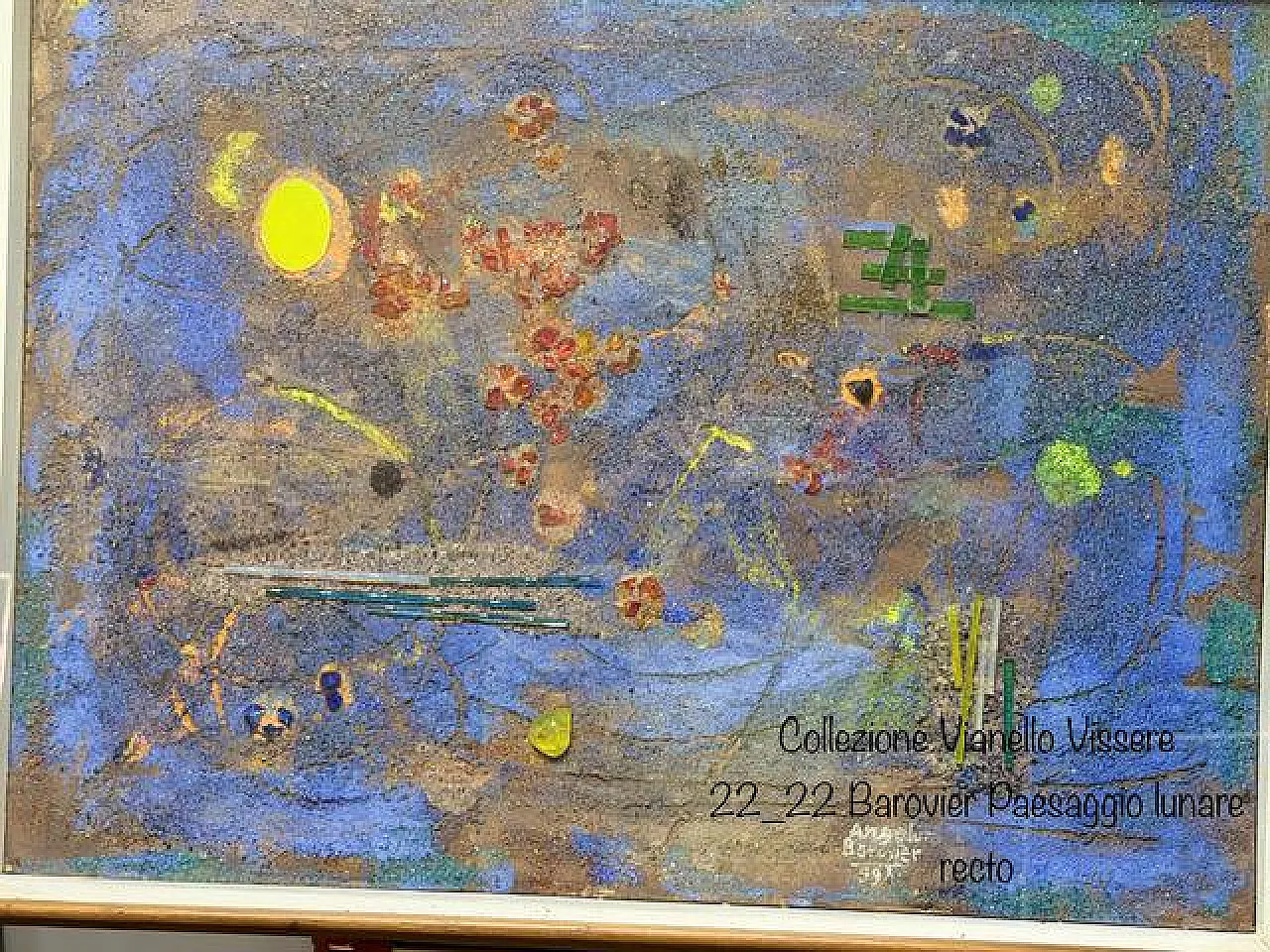
WORK 2: MOONLANDSCAPE
• Artist: Angelo Barovier (Venice, 1927 – Murano, 2008).
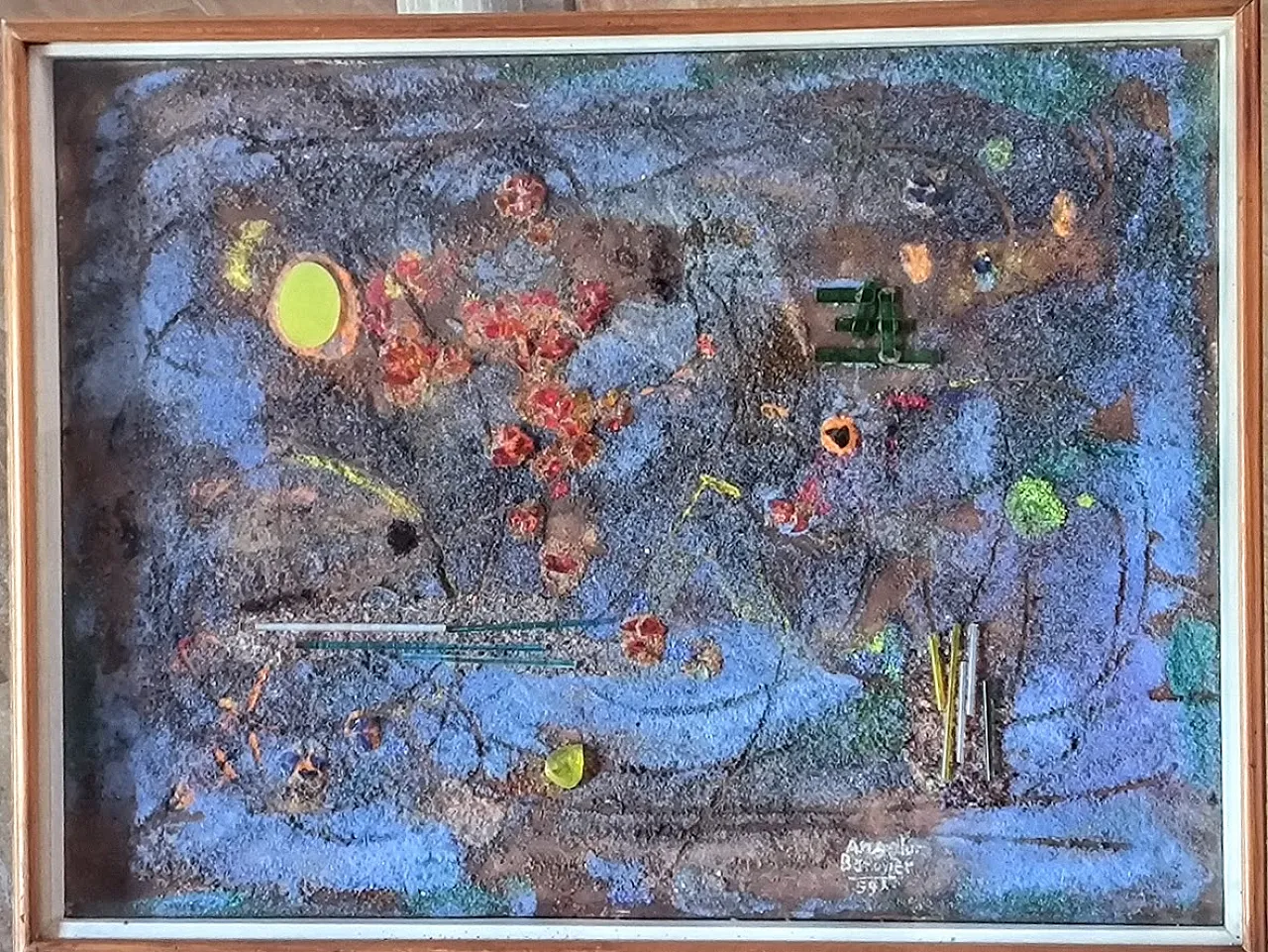
• Title of the Work: Lunar Landscape
• Signature and Date:
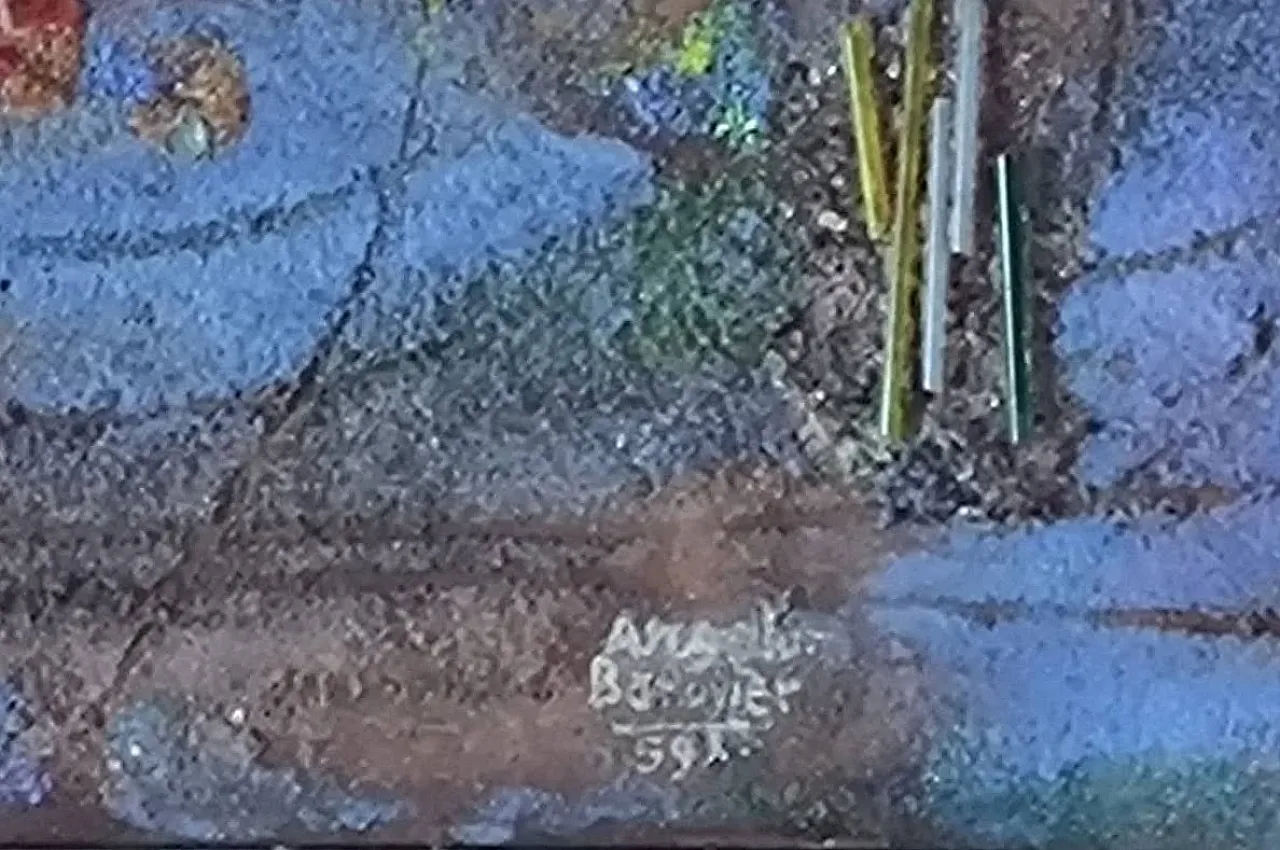
• On the front (recto): Signed and dated lower center "Angelo Barovier 1959".
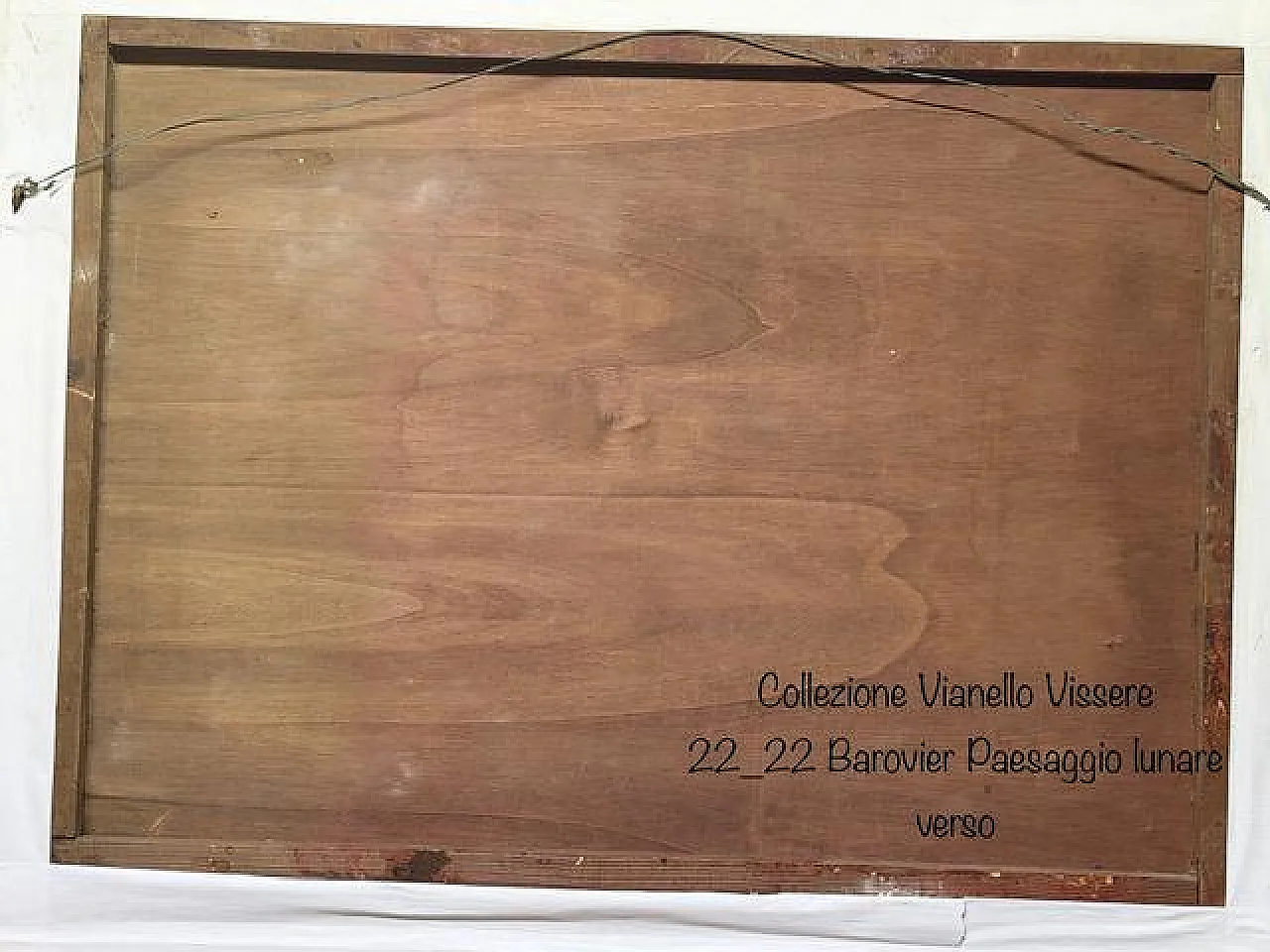
• On the back (verso): Surface of the wooden support frame, without visible autograph inscriptions on the panel (full-panel structure).
• Technique and Materials: Glass painting (application and cold fusion of glass powders, crushed crystals, geometric glass tesserae inserts, and Murano glass rods applied in relief on a treated panel).
• Dimensions: 85 x 65 cm
• Period: 1959
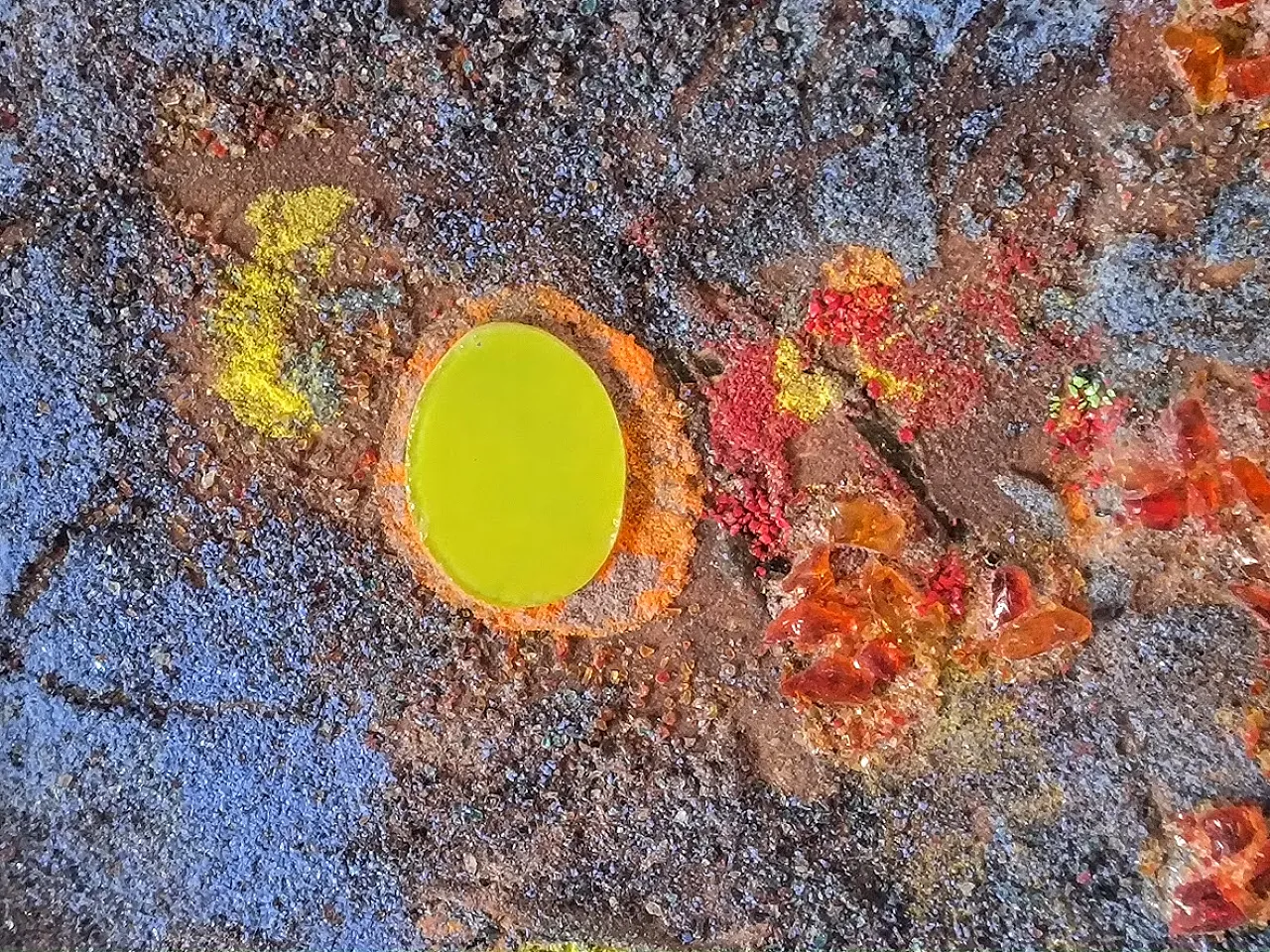
• Subject Description: Cosmic and abstract representation inspired by deep space. The textured midnight blue and powder blue background is dotted with mineral and sandy intrusions in brown and ochre tones. Three-dimensional applied glass elements stand out: a raised circular yellow disc on the left symbolizing a celestial body (moon/planet), clusters of parallel cylindrical glass rods (green and yellow) in the central and lower right sections, and scattered crystalline fragments that refract the light.
• Historical Provenance: Vianello Vissere Collection
--- The Rare Paintings on Fused Glass Plates from the 1950s
Art Mark "Angelo Barovier" – Artistic Direction Ercole Barovier
In the panorama of 20th-century Murano glass, the paintings on plate signed "Angelo Barovier" represent an elite, sophisticated, and highly intellectual chapter. To fully understand the genesis of these works, it is necessary to contextualize the artistic structure of the famous Barovier & Toso factory during the post-World War II period.
In the 1950s, the glassworks operated under the undisputed genius and artistic direction of Ercole Barovier (1889-1972), an innovative mind capable of bringing Venetian glass into the modern age. The "Angelo Barovier" signature affixed to these spectacular plates does not refer to the legendary fifteenth-century ancestor of the same name (the inventor of Murano crystal), but rather to an exclusive art mark, a dynastic and commercial tribute that the factory chose to adopt to mark its most prestigious pictorial and monumental production.
These pieces were not conceived as serial catalog items, but as true manifestos of the union between the chemistry of glass materials and avant-garde pictorial expressionism, conceived directly for major exhibitions, art galleries, or commissioned by enlightened mid-century interior designers.
- These two works are radically different from common decorative glass paintings. They are not, in fact, simple cold-painted works or surface enamels reworked in a muffle furnace. The production process for these plates is a masterful example of highly complex hot painting technique:
The artist began with a thick sheet of transparent or opaque glass, used as a blank canvas.
The surface was layered with fragments of polychrome glass, granules of varying grain sizes, metal oxide powders (to achieve the vibrant colors typical of the 1950s), and preformed glass tesserae. The resulting piece was then placed in a high-fired kiln. During firing, the different elements structurally fused with the support plate, without losing their formal identity but interpenetrating at the molecular level.
The plate then underwent a lengthy and delicate annealing process in tempering kilns to eliminate the material's internal tensions. The aesthetic result is astonishing and unique: the vitreous pigment acquires a sculptural thickness, a material bas-relief, and a three-dimensional light refraction capacity that is absolutely impossible to replicate on a normal canvas or panel. Light not only illuminates the surface, but also passes through the work, modifying its chromatic perception depending on the angle of observation.
Absolute Rarity on the Market
While Ercole Barovier's signature vases (such as the famous Barbarici, Zebrati, Oriente, or Saturnei series) appear relatively frequently at international auctions and on the antiques market, the independent pictorial plates from the 1950s are extremely rare. There are several reasons for this scarcity on the collector's market:
Most of the kiln-produced plates were designed to be directly integrated into the interior architecture of the time (screen inserts, monumental doors, partition walls, or luxury furniture). Many of them were destroyed during building renovations or remained unsigned because they were conceived as structural elements. The fact that these two specific works bear the original signature "Angelo Barovier" and are dated contemporaneously unequivocally attests to their status as "independent works of art." They were conceived from the outset as exhibition paintings, a factor that enhances their historical and collectors' value.
Finding two glass panels of this complexity in excellent and intact condition is a significant statistical rarity.
For these reasons, the acquisition and exhibition of two fused glass paintings from the 1950s represents a high-profile cultural event, capable of attracting the attention of both historic Murano glass collectors and international connoisseurs of great 20th-century interior design.




 SILVER Seller in Ferrara, Italy