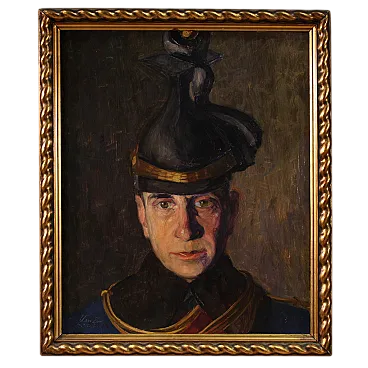
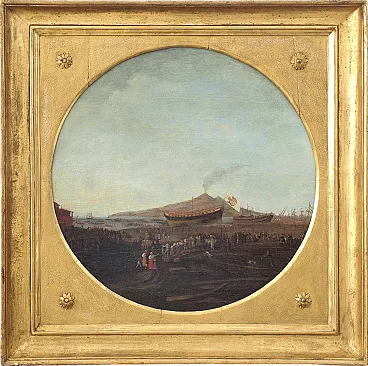
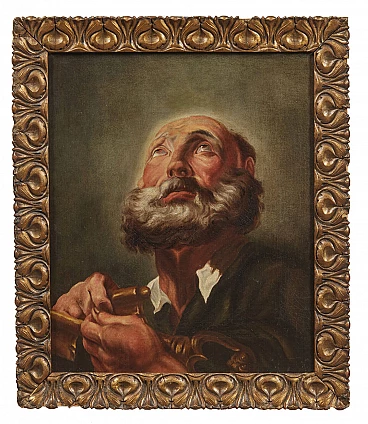
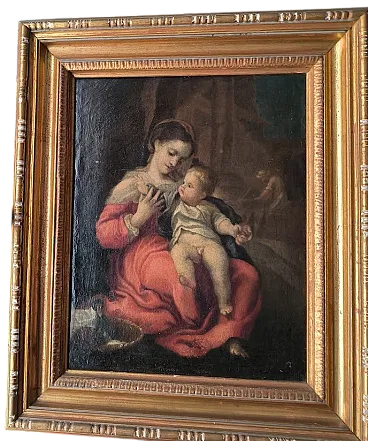
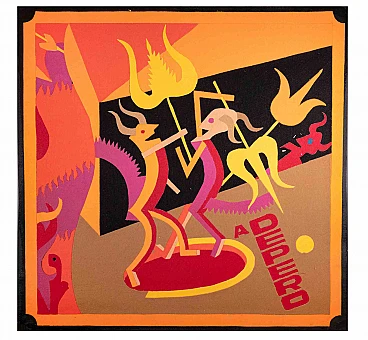
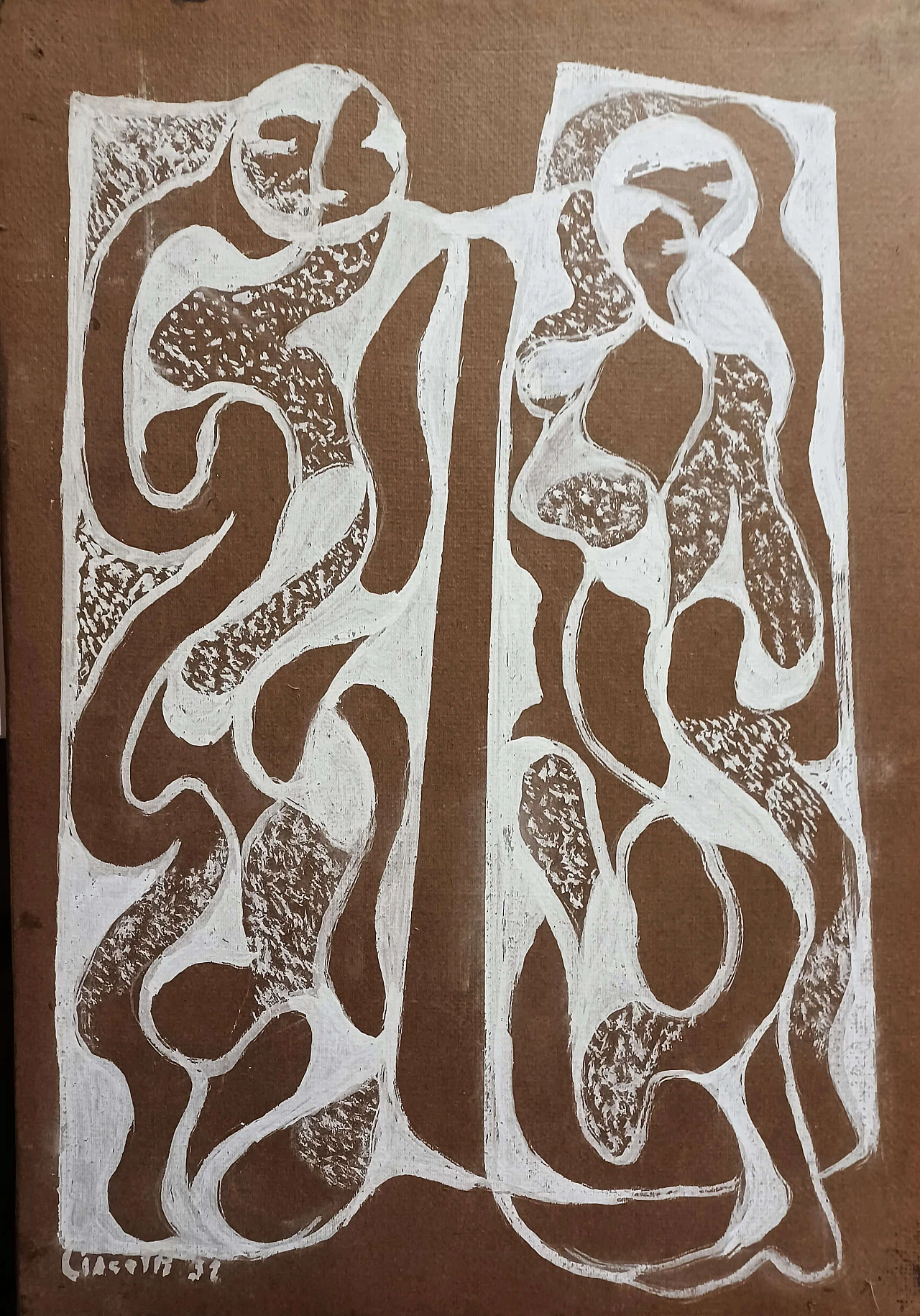
Arturo Ciacelli, Contact, year 1932.
Paper applied to canvas, 50 x 35 cm, signature and date on the front at lower left, label affixed to the back. Documentation available. Historic work in perfect condition. We are at your disposal for any information and details.
BIOGRAPHY
Arturo Ciacelli (Arnara, 1883 - Venice, 1966) learned the first rudiments of the art from his father, who worked as a mosaicist for the Vatican. Born in the province of Frosinone, he moved to Rome to study first at the Academy of France and then at the Academy of Fine Arts.
In the vivid Roman cultural climate, he came into contact in the early 20th century with those who were to become the main representatives of the Futurist nucleus: Umberto Boccioni (1882-1916), Giacomo Balla (1871-1958) and Gino Severini (1881-1966), with whom he participated in the Salone dei Rifiutati in 1905.
Alongside his Divisionist-style painting, he was also involved in set design, working for Gabriele d'Annunzio at the Teatro Argentina, together with Duilio Cambellotti (1876-1960). At the beginning of the 1910s, after marrying a Swedish painter, he moved closer to the Futurist movements of his friends Balla, Boccioni and Severini.
At this point, Arturo Ciacelli became the interpreter of a painting made up of the dynamic and rhythmic accents of the forceful lines that intersect to form abstract compositions, in which, however, there is always a figurative reference and a symbolic and almost mysterious meaning.
Sweden, Norway and Denmark
In 1910, after exhibiting at the Salon des Independantes in Paris, he moved with his wife to Stockholm, where he was asked to teach painting at the Adeon School. In addition to his teaching activities, he continued to exhibit regularly, beginning with a solo exhibition at the Adengatan Gallery in Stockholm, where he received great critical acclaim.
After moving on to the Bredgade School in Copenhagen, he began to spread the instances of Italian Futurism through a series of conferences he organised. Throughout the 1910s there were numerous exhibitions throughout Scandinavia, from Oslo to Malmö, Copenhagen to Stockholm.
But the spread of Arturo Ciacelli's works did not stop in northern Europe. Indeed, in 1914 he had an important solo exhibition at the Hessel Gallery in Paris, where he came into contact with the exponents of the Cubist-Futurist Avant-Garde and Orphic Cubism: Robert Delaunay (1885-1941), Joseph Léger (1881-1955) and Marc Chagall (1887-1985).
At this point, his painting began to be enriched by new chromatic intersections, but also by an almost magical substratum, which brought him closer to Orphism, even though his dynamic conception of line and the simultaneity of action remained at the heart of his explosive canvases and his inclination for decoration, which was becoming increasingly vivid.
In 1915 he became the director of the Ny-Konst Gallery in Stockholm, a role he held until 1921, which involved not only setting up exhibitions but also organising conferences and lectures on Italian Futurism and its international vocation.
These were also the years in which he began to combine music and painting, organising a series of simultaneous concerts between Oslo and Stockholm.
Decoration
Returning to Rome intermittently during the 1920s, he was involved in the foundation and decoration of the Cenacolo dell'Augusteo together with Enrico Prampolini (1894-1956), Julius Evola (1898-1974) and the writers Marinetti and Folgore.
The spirit of Futurism, in this case, opened up wonderfully to Dada accents, but above all to abstract concepts that concealed esoteric and mysterious meanings. In the 1920s, Arturo Ciacielli was mainly involved in mural decoration, not only in Rome but also in Stockholm and Copenhagen.
It was in the 1930s, however, that he began to exhibit at Italian exhibitions such as the Venice Biennale and the fascist trade unions, but also in numerous one-man shows, such as the one at the Dinesen Gallery in Rome in 1935, presented by his friend Marinetti.
The last years between Vienna and Italy
Having obtained a chair in handicrafts at the Italian Schools in Vienna, he moved there from 1939 to 1942. During the first years of the war, his studio was destroyed, but he continued to work tirelessly on decorating the Institute of Italian Culture.
Returning to Italy at the end of the war, Arturo Ciacelli continued to exhibit successfully throughout the 1950s, when he approached the Movimento d'Arte Concreta. After a major solo exhibition at the Palazzo delle Esposizioni in Rome in 1963, he died in 1966 while visiting the Venice Biennale.
Arturo Ciacelli: an Italian Futurist in Scandinavia
From the very beginning, Arturo Ciacelli's Futurist painting activity was perfectly coordinated with a regular and rich exhibition activity. In 1905, at the Salone dei Rifiutati, he presented a number of works, including Night, Borgo delle Cave, Autun


.png)
 BRONZE Seller in
Rimini, Italy
BRONZE Seller in
Rimini, Italy