

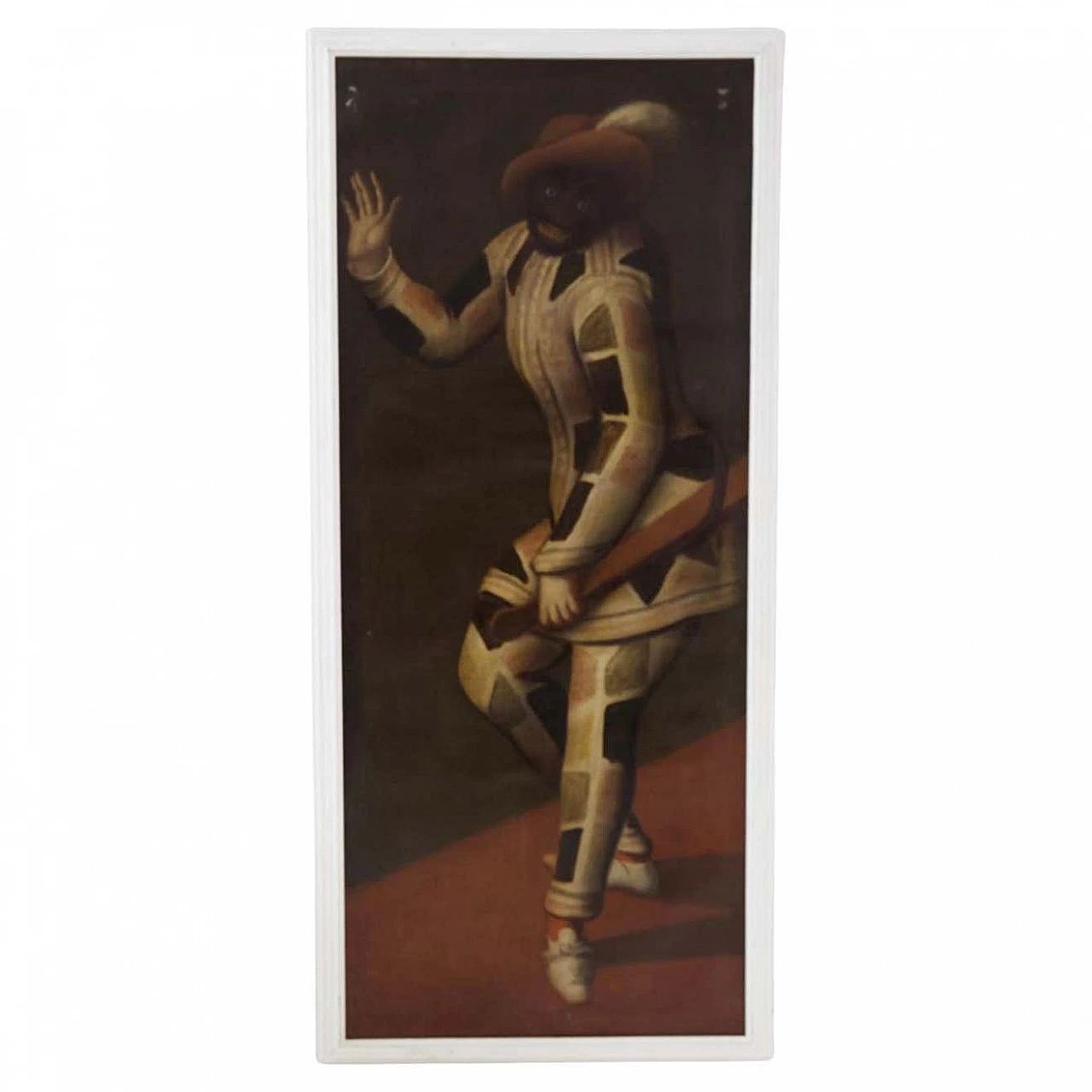
Painting of Harlequin attributed to Pietro Longhi, oil on canvas, 18th century
.png)
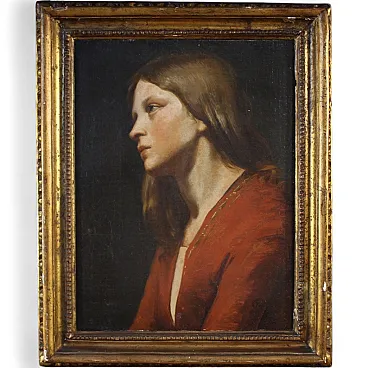
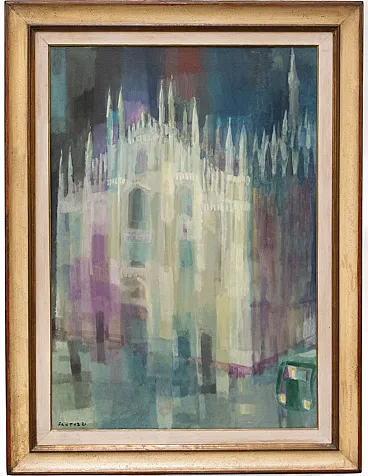
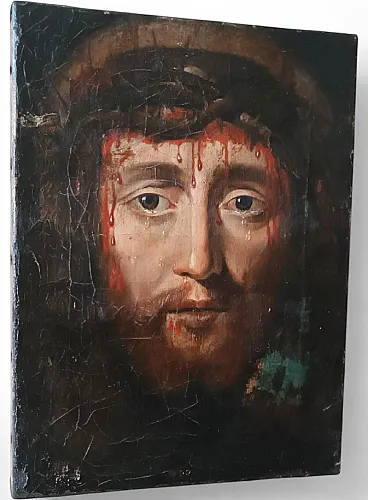
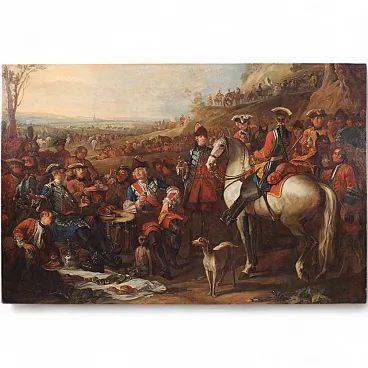
The painting, attributed to Pietro Longhi, depicts Harlequin, whose colourful lozenge dress has become synonymous with 'multicoloured' in the Italian language. His name is possibly derived from Hellequin, a jester devil of the French Middle Ages, and initially connoted a poor, stupid man ready to fight. Harlequin represents the culture of the Veneto as Pulcinella does that of Campania. He is the lucky emblem of comedy and is a cunning servant who tries to extort money from stingy and stupid masters. He has a remarkable wealth of expression, is plagued by chronic hunger and is amoral. His famous and traditional costume consists of a flamboyant black mask and a dress made of shiny, multi-coloured lozenges. Again, a legend aims to explain the origin of Harlequin's colourful outfit. The story goes that Harlequin was a child from a very poor family. On the occasion of Carnival at school, the teacher decided to organise a party, in which, however, the child was the only one unable to participate because he could not afford a suitable costume. His schoolmates came to his aid and, driven by a sense of solidarity, brought Harlequin's mother a piece of fabric from his own costume. With all these scraps of cloth, the poor child's mother made an original outfit, characterised by variegated colours. Harlequin was the most admired child on the day of the Carnival feast. It is a mask that is still alive thanks to the modern representations of Goldoni's 'Harlequin Servant of Two Masters'. The technique is a very hasty but precise oil painting on canvas, in fact there are not many details, a typical characteristic of Longhi's style, which is very essential. It is the vices of the Venetian aristocracy that Longhi wants to highlight. He is depicted dancing with a mandolin. The frame has been restored, varnished and repositioned, making the painting suitable for even the most spartan, but art-loving, surroundings. An unmissable work of art from 18th century Venice. Pietro Longhi portrayed events in the daily life of the Venetian aristocracy contemporary to him in a very realistic manner. His canvases depict typical moments of the Venetian world. In his paintings we find the same atmosphere as in Goldoni's comedies, the settings are discreet, in private and intimate contexts. Goldoni himself, a contemporary of Pietro Longhi, admired his work and dedicated a sonnet to him in which he referred to Longhi's work as a pictorial version of his theatre. With Goldoni we find ourselves in the middle of the 16th century, in the midst of the Venice Carnival, amid masks, music, laughter and haggling merchants. In the darkness of the calli we meet a figure dressed in red and wrapped in a black cloak: it is Pantalone, the Venetian mask symbol of the commedia dell'arte made famous throughout Europe by Carlo Goldoni. The masks of the commedia dell'arte parade through the canals of Venice: from Harlequin, the foolish 'Servant of two masters', to Columbine and the cunning Brighella, the enterprising and opportunistic face of the bourgeoisie. The cross-section of eighteenth-century life that Pietro Longhi's paintings offer us represents a precious testimony of customs thanks to which it is possible to reconstruct Venetian daily habits in detail. By highlighting a detail, such as a gesture, he attempts to evoke the essence of a situation. A series of four vertical paintings creates a splendid ensemble of late 18th century paintings attributed to Pietro Longhi.
ID: 36842-1667828670-49869
Time period







 SILVER Seller in Milano, Italia