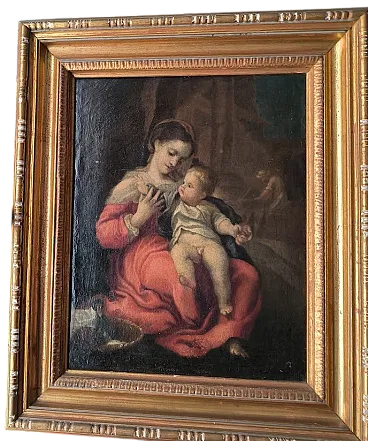
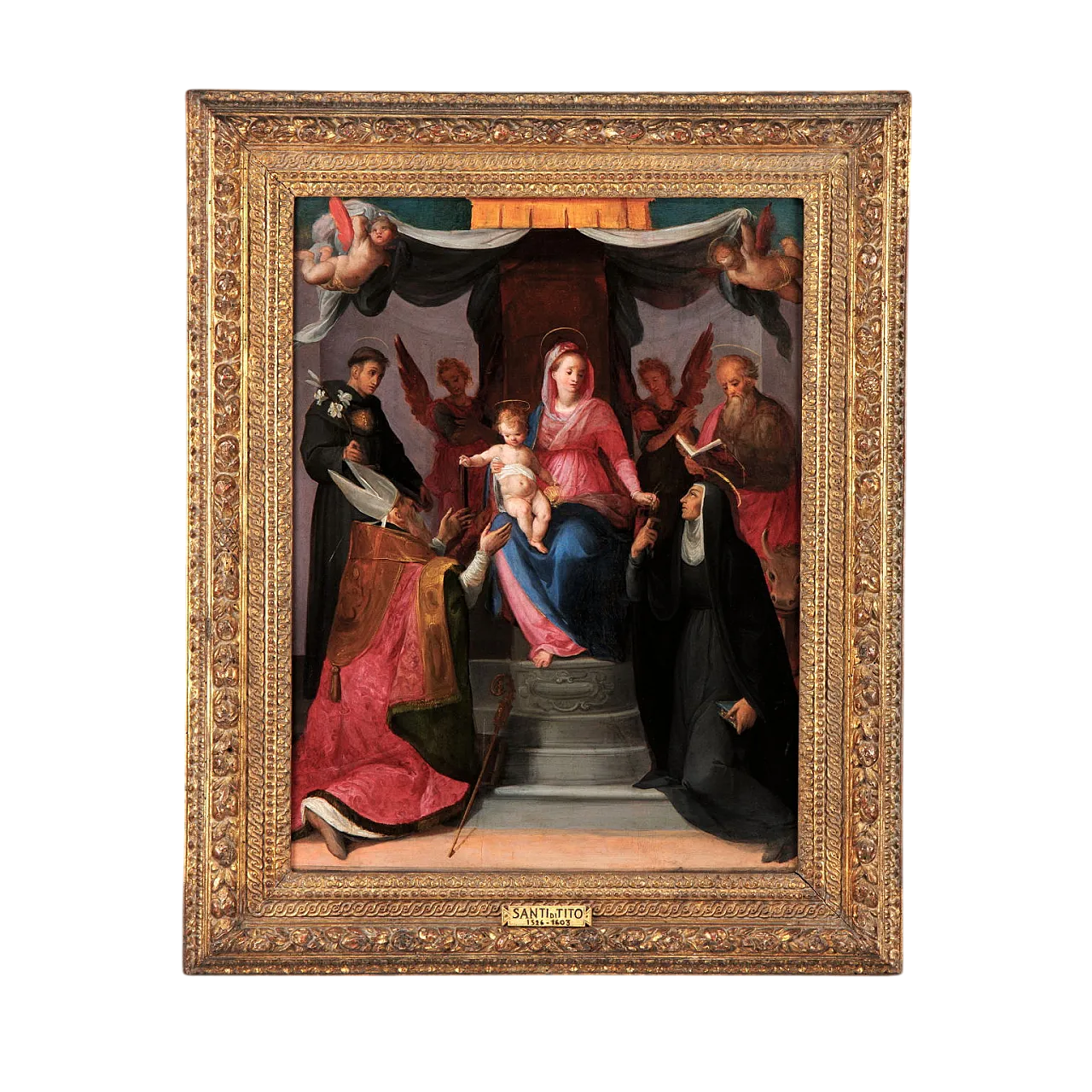
The painting presents the Madonna enthroned with the Child, two praying angels and the saints Nicola da Tolentino, Agostino, Luca Evangelista and Monica, beneath an elegant canopy. The work must be recognized as a preparatory sketch for a large altarpiece, still unknown today. Proof of this is the size of the panel, which is not suitable for an altarpiece in a church or even for a small chapel in a private residence; the painting, which in some places, such as the two angels on the sides of the Madonna and Child or in Saint Luke the Evangelist, is deliberately left in a rough state; and, finally, for the presence of evident repentance. In this regard, we can note the left arm of the holy bishop, initially thought to be closer to the right one, and the right hand of the saint. Even though the panel is a sketch, we can see some details of great pictorial refinement, demonstrating the quality of the painter and the importance that these objects had with respect to the final work: the gold finishes, for example in the Saint Nicholas of Tolentino, in the loincloth of the little angel at the top left and in the globe held by the Child, enrich the preciousness of the composition. The facial features of the figures are outlined with the tip of the brush, while the clothes are constructed with a more vigorous and less rigorous brushstroke, further demonstrating how the work was not to be considered independent. In this regard, observe the cope of the holy bishop, in which we can glimpse some figurative decorations - saints or apostles - and a decoration imitating velvet executed with a rapid brushstroke that effectively traces only the general profile. The Saints are characterized by a luminous palette which particularly highlights the central representation with the Madonna and Child, Saint Augustine and the angel at the top right. The shadows and lights are studied with particular attention: the two praying angels are wrapped in the shadow created by the canopy and the chiaroscuro effects on Saint Luke, Saint Monica and on the steps of the throne are accurate. The presence of the canopy is a clear legacy of the Florentine culture of the early sixteenth century: think of the altarpieces by Raphael (Madonna del Baldacchino, Galleria Palatina at Palazzo Pitti, Florence) and Fra Bartolomeo (Pala Pitti, Galleria Palatina at Palazzo Pitti, Florence) , from which our painter takes - as was still the norm in the second half of the sixteenth century in Florence - the general composition of the Sacred Conversation. Marco Collareta was responsible for attributing the work to Santi di Tito (Borgo San Sepolcro 1536 – Florence 1603) on the occasion of the famous 1980 exhibition: Palazzo Vecchio: Medici commissioning and collecting. On that occasion the scholar dated the panel in the mid-1560s, recognizing a close link with the altarpiece painted by the Tuscan painter in 1566 for All Saints' Day in Florence and noting in the painting still "the memory of the chromatic liveliness of the frescoes created by the painter during of his Roman stay by 1564" (M. Collareta, 552. Madonna with Child, Angels and Saints, in Palazzo Vecchio: Medici commissioning and collecting, Milan 1980, pp. 283-284.) The presence of the holy bishop Augustine and the Augustinian saints Nicola da Tolentino and Monica, leaves no doubt in estimating that the work was commissioned by a community of Augustinians or by a private individual devoted to that order. The presence of the Evangelist could be motivated by the dedication of an altar or a chapel to that saint, or by the client whose name must have been Luca. The Basilica of Santo Spirito is the home of the Augustinians in Florence and could certainly be a place for which Santi di Tito worked in this case. Considering how the painter, absolute protagonist of Florentine and Tuscan painting in the second half of the sixteenth century, was involved in different commissions in the Florentine countryside and in Tuscany (for example in Arezzo, Cortona and Grosseto) and the widespread diffusion of the Augustinian order in this and other regions, it remains difficult to specify their location.



.png)



 PLATINUM Seller in Milano, Italy