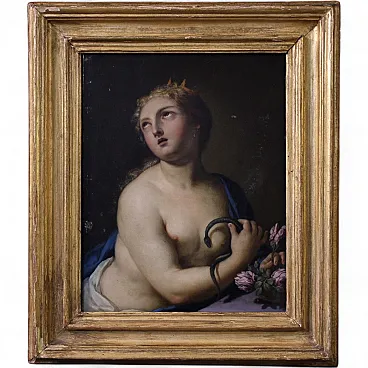
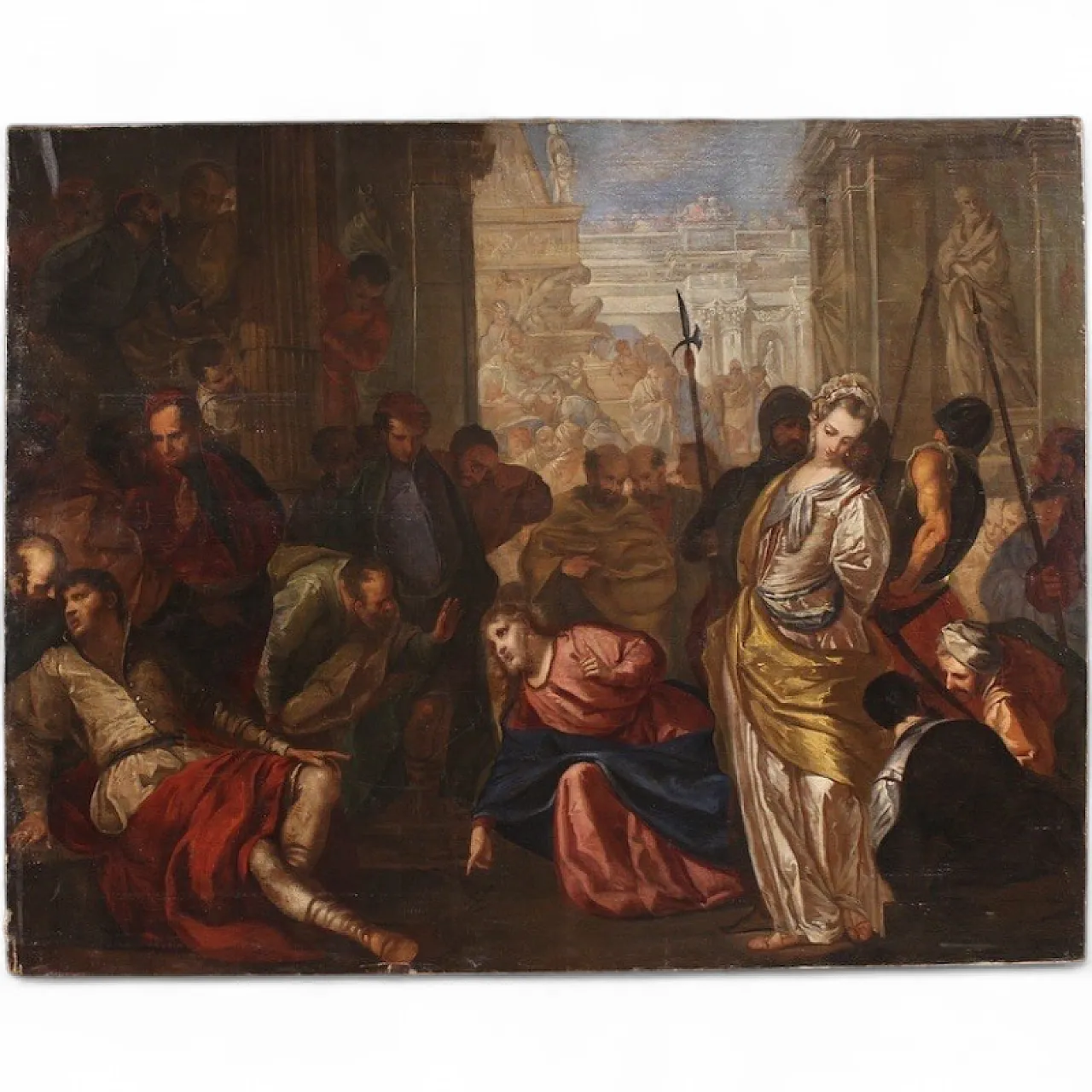
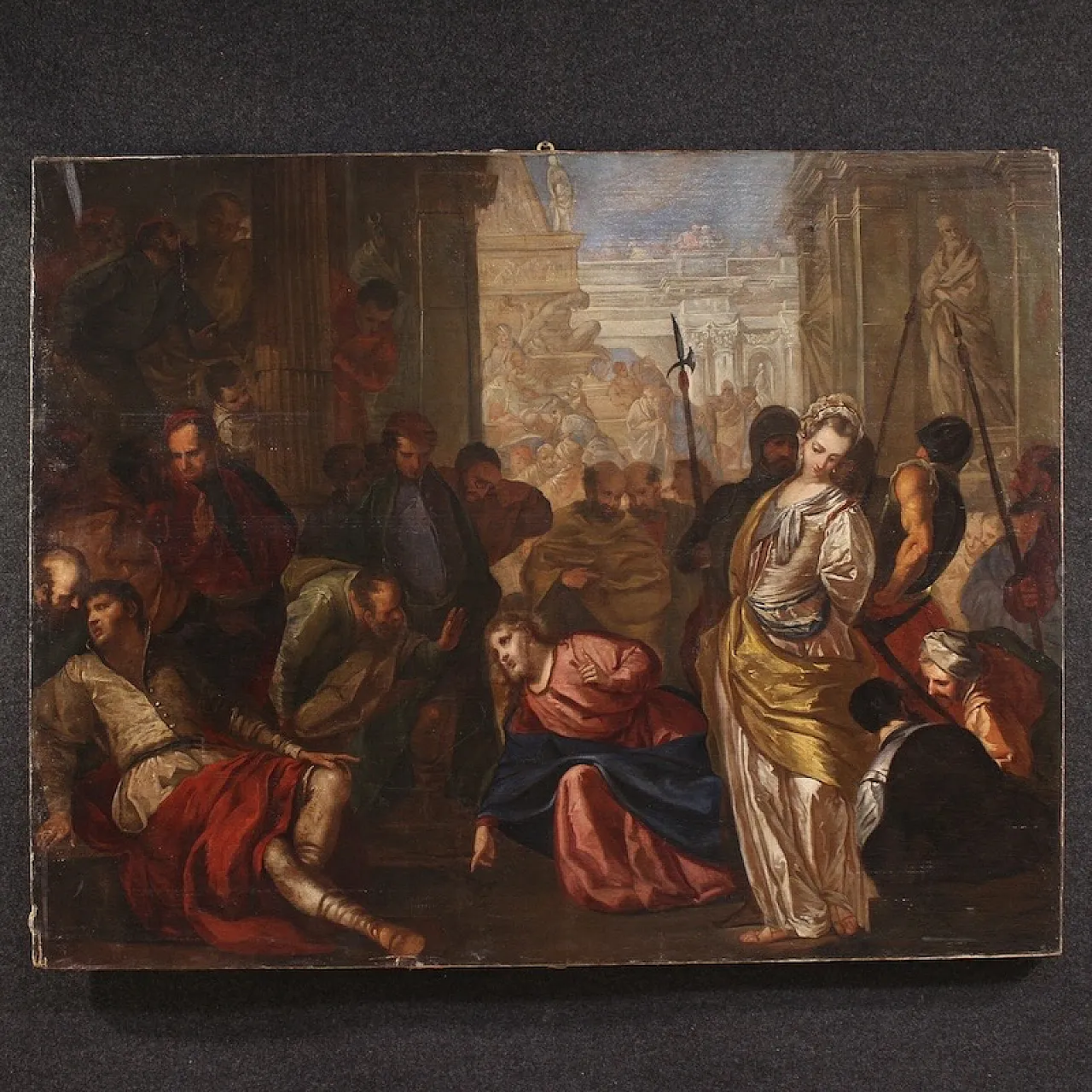
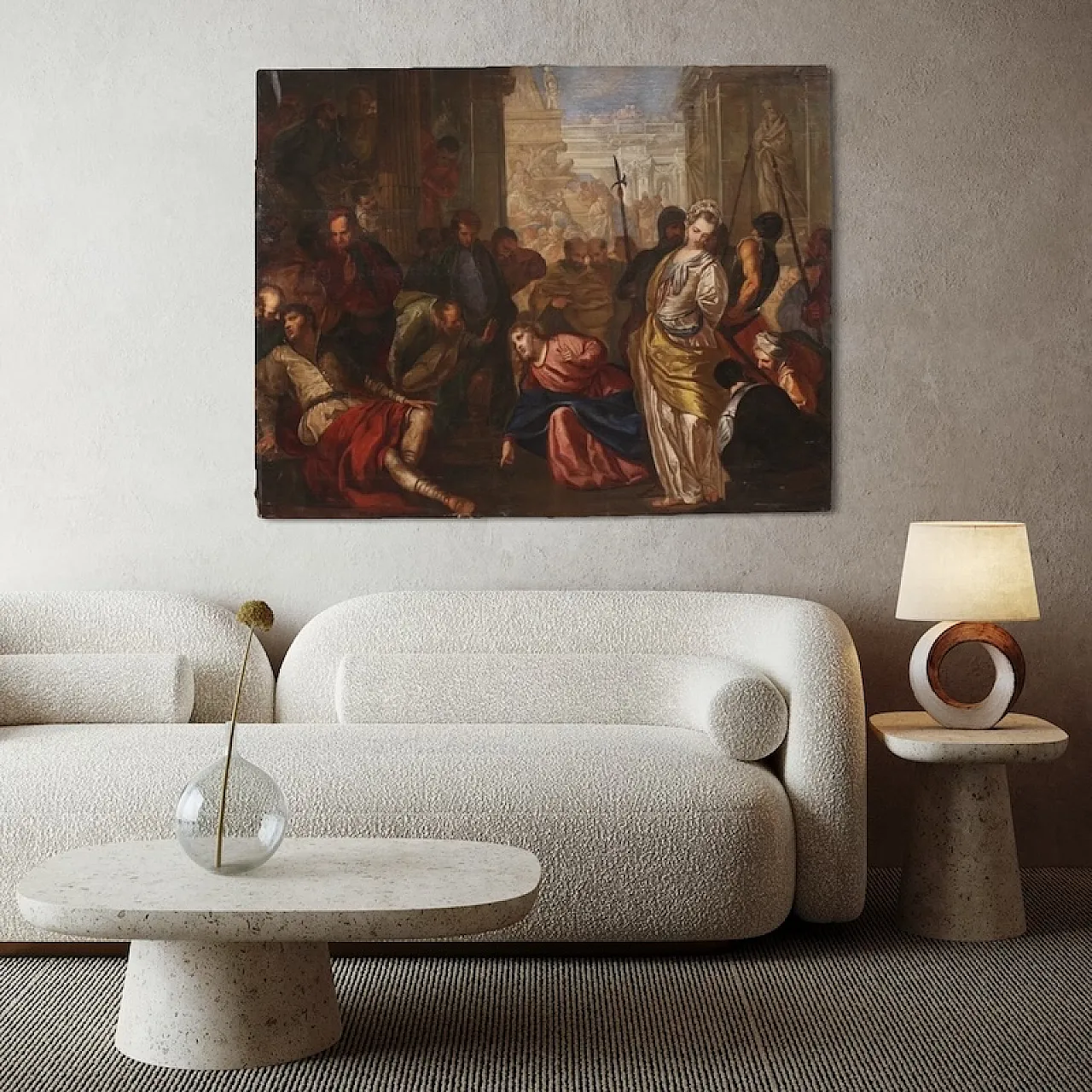
Important Italian painting from the end of the 16th century. Oil on canvas work attributed to the great Venetian painter Francesco Montemezzano (1555 – 1602), depicting the famous episode of Christ and the adulteress, taken from the Gospel of John.
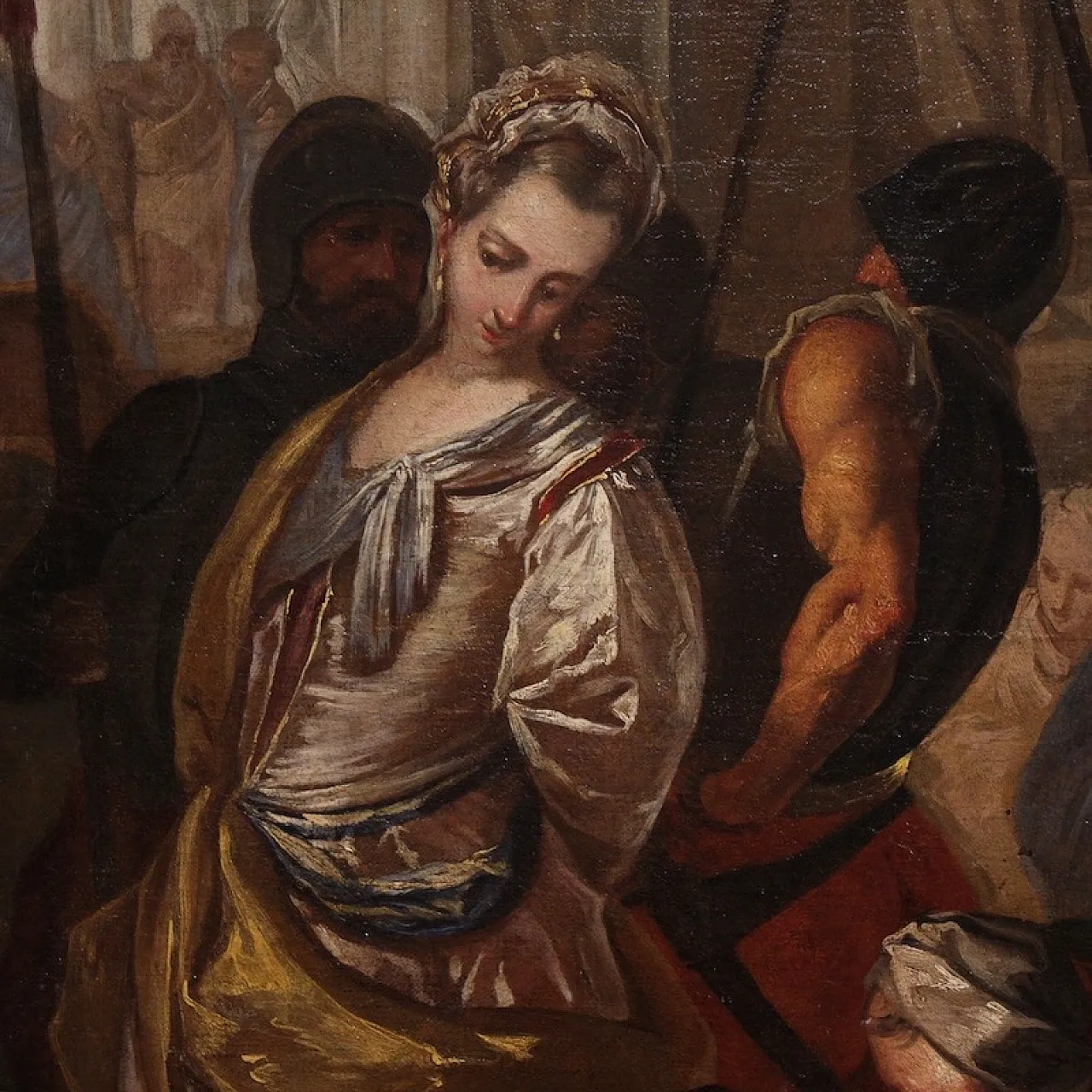
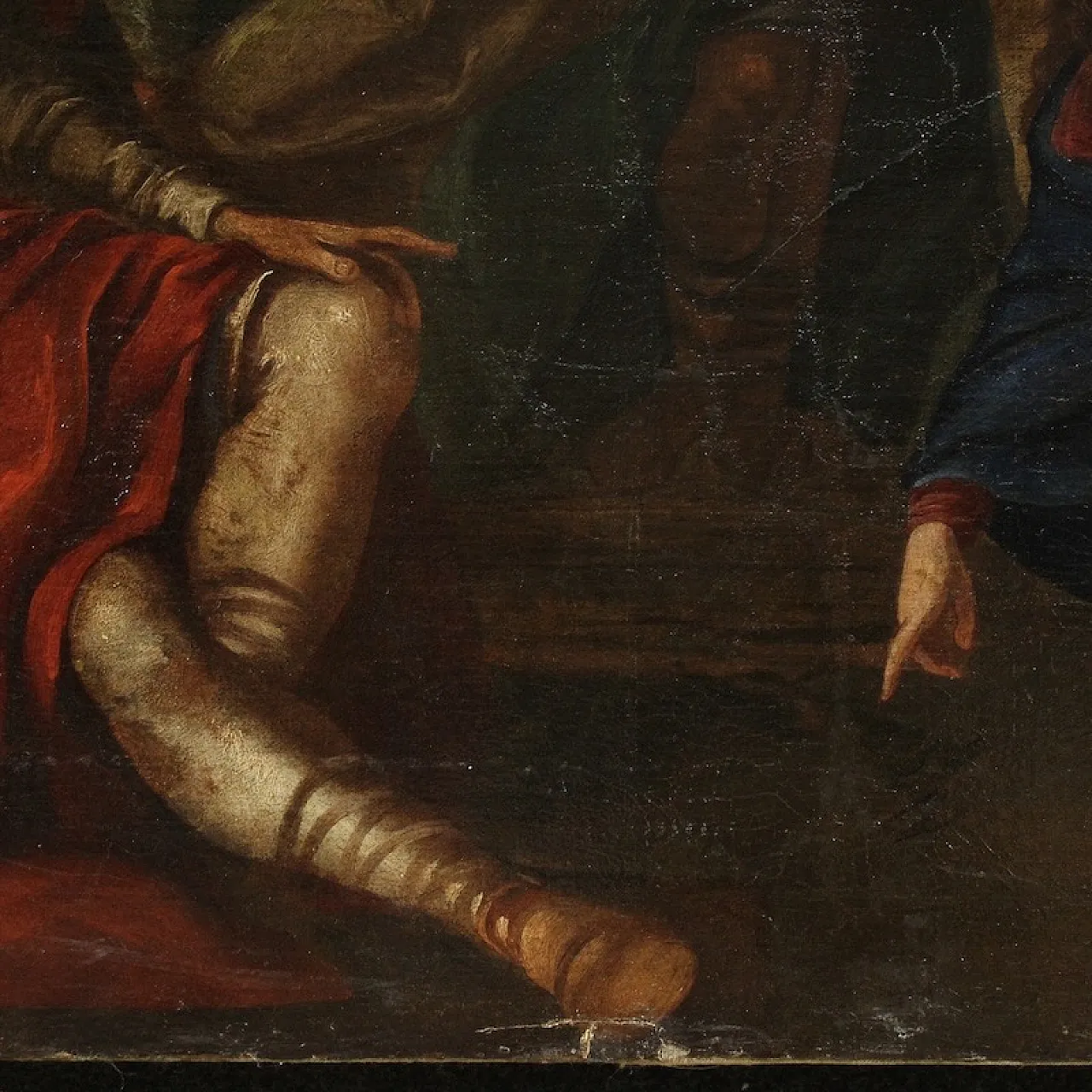
At the center of the composition, Jesus, kneeling, bends to write with his finger on the ground while he is questioned by the Pharisees about the fate of a woman caught in adultery. Around the protagonists gathers a crowd of characters with varied poses and carefully characterized expressions, within a grandiose Renaissance architecture that gives depth to the entire scene. The artist chooses to depict the moment of greatest narrative tension, the one immediately preceding Jesus' famous response "Let him who is without sin among you cast the first stone". The figure of the adulteress, embellished with an elegant white dress and a large golden drape, introduces a refined chromatic balance that recalls the best Venetian pictorial tradition.
The scenographic layout, the monumentality of the architecture, the perspective construction of the space and the brilliant chromatic harmony directly recall the lesson of Paolo Veronese, of whom Francesco Montemezzano was one of the most authoritative students. The quality of the drapery, the brightness of the palette and the compositional balance make the attribution fully plausible (the painting is not currently accompanied by expertise, but it is possible to request one upon payment of the relevant additional costs).
Francesco Montemezzano was born in Verona around 1555 and worked mainly in the Veneto territory. Trained in the workshop of Paolo Veronese, he assimilated his taste for large architectural scenography, the elegance of the figures and the extraordinary chromatic richness. His works are today preserved in important religious buildings and public collections in the Veneto, including the Church of San Francesco della Vigna and the Church of San Nicolò dei Mendicoli in Venice.
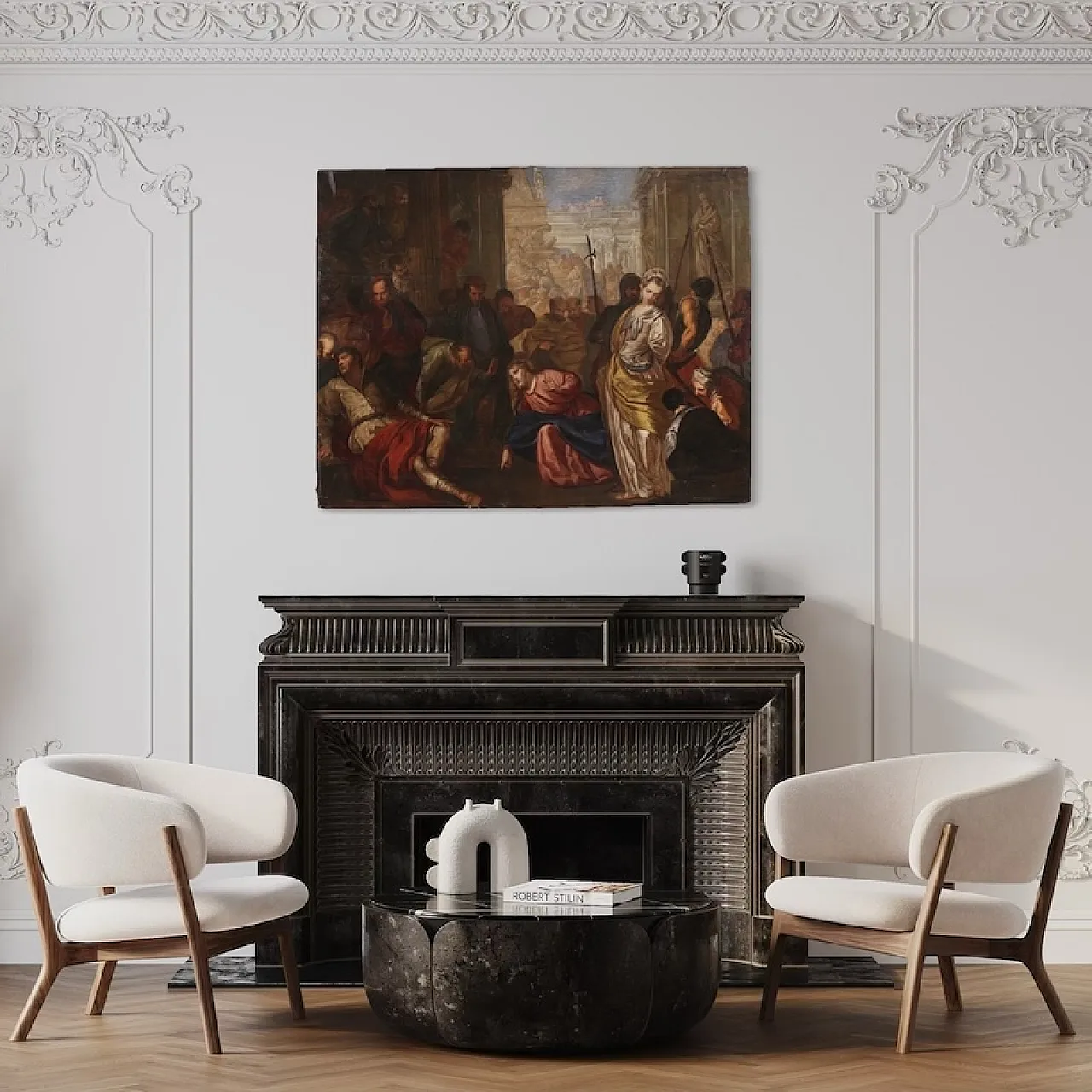
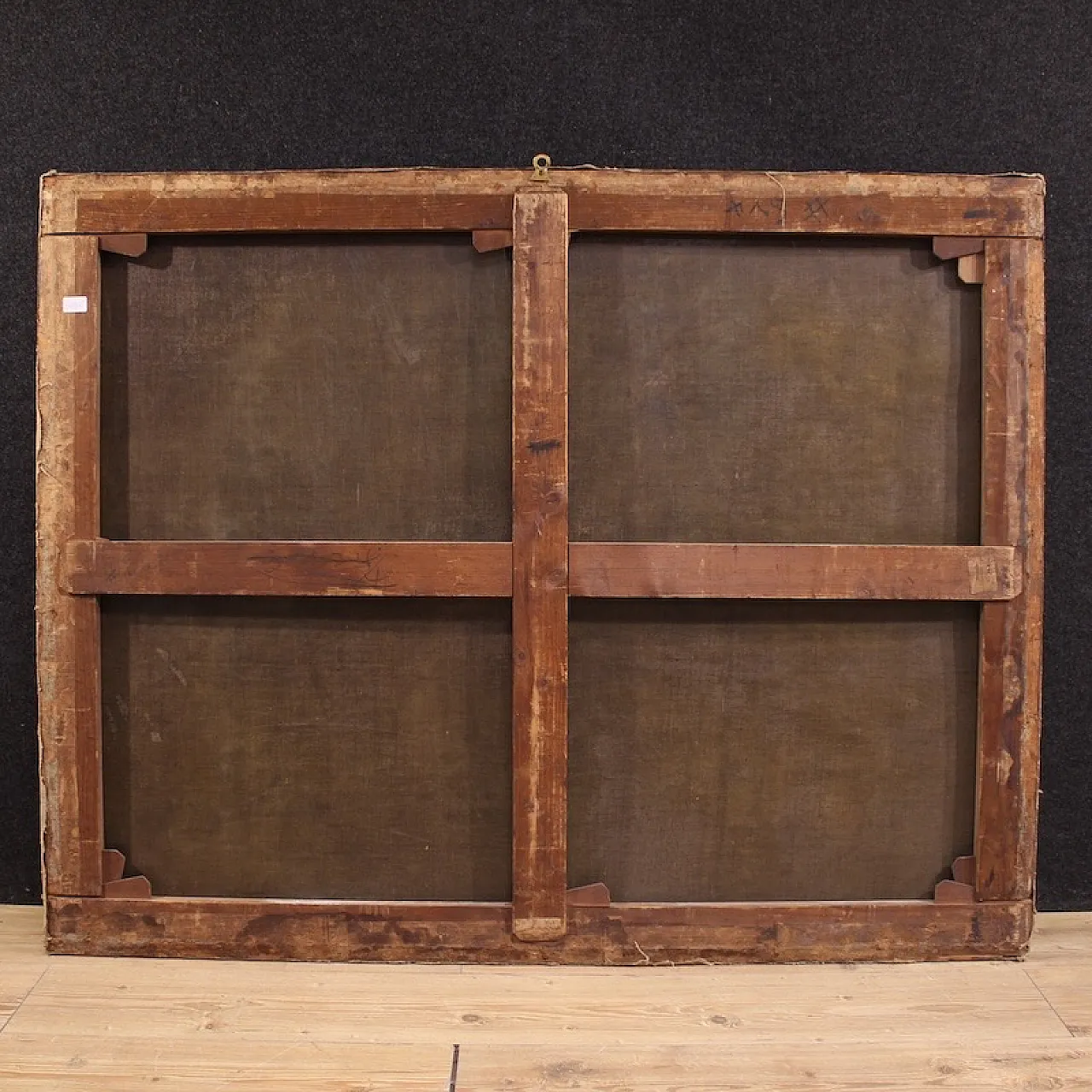
Works attributed to Francesco Montemezzano appear with a certain rarity on the antiques market and are particularly appreciated by international collectors. It is a work of considerable historical and collectible charm, ideal for enriching a collection of ancient Italian masters or for embellishing reception environments in which its refinement can be fully valorised. Over time it has been the subject of a restoration including relining, replacement of the frame and limited localized pictorial restorations. Overall, the painting is in a good state of conservation.




.png)













 SILVER Seller in Cuneo, Italy