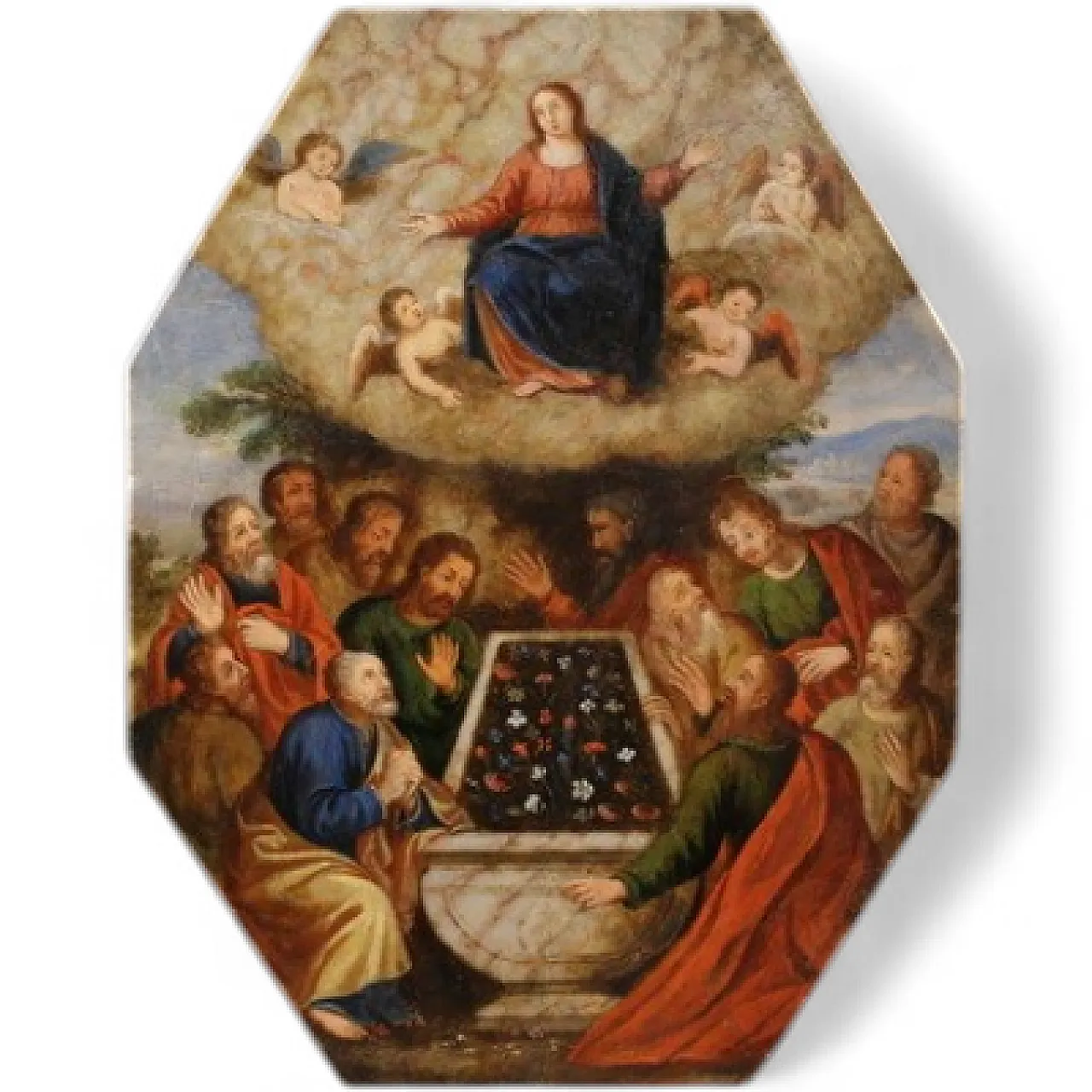
A rare Italian painting from the second half of the 16th century. This octagonal oil on marble work depicts the Assumption of the Virgin, attributed to the Marche painter Ercole Ramazzani (1535-1598).
The vertical composition is divided into two distinct but closely related registers. In the upper section, the Virgin appears among the clouds, wrapped in her traditional red robe and blue cloak, while angels accompany her as she ascends. In the lower register, the Apostles gather around Mary's now-empty tomb. The figures react to the miraculous event with a lively succession of gestures and expressions, lending dynamism to the scene. Particularly striking is the detail of the open sarcophagus, inside which, according to tradition, a profusion of small, multicolored flowers appears in place of the Virgin's body.
The choice of marble as the pictorial support is of particular historical and collectors' interest. During the 16th century, painting on stone enjoyed significant popularity in the technical and theoretical experiments that developed around the celebrated comparison between painting and sculpture. One of the arguments traditionally cited in favor of sculpture's superiority was the material's greater durability, theoretically eternal. Painting directly on stone ideally allowed the artist to reconcile the qualities of both arts—the color, narrative ability, and illusionism of painting—with the solidity and longevity associated with sculpture. The small size suggests a private devotional purpose or a commission for a prestigious collection.
In the painting under consideration, however, the marble is not simply a support on which to apply the paint, but becomes an integral part of the image. In some passages, particularly in the clouds and the sarcophagus, the artist adopts the refined expedient of intentionally allowing the stone material to emerge, avoiding covering it with paint. The natural hues and veining of the stone are thus incorporated into the composition and used as true pictorial elements.
Ramazzani was a pupil of Lorenzo Lotto and later developed a personal language in which Lotto's influences merged with the Mannerist culture of central Italy. His work, predominantly religious, is characterized by lively compositions and vibrant colors, elements that find significant similarities with the painting under consideration (the work is currently accompanied by an expertise, but it can be requested upon payment of the relevant additional costs).
The small size allows it to be easily placed in a study, a library, a private chapel, or, given the rarity of the object, inside a display case for a Wunderkammer collection, the so-called cabinet of curiosities.
The painting was already restored during the 20th century. The previously fragmented marble slab was carefully reassembled and then mounted on a wooden support panel. It features small patches of color, but is overall in good condition.



.png)


-large.webp)
-large.webp)
-large.webp)
-large.webp)
-large.webp)
-large.webp)
-large.webp)
-large.webp)
-large.webp)
-large.webp)
-large.webp)
-large.webp)
-large.webp)
-large.webp)
 SILVER Seller in Cuneo, Italy