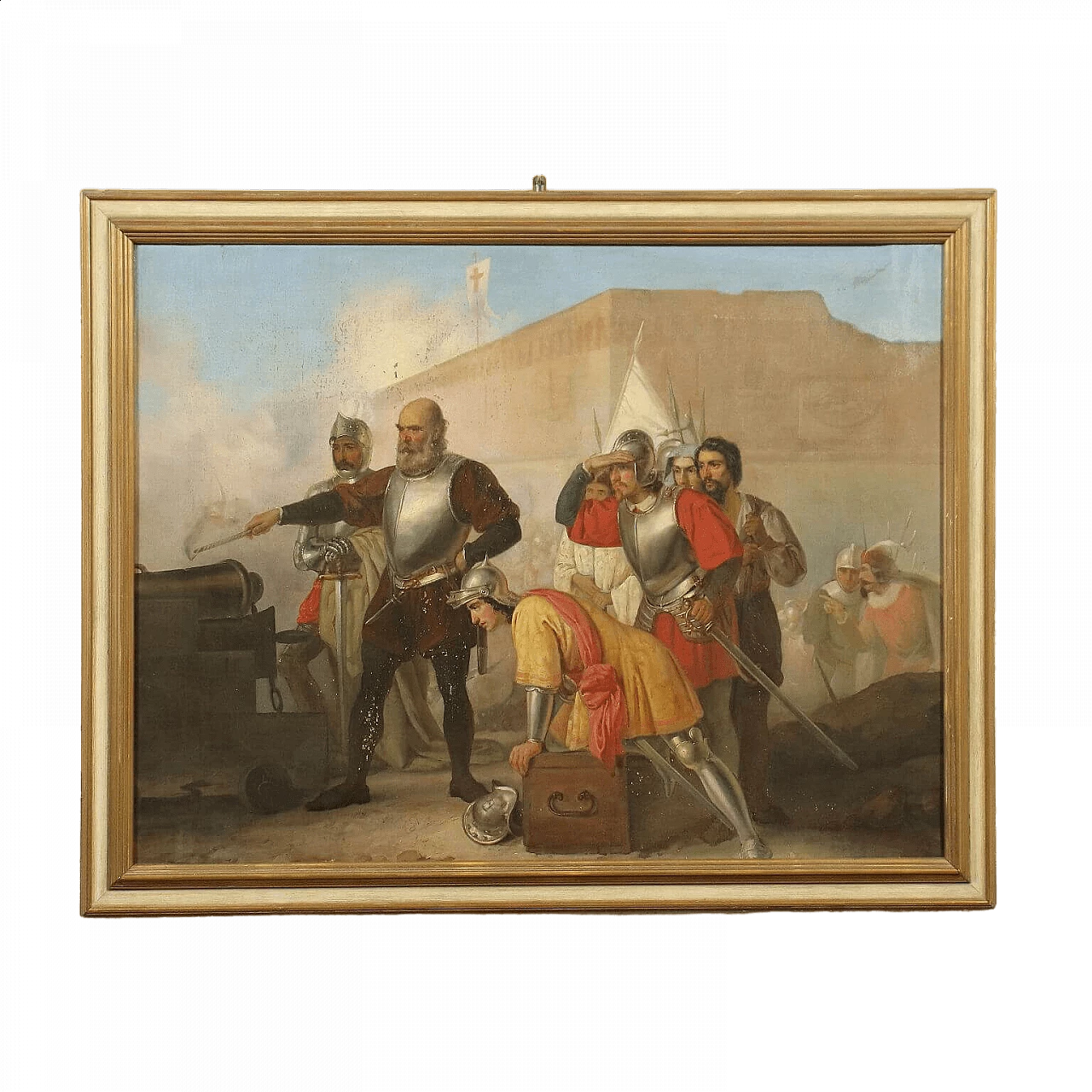
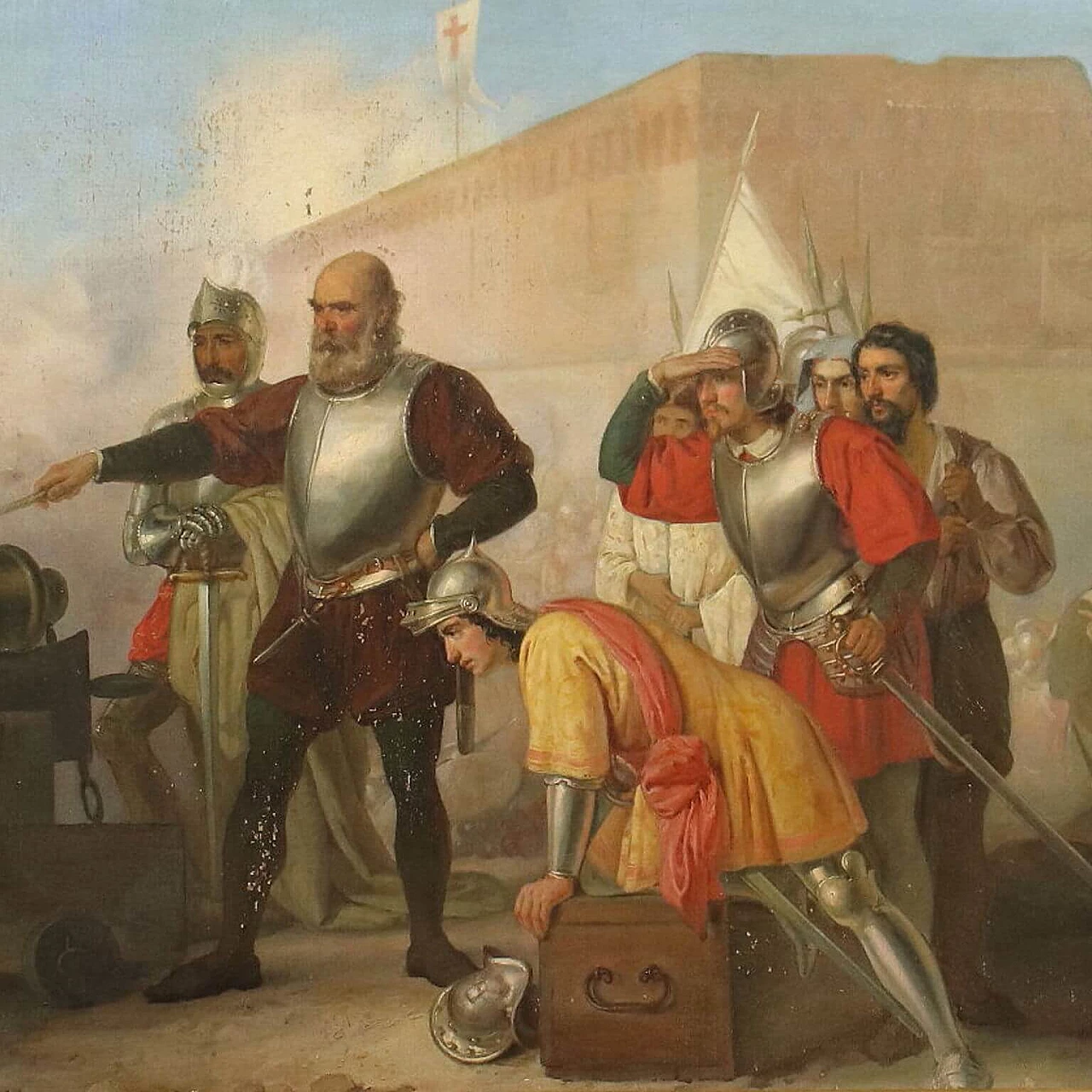
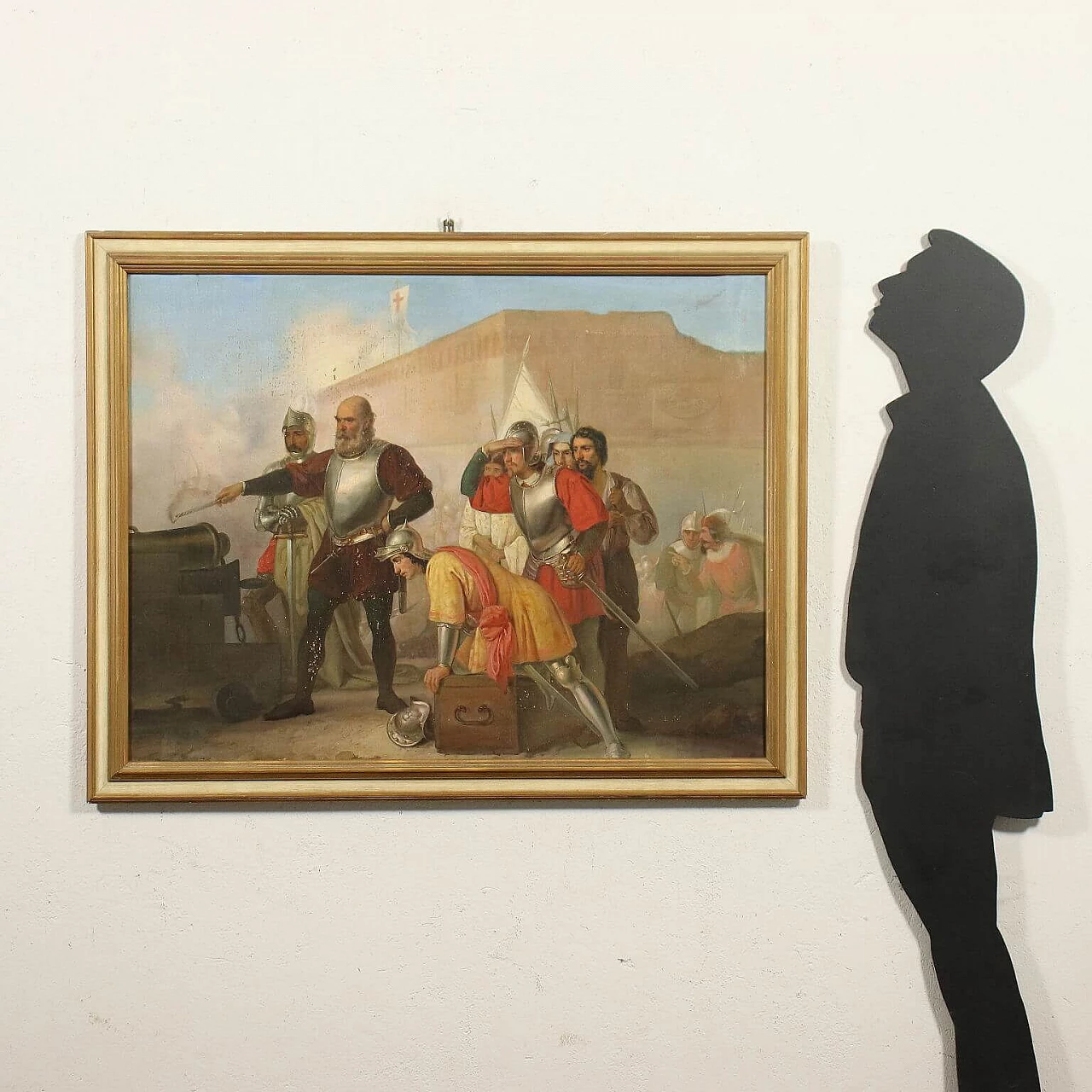
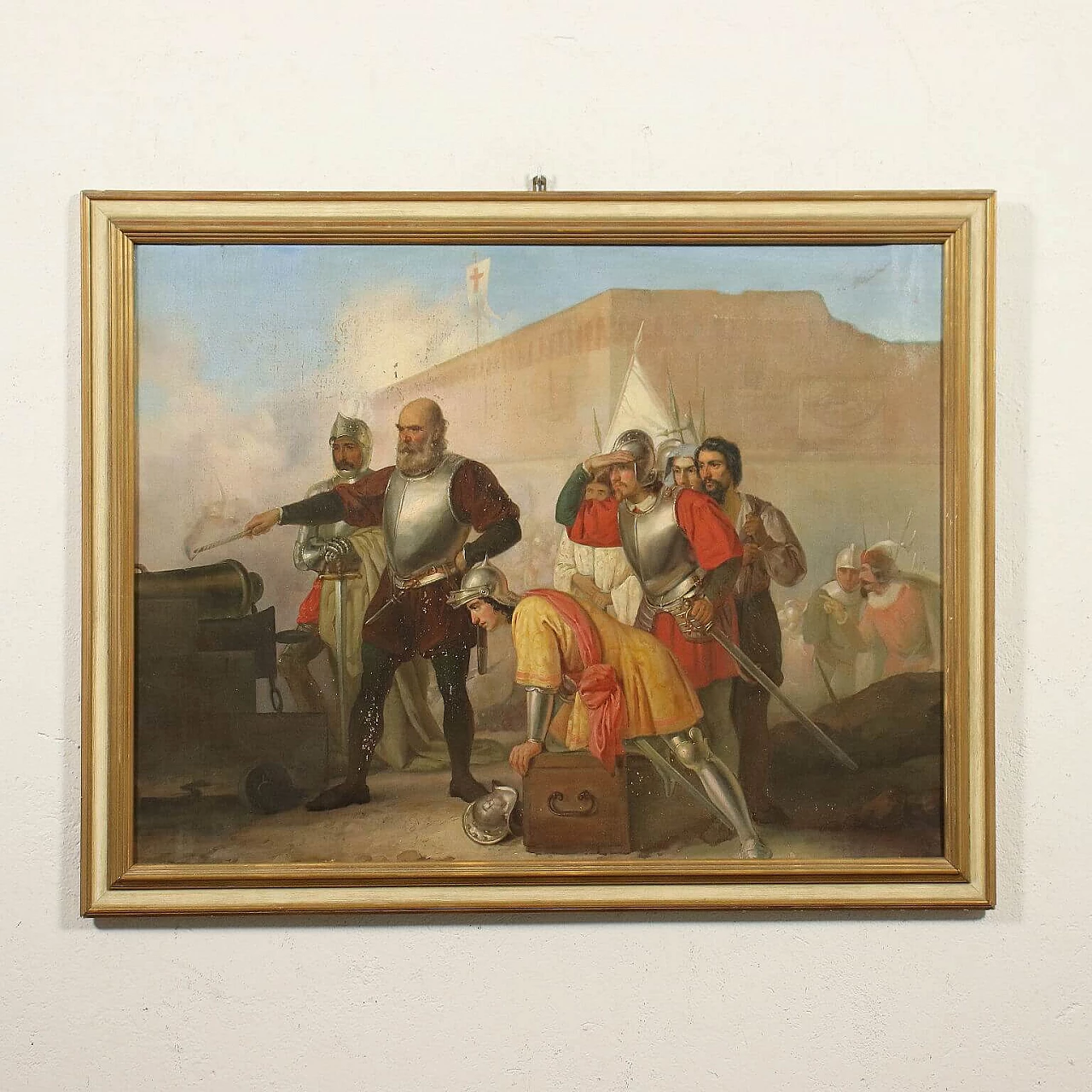
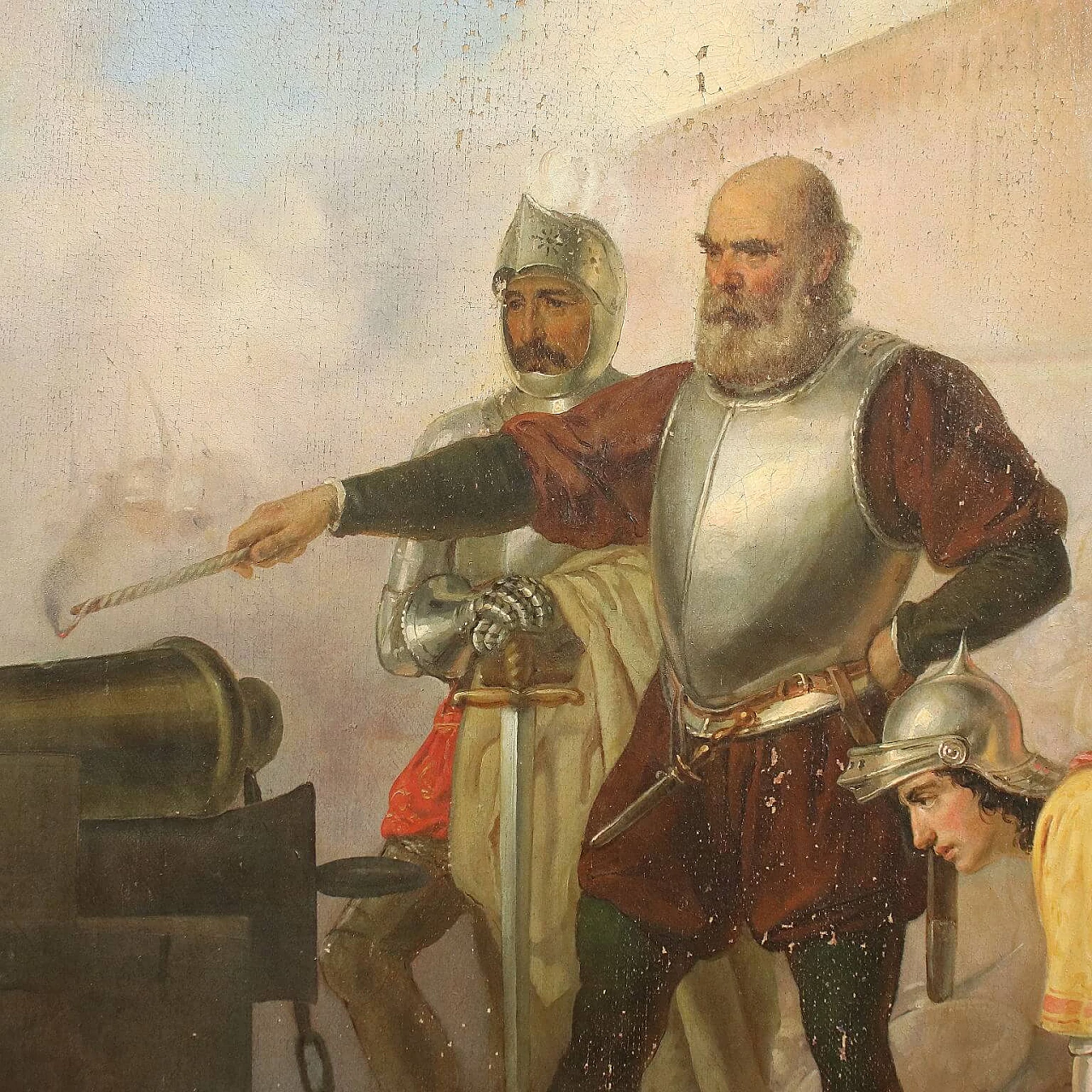
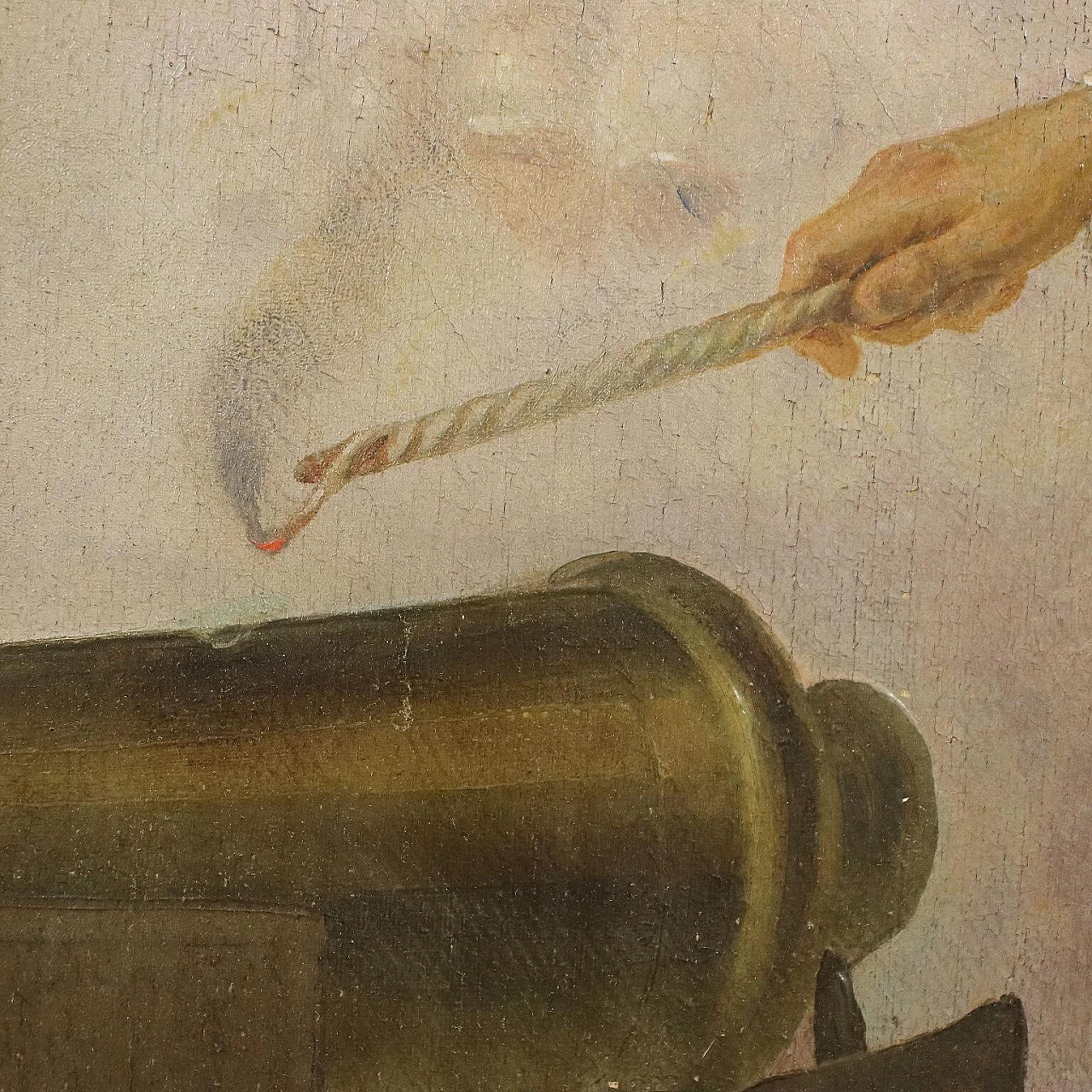
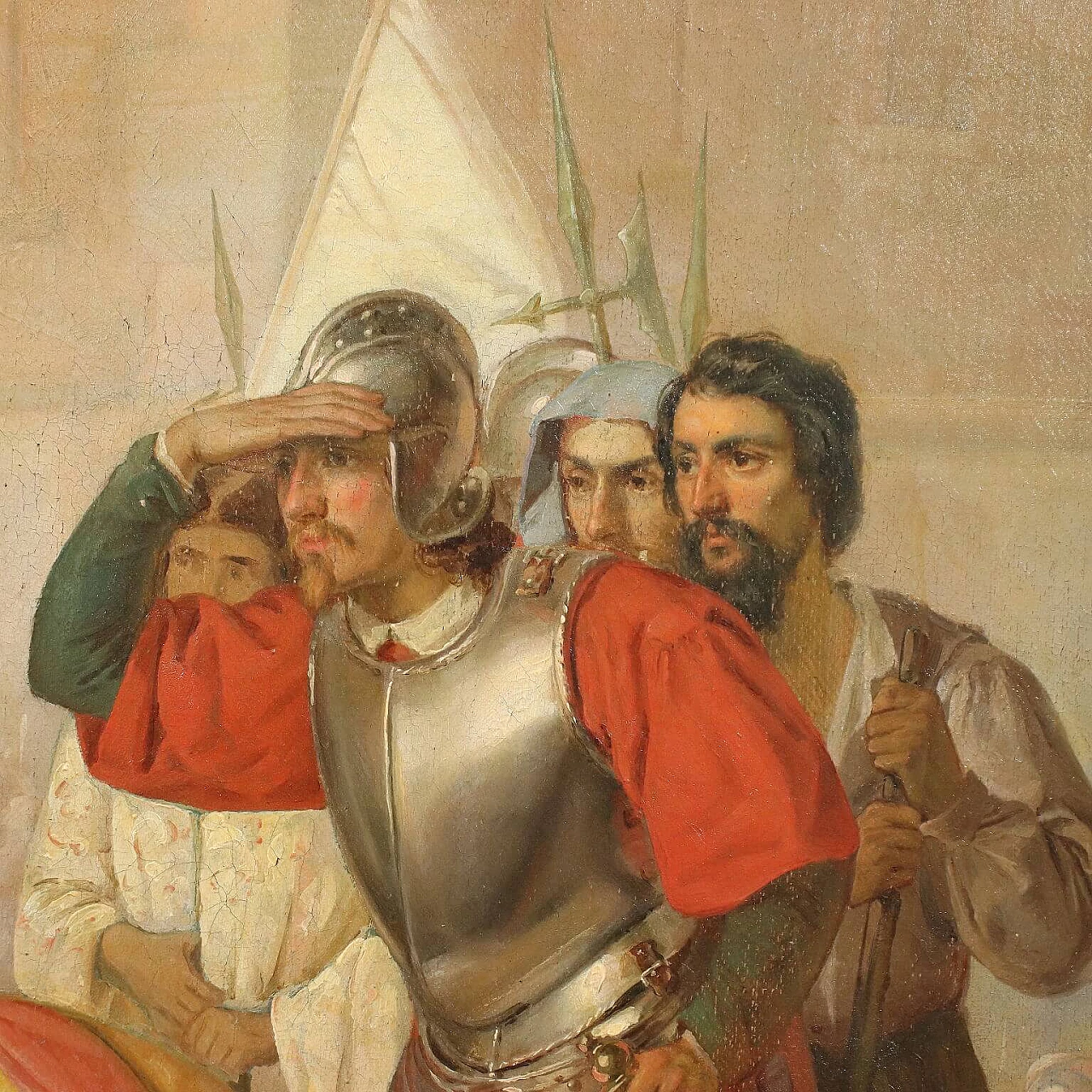
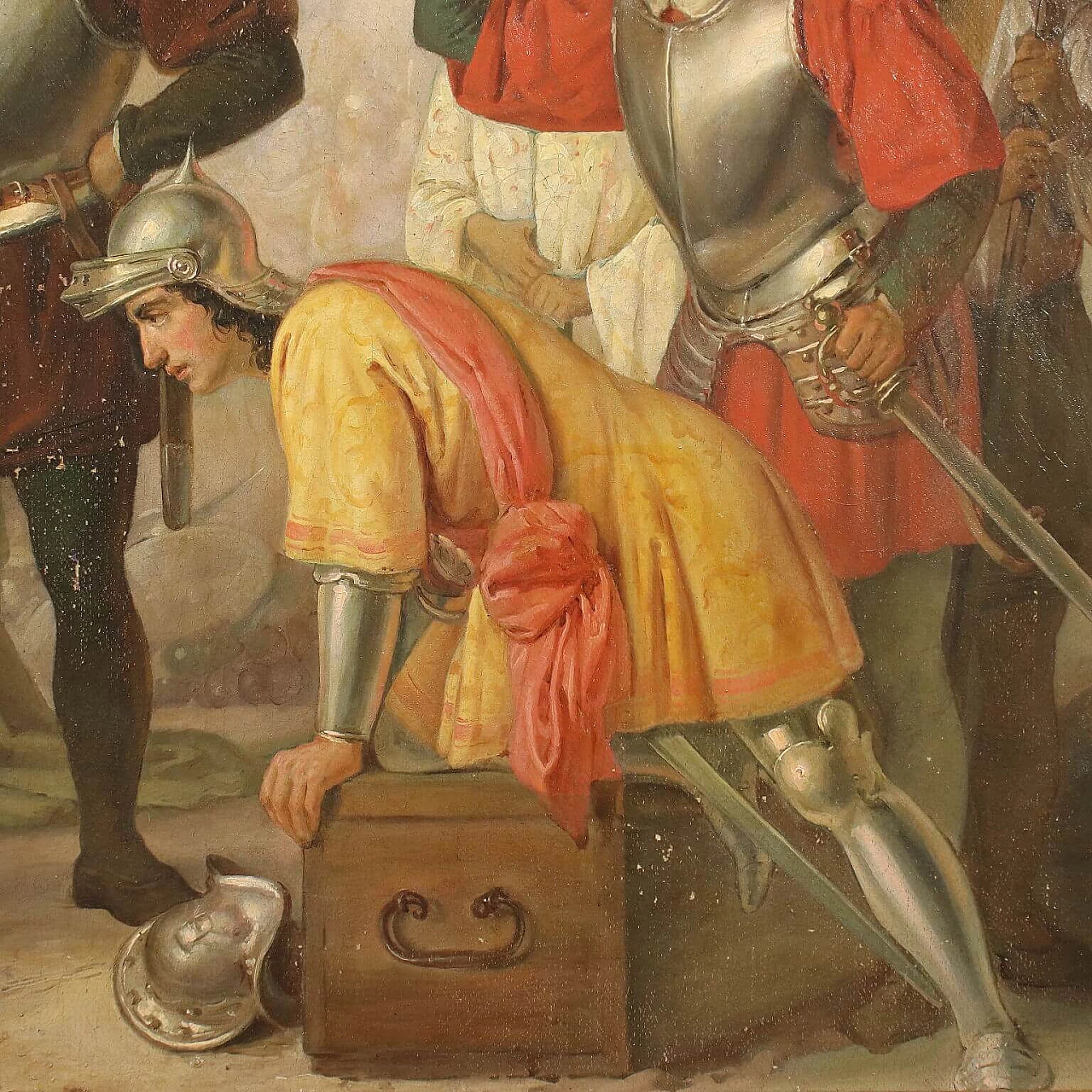
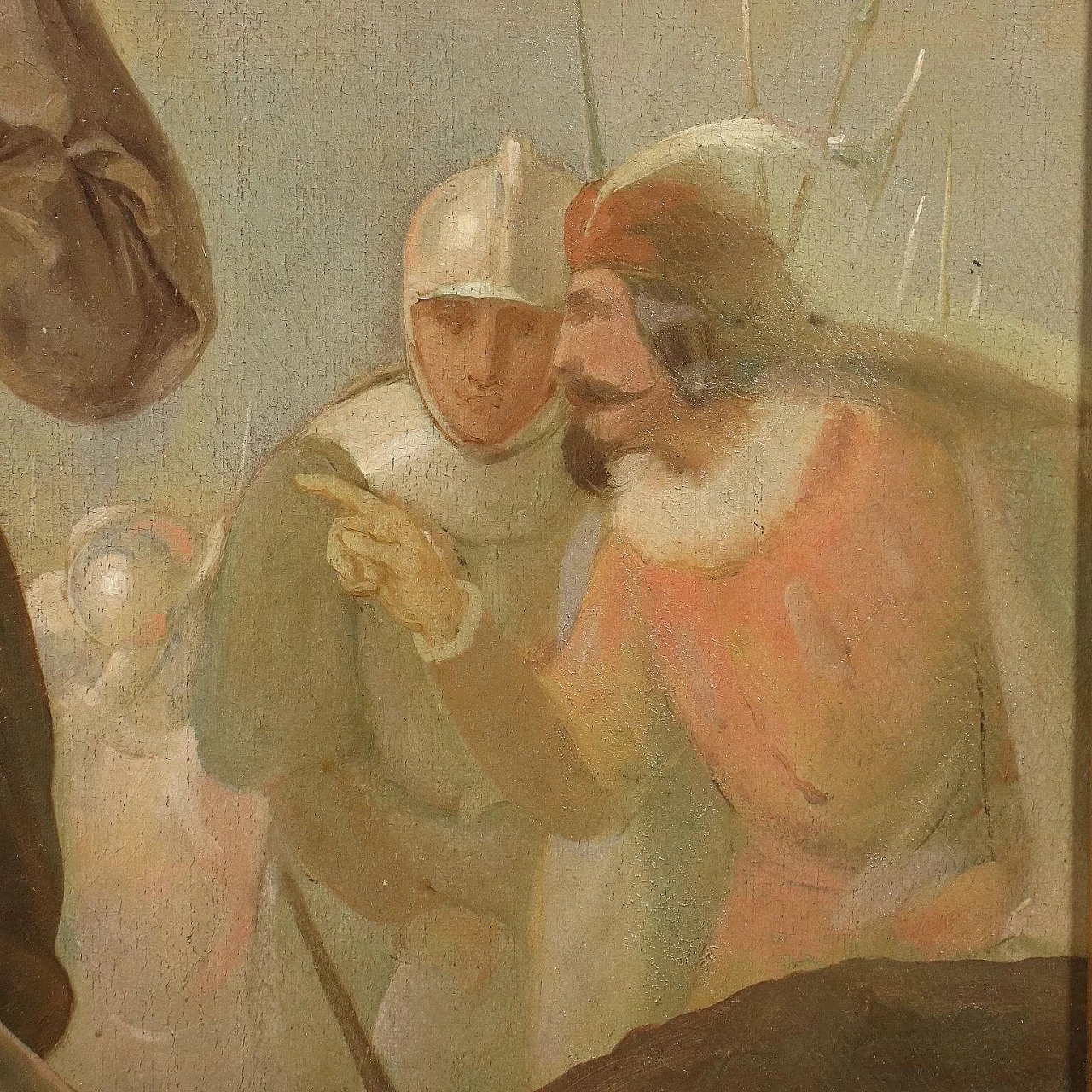
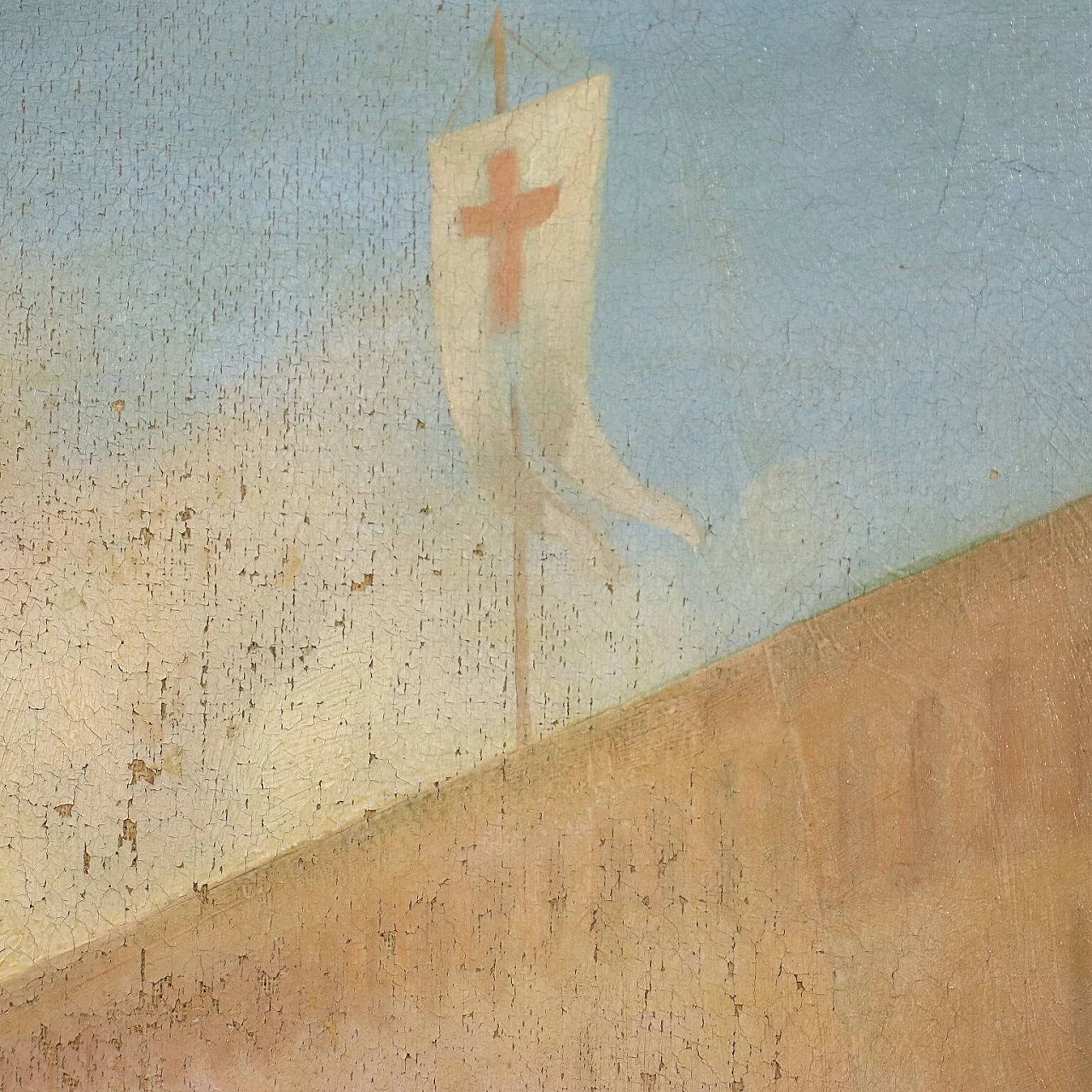
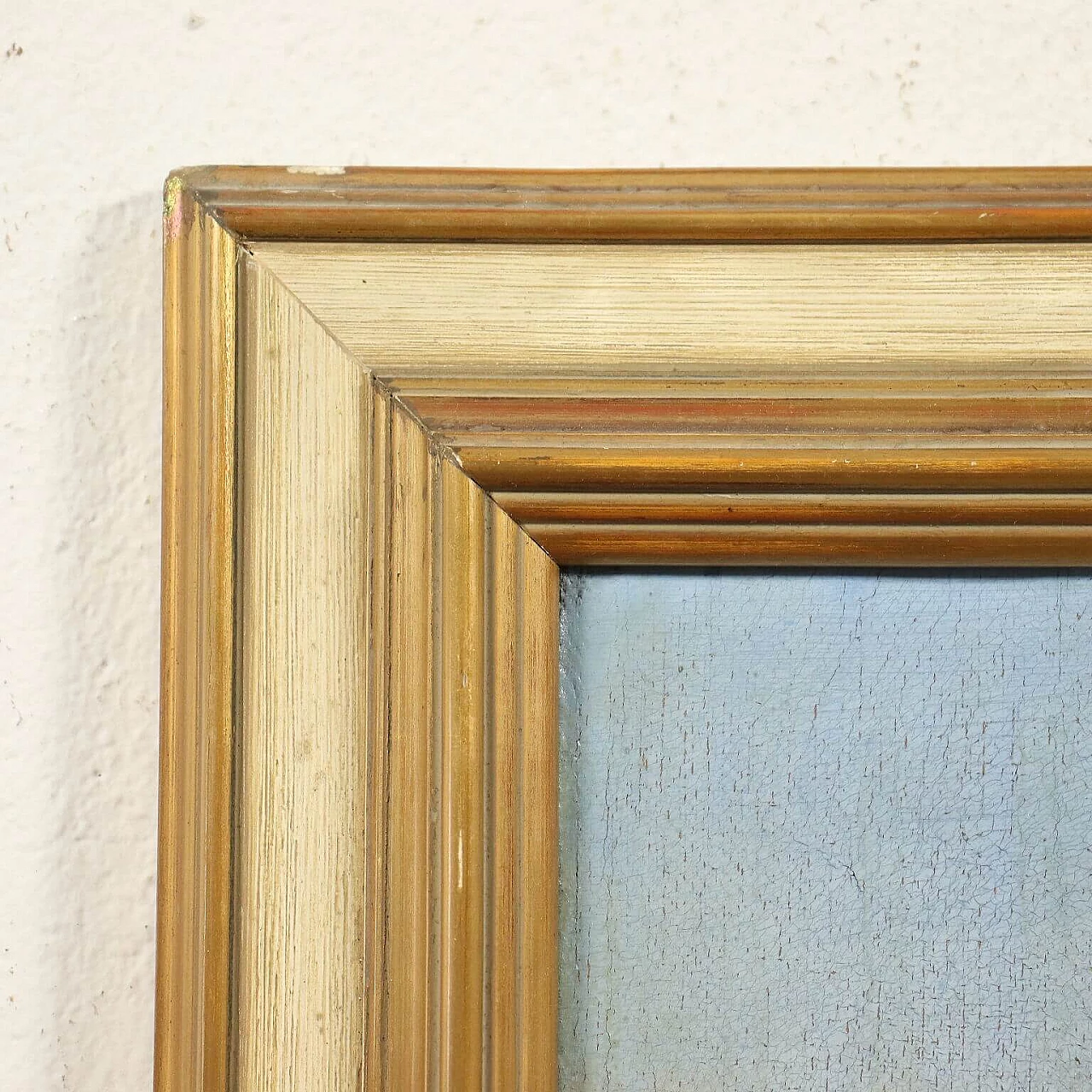
Oil painting on canvas by Giovanni Boni depicting a siege scene, 19th century. Outside the fortifications of a city, a commander, surrounded by his soldiers, is about to light the fuse of a cannon. The army is defending the citadel outside the walls, and the soldiers scan the horizon looking down: this leads one to place the scene on the fortifications of a city, particularly those of Genoa, which stand on the mountains behind and from which the Genoese defended the city against attacks from the sea; the placement in Genoa is endorsed by the banner flying on the walls, the Cross of St. George (red cross on a white field), the banner of the Republic of Genoa. The style of armor, weapons, and robes would refer to the 1522 siege of Genoa. It is thus a nineteenth-century depiction of a historical episode, which therefore falls within that pictorial production widespread widely in Italy in the 19th century, inspired by the new historical novel proposed by literature. On the back of the frame is the name G. Boni, along with a number that refers to participation in official exhibition. Giovanni Boni was a pupil of the Brera Academy, in particular a follower of Giuseppe Sogni, an artist who was among the first to favor painting with historical subjects in its innovative Romantic declinations. Not much is known about Boni, either biographically or in terms of his production. Only the Nudo d'uomo (Painted Academy), with which he won the first prize for the Scuola del Nudo at Brera in 1852, is known of his certain attribution. The work effectively renders the figures and the pathos of the scene with expressive effectiveness; the figures in the foreground are very well characterized in their poses, expressions, details of clothing and weapons, while then the other figures fade into the background, suggesting the presence of a large army. The painting, still in first canvas, has small diffuse color lacks. It is presented in a style frame. Size without frame: 112 x 85 cm.



.png)
 PLATINUM Seller in Milano, Italy