







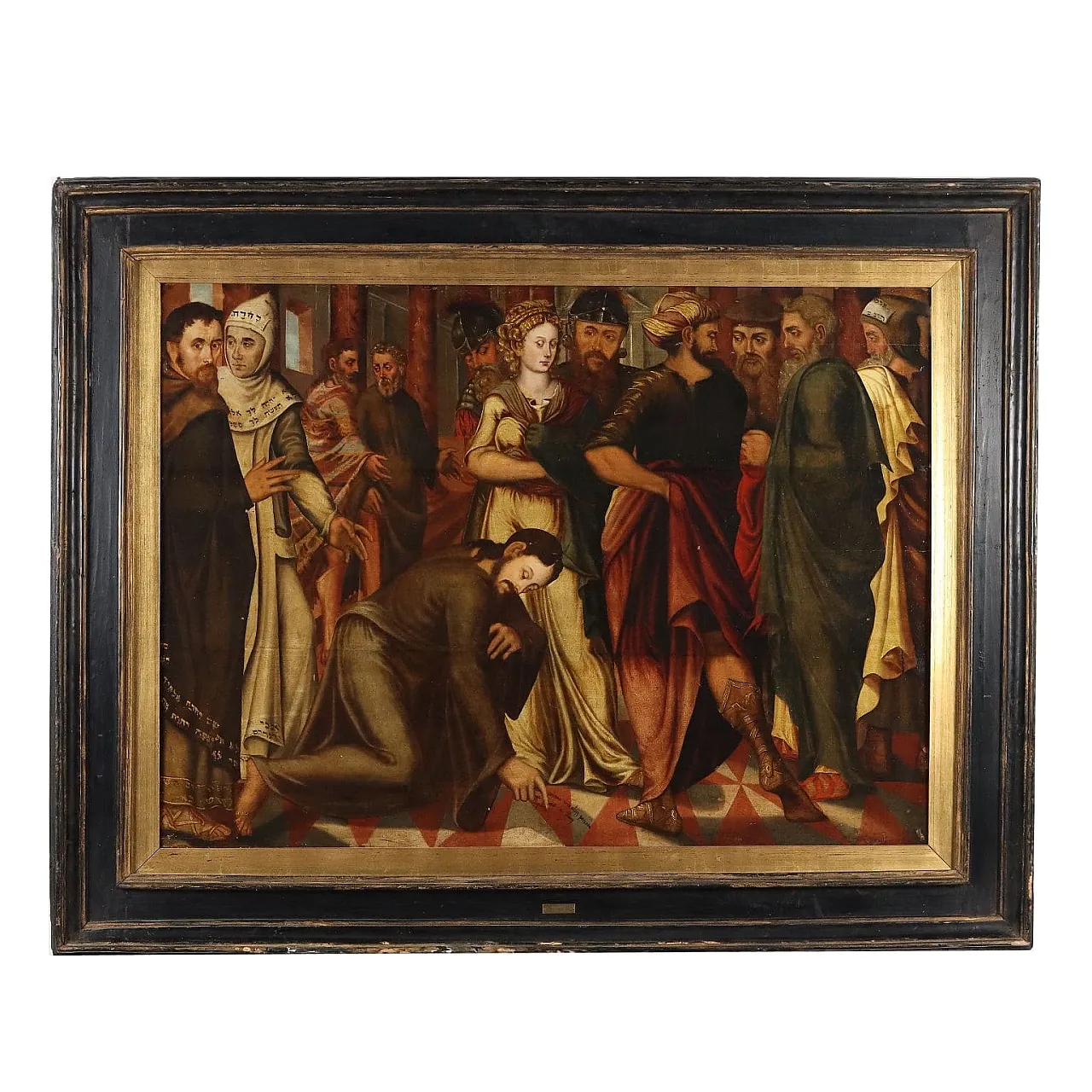
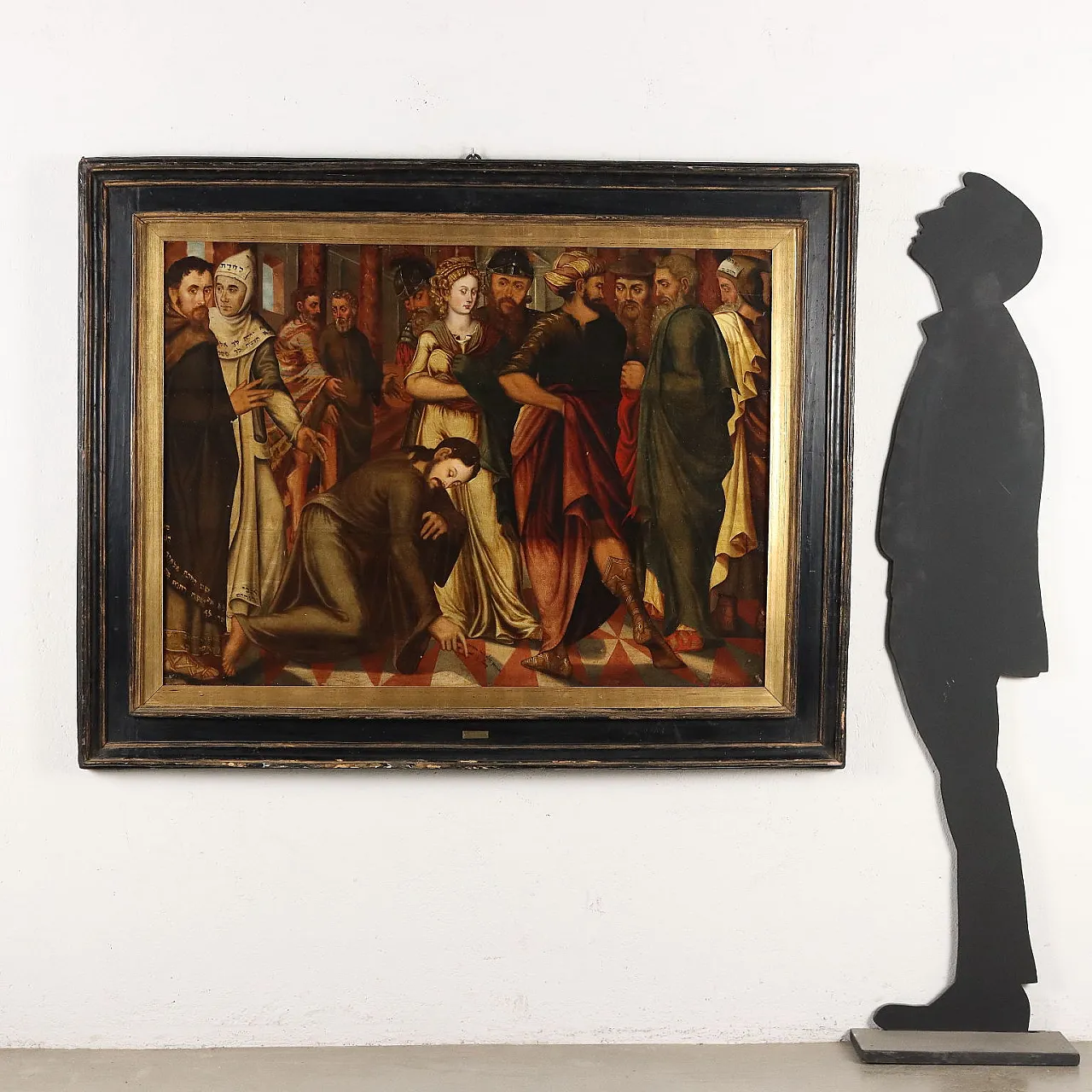
Christ and the adulterous woman, oil on wooden board, 16th century










.png)
Oil on panel. 16th-century Flemish school. The work bears at the base a label attributed to Lambert Van Noort (1520 -1571), justified by the proximity to his pictorial manner found in the faces of Jesus and Magdalene, but unconfirmable for other parts of the painting. The work recounts the episode in the Gospel of John in which the scribes and Pharisees brought to Jesus a woman accused of adultery, to test her compliance with the law of Moses, which called for stoning. But Jesus, stooping to the ground, wrote his finger in the dust, then urged, uttered the words "Let he who is without sin among you cast the first stone" , saving the woman and later forgiving her. The large scene is crowded with a large, tight-knit group of characters. Jesus in the center, is the only figure bent over on the ground, estranged from the rest of the group and fixed in his gesture of writing with one finger; standing behind him, with a precise vertical alignment of his face with that of Christ, is the accused woman, who covers her body with her cloak observing Crsito's gesture, as she awaits the judgment; all around are the scribes, Pharisees, and some soldiers, who instead talk animatedly among themselves, fidgeting, and confronting each other pointing out what Jesus is doing. The subject was widely represented in Flemish painting, with different modes of interpretation. While in this painting the Flemish school is well perceived in the faces with hard features and the rather stiff bodies in the movements of the scribes and Pharisees, as well as in the depiction of the background building and the meticulous depiction of the shoes in the right foreground, the two figures of Jesus and the woman, on the other hand, are affected by the Italian influence, which softened the features of the faces, gave the movements of the body more composure and gracefulness, and with the help of a brighter color made them stand out in the midst of the other figures. The panel of the painting was restored and parqueted in the first half of the 1900s. The painting is presented in adapted antique frame.
ID: 2096-1711737530-86913
Time period

 PLATINUM Seller in Milano, Italy