


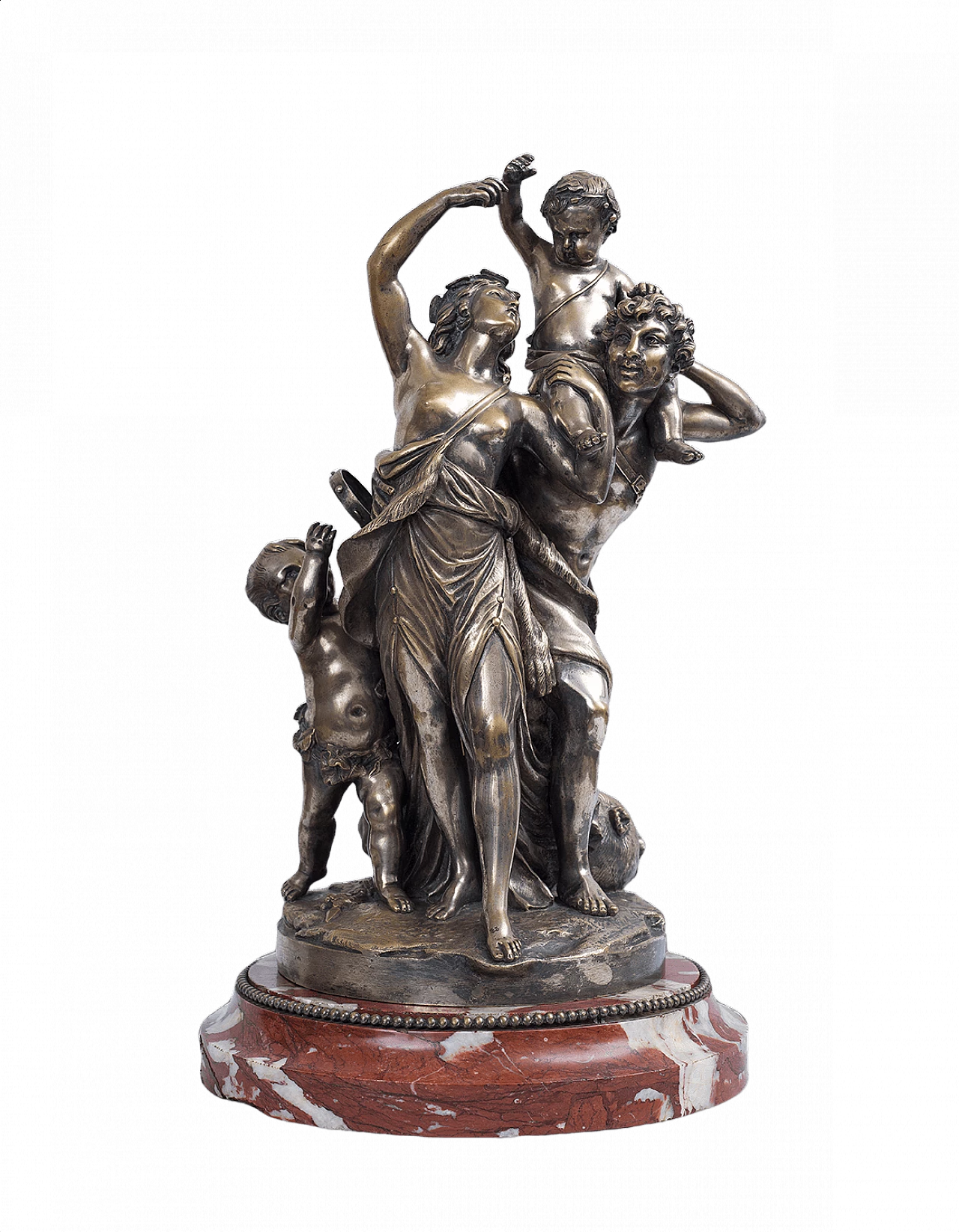
Sculpture depicting the Triumph of Bacchus signed Clodion, 19th century
.png)
Silver-plated bronze sculpture depicting the Triumph of Bacchus. This magnificent sculptural figural group features the Roman god of the vine and festive wine, Bacchus, a beautiful half-naked classical maiden and a beautiful pair of cherubs: one dancing while holding a tambourine and the other sitting on Bacchus' shoulders during the jovial Bacchanalia. The sculpture stands on a magnificent round base of red French marble. Background: Claude Michel, known as Clodion. Nancy (1714) - Paris (1785). French sculptor. At the age of 17 he was in Paris, in the studio of his uncle Lambert Sigisbert Adam (a leading sculptor in Paris at the time), under whose guidance his style was oriented towards Rococo. When his uncle died in 1762, he moved to Rome, where he continued his training at the Academy of France. Here his statuettes, vases and bas-reliefs, inspired by ancient finds, won over connoisseurs and collectors: even the Empress of Russia tried, in vain, to bring him to her court. He returned to France in 1771, preceded by a great reputation, and in 1773 was admitted to the Academie Royale. He produced a number of monumental works: for Rouen Cathedral, the marble statue of Saint Cecilia, a bronze Christ Crucified and, by order of King Louis XVI, the statue of Montesqieu. But his fame is more linked to his small works in terracotta, marble and bronze: allegories, mythological characters, fauns, nymphs, bacchae, satyrs, children, dancers, young women, bathers, with their bold and sensual grace, portrayed in gallant, joyful and ironic attitudes, examples of the best Rococo; small works much appreciated by the aristocracy and the rich bourgeoisie, who displayed them in their luxurious residences, where his very flattened relief panels, used as decorative friezes and over doors, were often found. The French Revolution was his greatest achievement, but the new post-revolutionary society no longer appreciated his style. He therefore returned to Nancy, where he worked on the decoration of rich private houses (for example, the bas-relief aquatic decoration for the Digoine castle) and prepared models for the Niederwiller factory. In 1798 he received the commission for the bas-relief of the Grande Armée column and the Arc de triomphe of the Carrousel in Paris, built to commemorate Napoleon's victories. He is a sculptor who left his mark on the history of French art, much imitated by other artists. Many of his works are in the Louvre, Versailles, the South Kensington Museum and other important museums. Provenance: 19th century France. Measurements: base: Diameter 25cm. H46cm. Document: Certificate of Authenticity.
ID: 12351-1646752850-34576
Time period